
Okayyyy, I’ll join everyone else in responding to today’s news (instead of just sighing, gazing into middle distance). The profit incentive baked into private prisons is a mess. But you know what else is a HUGE MESS?
The revenue incentive in the federal jail market. 🧵
The wonderful Jack Norton @jcknorton calls this “an intercounty carceral arms race... to build and bigger and bigger jails.”
https://t.co/98s22r2fWL
of people detained by the Marshals increased 32 percent in ONE YEAR.
This is a terrible system all of the time. As @jcknorton found in Glades County, FL, it can create this whole new WEIRD system of private profits, going to investors who back big new jails.
https://t.co/EsTK4wd7EX
https://t.co/DuSz7HtEHp
https://t.co/35ggeNKe0E
https://t.co/qljBoNGHaa
https://t.co/fc0Gv6plwr
More from Government

1.
Act of 1871
This is VERY Long but it will end with a MEGA BOOM!
Bookmark it and read it in small bits to digest it all.
This info, comes from some reputable anons and my own digging, compiled together as a superthread!
InevitableET, IPOT... to name a few.
2.
https://t.co/udep5WEYUp
https://t.co/bnzeQek6zv

3.
The TL; DR version is they, by military force, and illegitimate legislature, amended the constitution against the will of The People and legally tricked us into becoming unwitting indentured slaves of human capital and resources to THE UNITED STATES OF AMERICA the corporation)
4.
Republic vs Democracy
-They needed to get away from the Republic and create a Democracy in order to drive us towards socialism and inevitably a dictatorship (National Socialist Party aka NAZI)

5.
Flag

Act of 1871
This is VERY Long but it will end with a MEGA BOOM!
Bookmark it and read it in small bits to digest it all.
This info, comes from some reputable anons and my own digging, compiled together as a superthread!
InevitableET, IPOT... to name a few.
2.
https://t.co/udep5WEYUp
https://t.co/bnzeQek6zv
3.
The TL; DR version is they, by military force, and illegitimate legislature, amended the constitution against the will of The People and legally tricked us into becoming unwitting indentured slaves of human capital and resources to THE UNITED STATES OF AMERICA the corporation)
4.
Republic vs Democracy
-They needed to get away from the Republic and create a Democracy in order to drive us towards socialism and inevitably a dictatorship (National Socialist Party aka NAZI)
5.
Flag


Which metric is a better predictor of the severity of the fall surge in US states?
1) Margin of Democrat victory in Nov 2020 election
or
2) % infected through Sep 1, 2020
Can you guess which plot is which?
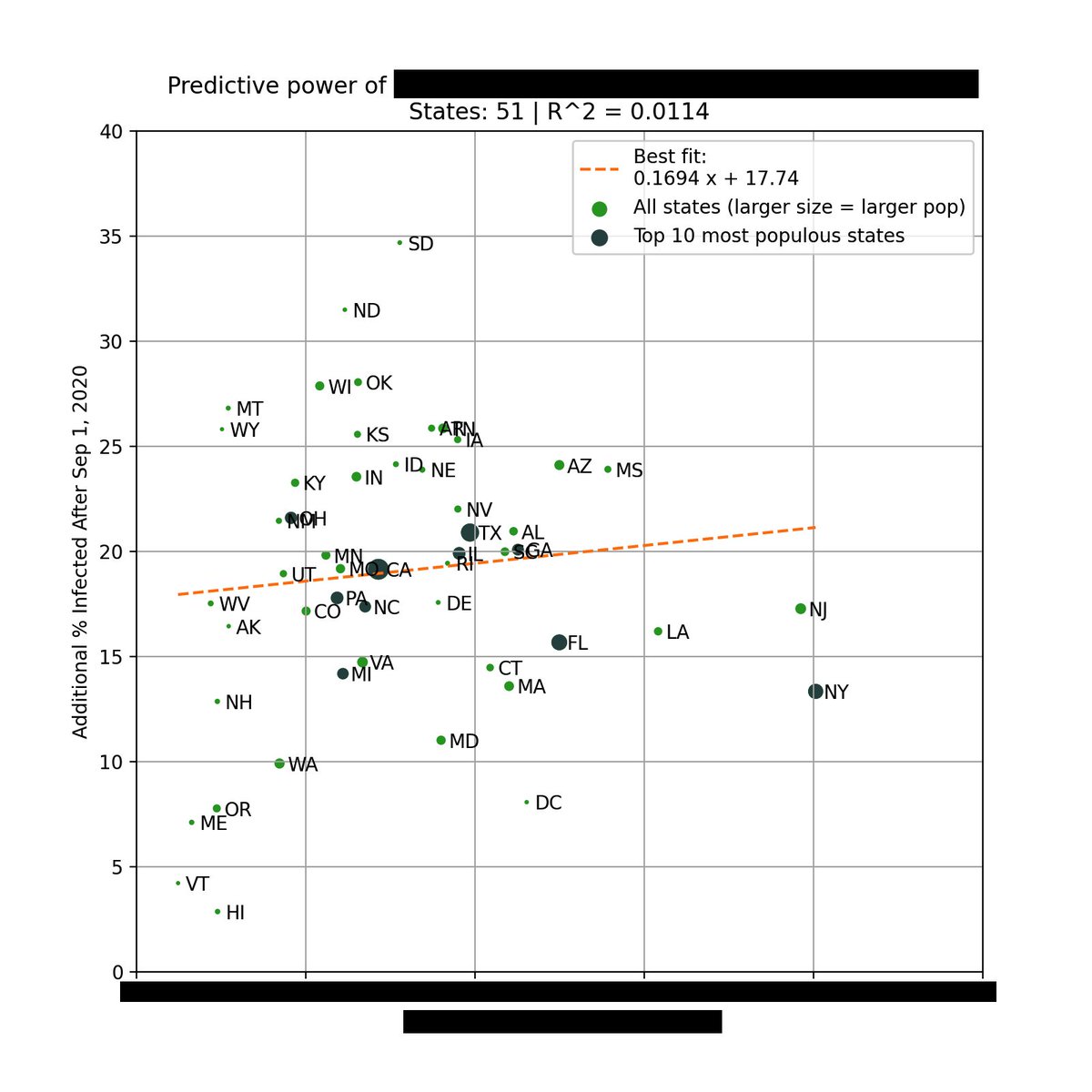
The left plot is based on the % infected through Sep 1, 2020. You can see that there is very little correlation with the % infected since Sep 1.
However, there is a *strong* correlation when using the margin of Biden's victory (right).
Infections % from https://t.co/WcXlfxv3Ah.

This is the strongest single variable I've seen in being able to explain the severity of this most recent wave in each state.
Not past infections / existing immunity, population density, racial makeup, latitude / weather / humidity, etc.
But political lean.
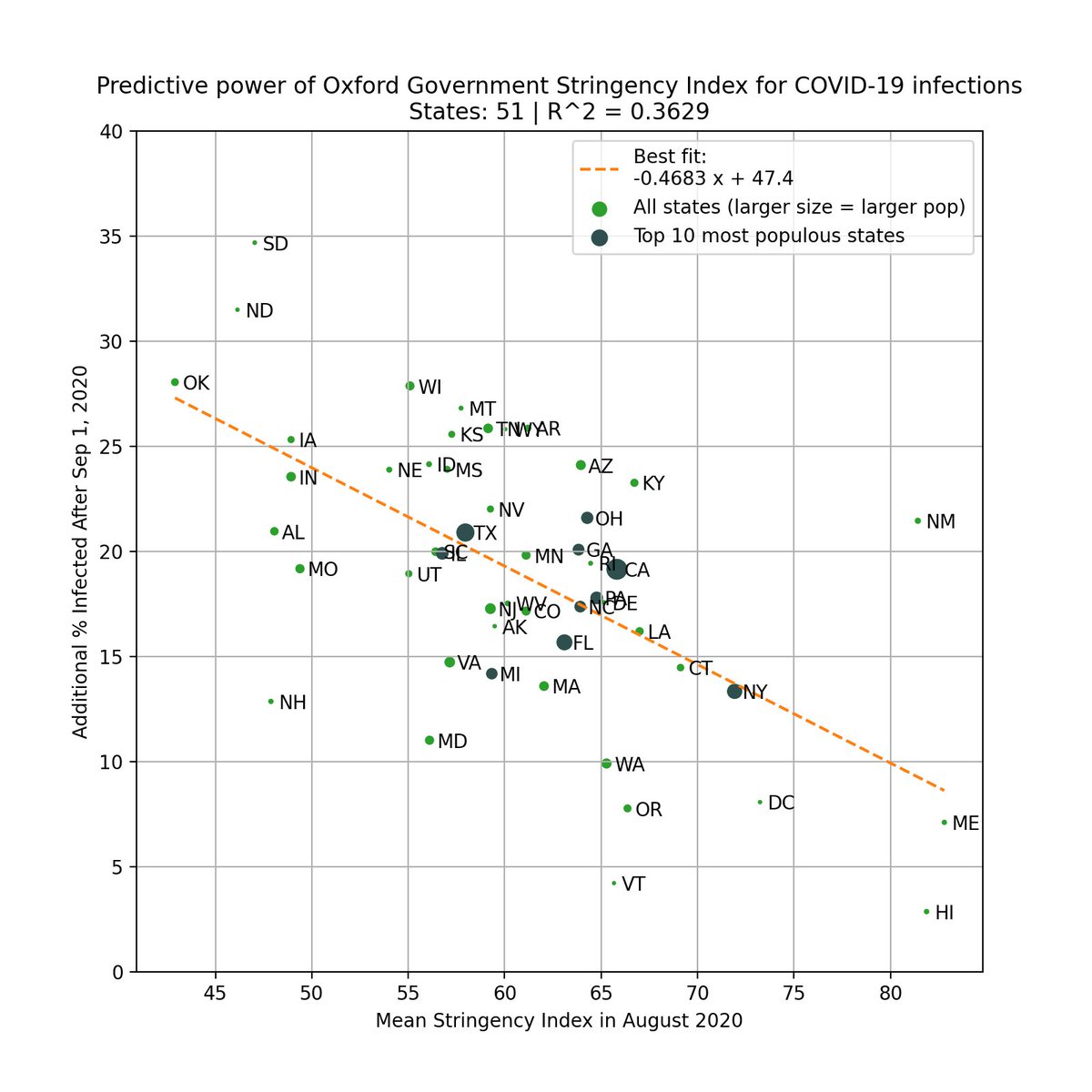
One can argue that states that lean Democrat are more likely to implement restrictions/mandates.
This is valid, so we test this by using the Government Stringency Index made by @UniofOxford.
We also see a correlation, but it's weaker (R^2=0.36 vs 0.50).
https://t.co/BxBBKwW6ta
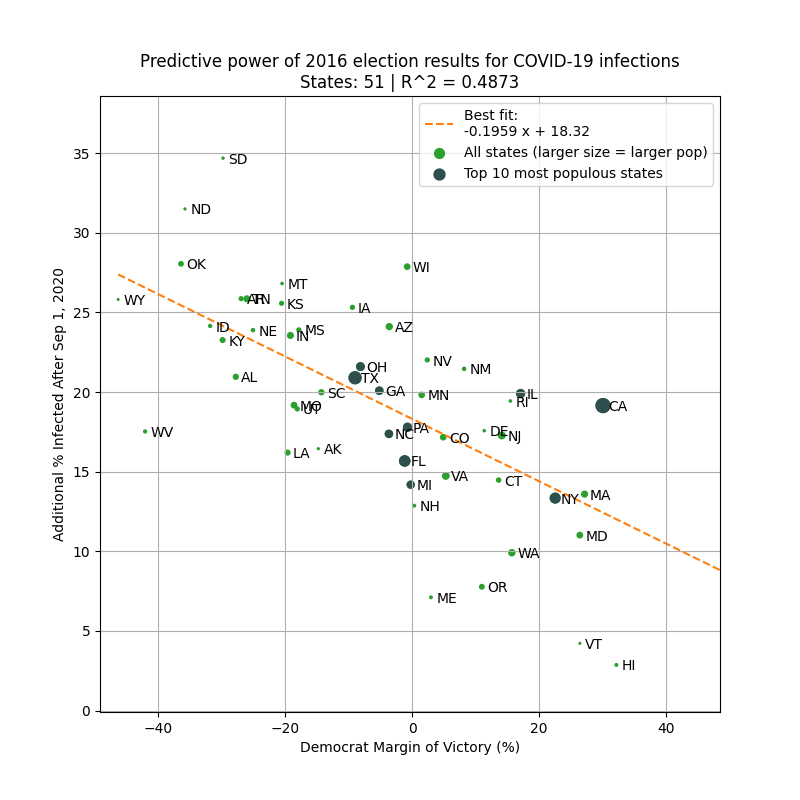
To avoid look-ahead bias/confounding variables, here is the same analysis but using 2016 margin of victory as the predictor. Similar results.
This basically says that 2016 election results is a better predictor of the severity of the fall wave than intervention levels in 2020!
1) Margin of Democrat victory in Nov 2020 election
or
2) % infected through Sep 1, 2020
Can you guess which plot is which?
The left plot is based on the % infected through Sep 1, 2020. You can see that there is very little correlation with the % infected since Sep 1.
However, there is a *strong* correlation when using the margin of Biden's victory (right).
Infections % from https://t.co/WcXlfxv3Ah.
This is the strongest single variable I've seen in being able to explain the severity of this most recent wave in each state.
Not past infections / existing immunity, population density, racial makeup, latitude / weather / humidity, etc.
But political lean.
One can argue that states that lean Democrat are more likely to implement restrictions/mandates.
This is valid, so we test this by using the Government Stringency Index made by @UniofOxford.
We also see a correlation, but it's weaker (R^2=0.36 vs 0.50).
https://t.co/BxBBKwW6ta
To avoid look-ahead bias/confounding variables, here is the same analysis but using 2016 margin of victory as the predictor. Similar results.
This basically says that 2016 election results is a better predictor of the severity of the fall wave than intervention levels in 2020!
You May Also Like


Trump is gonna let the Mueller investigation end all on it's own. It's obvious. All the hysteria of the past 2 weeks about his supposed impending firing of Mueller was a distraction. He was never going to fire Mueller and he's not going to
Mueller's officially end his investigation all on his own and he's gonna say he found no evidence of Trump campaign/Russian collusion during the 2016 election.
Democrats & DNC Media are going to LITERALLY have nothing coherent to say in response to that.
Mueller's team was 100% partisan.
That's why it's brilliant. NOBODY will be able to claim this team of partisan Democrats didn't go the EXTRA 20 MILES looking for ANY evidence they could find of Trump campaign/Russian collusion during the 2016 election
They looked high.
They looked low.
They looked underneath every rock, behind every tree, into every bush.
And they found...NOTHING.
Those saying Mueller will file obstruction charges against Trump: laughable.
What documents did Trump tell the Mueller team it couldn't have? What witnesses were withheld and never interviewed?
THERE WEREN'T ANY.
Mueller got full 100% cooperation as the record will show.
BREAKING: President Donald Trump has submitted his answers to questions from special counsel Robert Mueller
— Ryan Saavedra (@RealSaavedra) November 20, 2018
Mueller's officially end his investigation all on his own and he's gonna say he found no evidence of Trump campaign/Russian collusion during the 2016 election.
Democrats & DNC Media are going to LITERALLY have nothing coherent to say in response to that.
Mueller's team was 100% partisan.
That's why it's brilliant. NOBODY will be able to claim this team of partisan Democrats didn't go the EXTRA 20 MILES looking for ANY evidence they could find of Trump campaign/Russian collusion during the 2016 election
They looked high.
They looked low.
They looked underneath every rock, behind every tree, into every bush.
And they found...NOTHING.
Those saying Mueller will file obstruction charges against Trump: laughable.
What documents did Trump tell the Mueller team it couldn't have? What witnesses were withheld and never interviewed?
THERE WEREN'T ANY.
Mueller got full 100% cooperation as the record will show.


