Categories For later read

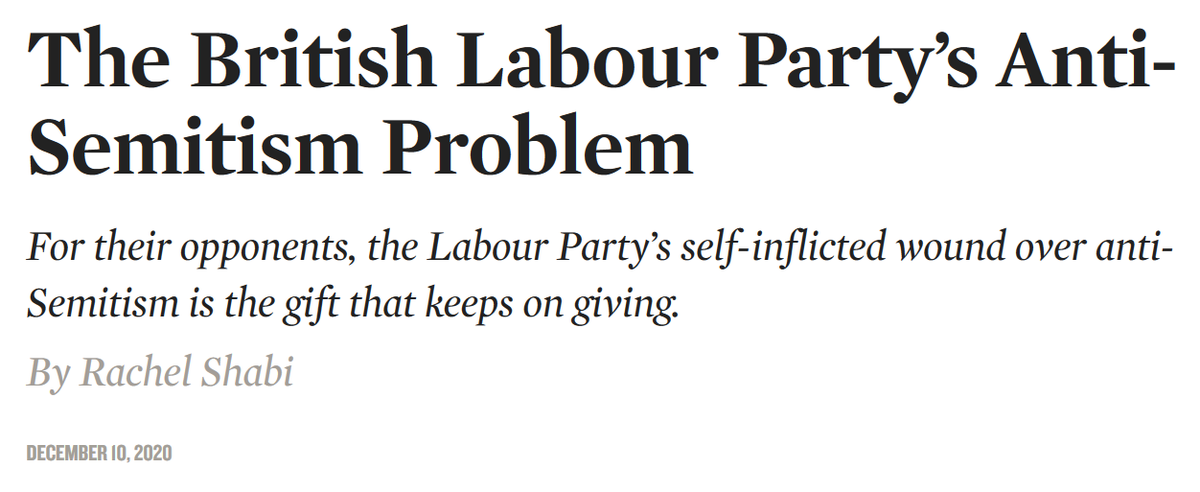
Shabi takes the EHRC and its report entirely at face value: a “sobering verdict”, no less. This is not the first time she’s done this: she also uncritically endorsed the claims made in the BBC’s Panorama documentary in July 2019. 2/
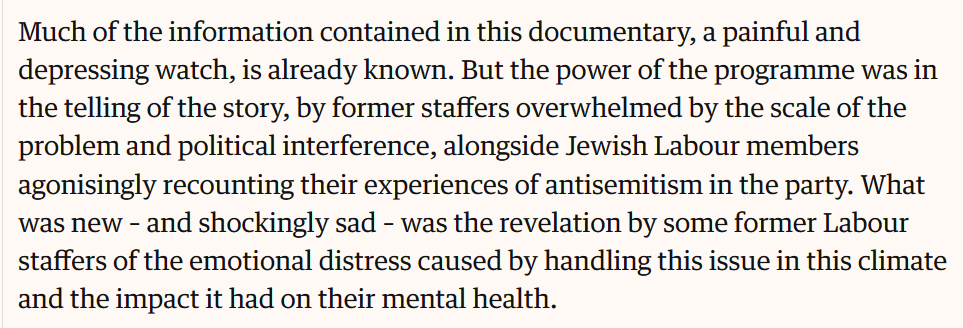
She then scolded the Labour leadership for stating that the central claims made in that documentary were demonstrably untrue and indeed the opposite of the truth, something that has become even more obvious since. 3/
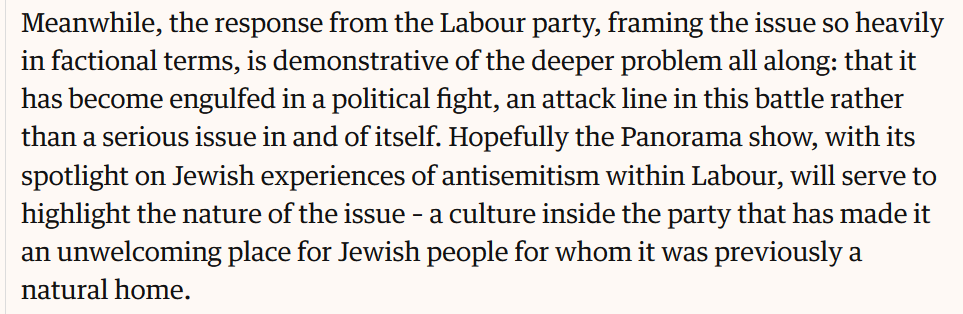
As Richard Sanders & Peter Oborne pointed out, the findings of the EHRC report itself on Labour's disciplinary process tacitly contradict the Panorama documentary. It’s logically impossible to endorse both. 4/
https://t.co/rIFZFHxGhf
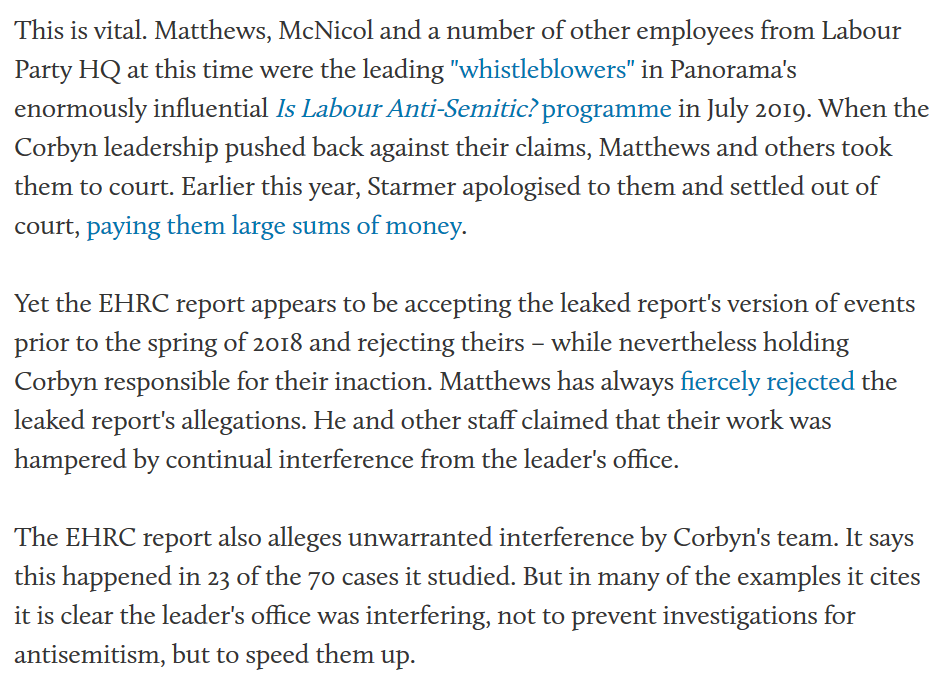
Instead of pointing out this discrepancy, Shabi simply moves on, seemingly with no reflection, to uncritically endorse the EHRC, ignoring the evidence of its crude partiality.


In other words, when something is self-verifiable or self-iterating, looking too heavily towards the originator can be a distraction along the path. Results speak for themselves.
Some folks have applied that to Bitcoin as well.
https://t.co/NYk1IKFDt4
For example, sometimes there are debates about Satoshi Nakamoto’s original intent. Should block sizes be increased to facilitate “e-cash” or should block sizes be kept small for any user to run a node?
\u201cIf you meet Satoshi on the road, kill him.\u201d\u2013 The Tao of Bitcoin
— Max Keiser (@maxkeiser) February 14, 2019
This is the type of problem encountered by engineers all the time: trade-offs.
A project can iterate or stay the same depending on what the market says.
Sometimes the successful product ends up being very different than the engineer initially envisioned. Sometimes it’s exactly like what they envisioned.
With Bitcoin, there are developer-vs-developer disputes, and disputes between finance-types and earlier users.
This is similar to natural selection, with “nature” as the market. Some creatures haven’t changed in hundreds of millions of years. Others have changed notably, or transformed into something else entirely.


Poll: where is the temporal center of gravity of all your live projects based on average age of start-dates?
— Venkatesh Rao (@vgr) January 17, 2021
I suspect a healthy weighted average should be ~ (age-20)/2. So a 30 year old should be at 5, a 40 year old at 10, a 50 year old at 15 etc.
Standard deviation should be ~average/3 maybe, so distribution spreads as you age and accumulate projects and get better at them.
Other things being equal, people get good at starting in their 20s, at follow through in 30s, at finishing in 40s.
No point learning food follow through until you’ve found a few good starts to bet on. No point getting good at finishing until a few projects have aged gracefully.
I’m in the 7+ range myself. Probably 8-9. Slightly less than healthy for my age.
I suspect most self-judgments on being good starters/follow-through-ers/finishers are really flawed because of the non-ergodicity of project management skill learning. You can’t learn good practices for the 3 phases in an arbitrary order. On,y one order actually works.

Please know that your friendly SmithTweeters give heavy side-eye to Smith’s use of phrases like “savage nations” and “naked savages” and so on. They are obviously shocking to the modern ear, and they should be. #WealthOfTweets #SmithTweets
“Well, it’s the 18th century, what do you expect?” just isn't a sufficient explanation. #WealthOfTweets #SmithTweets
The 21stC changed from talking about the First World/Third World to talking about developed/developing nations. That’s a good change and a respectful one. The terms we use for countries will continue to change. See:
Probably the best way to think about Smith’s use of the term “savage nations” is to think of it as its own developmental stage on its way to a better set of terms for talking about the differences among nations. https://t.co/2wr7yACEv5 #WealthOfTweets #SmithTweets

Let's recap some shenanigans - #Ward45 sure had plenty
In January, Jimmy called out The Crew at Copernicus
A photo bomber, a bounty, and the mayor visited us
https://t.co/YHgWKxWv8m
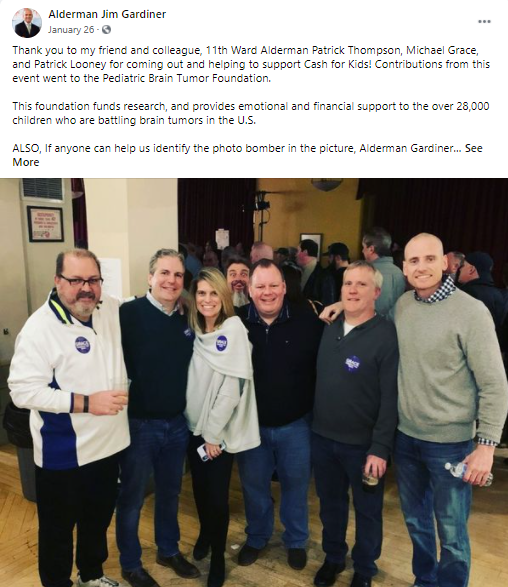
Stay tuned for the #livetweet of this #45theward community meaning.
— RhymeNoxious (@BlondeNoxious) January 28, 2020
Sarcasm and hyperbole probably unintentional.
Please forgive typos. It's been a long day. pic.twitter.com/ZmhUWv1SNl
The Point is resurrected in February - now ten storeys instead of 10
A firetruck can’t make a turn and Cuyler Plaza meets its end
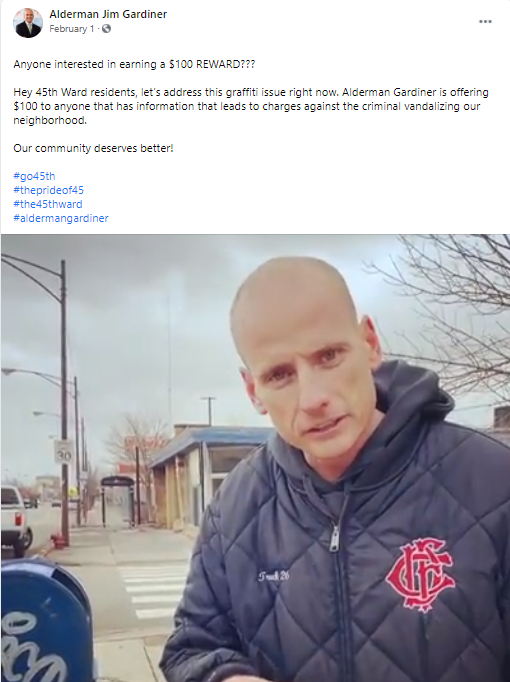
Jimmy shows how tough he is and takes a stand against graffiti
A vigilante video offering a hundred-dollar bounty
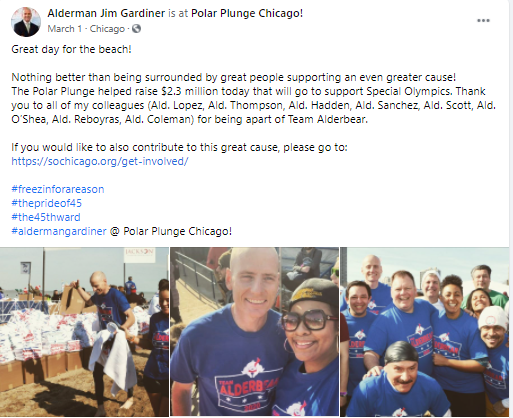
March first Jimmy does the polar plunge with Team Alderbear
And barely wins committeeman - his enormous signs everywhere
In April Willie Wilson donates masks, Jimmy hands out burgers Epically
He can't seem to figure out how to wear a mask properly
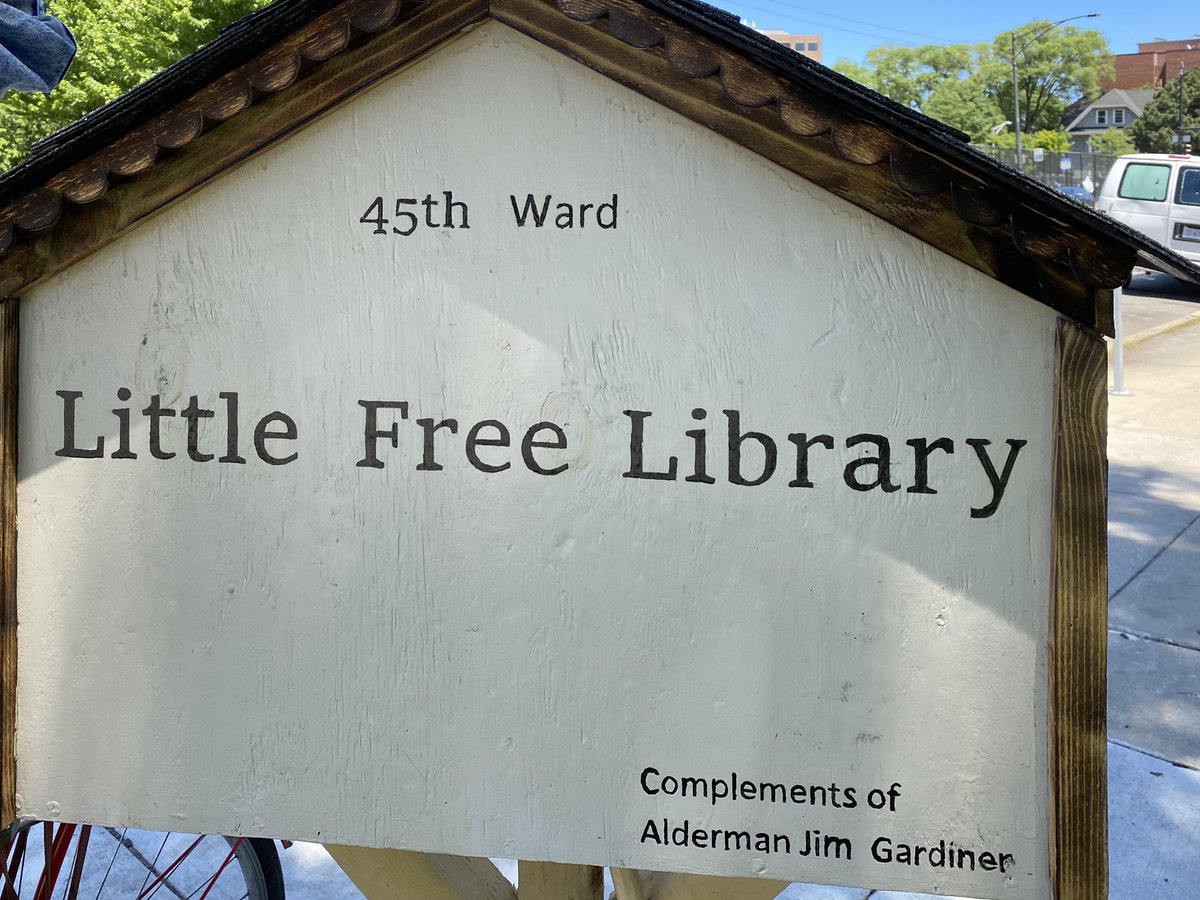
In May at the little free library we meet (with complements) Al Chemist
Jimmy patrols the ward from the threat of antifa activitists
It’s June and Jimmy is hiding behind his office
While constituents march for racial justice
“Where’s Jim Gardiner” the crowd chants
Asked if he believes Black lives matter by a Black man
Jim doesn’t answer, instead just deflects
A defining cowardly moment - one we won’t forget


Tell me about a great movie-going experience you'll never forget.
— Kristy Puchko (@KristyPuchko) December 3, 2020
Not as a memorial, but as a chance--right now--for us all to tap into that communal joy of the cinematic experience. pic.twitter.com/GqJfqUZ5as
The strange thing is that I don't think I had even heard of "Aladdin" until she said anything. Maybe? I'm not sure. But I don't remember feeling like we were expecting to see it. I don't remember being disappointed. But to her, I think it felt like one more way she had failed us.
This was in the final year of her marriage to her second husband--our first "stepfather"--and there were reasons the three of us were in this car and not back at our place with him and his two kids. He was very abusive, and these car rides felt like a break.
So, we were sitting there in the car while she was contemplating how to get us out of this situation, but by now, it had become almost a weekly ritual, which was not lost on us, obviously. So, we're sitting there, and she starts crying and says the thing about "Aladdin".
And then, while crying, she says: "You've never been to the movies," which was true. My sister and I had not been to a movie theater up to that point in our short lives. I remember saying "that's okay", and my sister said the same and put her little hand on my mother's arm.

Five Eyes is VERY important.
It won’t be around much longer.
Relevant here but not the focus.
2)
https:// https://t.co/f24vLp3Z5h

3)
The Five Eyes (FVEY) is an intelligence alliance comprising Australia, Canada, New Zealand, the United Kingdom and the United States. These countries are parties to the multilateral UKUSA Agreement, a treaty for joint cooperation in signals intelligence.
4)
The origins of the FVEY can be traced back to the post–World War II period, when the Atlantic Charter was issued by the Allies to lay out their goals for a post-war world.
5)
During the course of the Cold War, the ECHELON surveillance system was initially developed by the FVEY to monitor the communications of the former Soviet Union and the Eastern Bloc, although it is now used to monitor private communications worldwide.


Stephens goes on in his column (which never saw light of day) to cite famous Lee Atwater quote that uses racial slur, and which NYT has cited \u201cat least seven times.\u201d
— Dylan Byers (@DylanByers) February 11, 2021
"Is this now supposed to be a scandal?\u201d he asks.
...
Four times. The column used the n-word (in the context of a quote) four times. https://t.co/14vPhQZktB
That is correct. In his draft he quotes Atwater using the word (4 times) and he does not redact it.
— Dylan Byers (@DylanByers) February 11, 2021
For context: In 2019, a Times reporter was reprimanded for several incidents of racial insensitivity on a trip with high school students, including one in which he used the n-word in a discussion of racial slurs.
That incident became public late last month, and late last week, after 150 Times employees complained about how it had been handled, the reporter in question resigned.
In the course of all that, the Times' executive editor said that the paper does not "tolerate racist language regardless of intent.” This was the quote that Bret Stephens was pushing back against in his column. (Which, again, was deep-sixed by the paper.)