If you have watched it closely, the film ends(before credits) with this quote about Bale's character, Michael Burry:
Is investing in water possible?
If you have watched it closely, the film ends(before credits) with this quote about Bale's character, Michael Burry:
To give you a recap, Michael Burry is the person who predicted the 2008 crisis and also made a lot of money by shorting the market.
And, now he is focusing on investing in water.
Water is a scarce commodity, where only 1% of the Earth's surface water is freshwater.
Burry has been buying water and farmland assets before it gets expensive. Even Wall Street has started treating water as a serious investment.
There are index funds, ETFs, companies that focus only on water. Invesco S&P Global Water Index is one of them. This ETF invests in water utilities, infrastructure, equipment, etc.
More from Etf


Important.
Whenever you invest in Fund of funds, check the expense ratios of both the local fund & the global fund which is investing into.
e.g., Nasdaq FOF ER is 0.1%, but you have to add the ER of ETF which 0.54%, total 0.64%
Good to see AMCs like @EdelweissMF mentioning it.
Whenever you invest in Fund of funds, check the expense ratios of both the local fund & the global fund which is investing into.
e.g., Nasdaq FOF ER is 0.1%, but you have to add the ER of ETF which 0.54%, total 0.64%
Good to see AMCs like @EdelweissMF mentioning it.
When you invest in a global fund, and compare expenses across funds:
— Radhika Gupta (@iRadhikaGupta) June 22, 2021
1. Compare \U0001f34e to \U0001f34e: Total cost includes offshore fund cost plus what local AMC charges.
2. Get this data from the AMC website. Many 3rd party websites don\u2019t include underlying fund costs.
1/3


You May Also Like








@EricTopol @NBA @StephenKissler @yhgrad B.1.1.7 reveals clearly that SARS-CoV-2 is reverting to its original pre-outbreak condition, i.e. adapted to transgenic hACE2 mice (either Baric's BALB/c ones or others used at WIV labs during chimeric bat coronavirus experiments aimed at developing a pan betacoronavirus vaccine)
@NBA @StephenKissler @yhgrad 1. From Day 1, SARS-COV-2 was very well adapted to humans .....and transgenic hACE2 Mice
@NBA @StephenKissler @yhgrad 2. High Probability of serial passaging in Transgenic Mice expressing hACE2 in genesis of SARS-COV-2
@NBA @StephenKissler @yhgrad B.1.1.7 has an unusually large number of genetic changes, ... found to date in mouse-adapted SARS-CoV2 and is also seen in ferret infections.
https://t.co/9Z4oJmkcKj

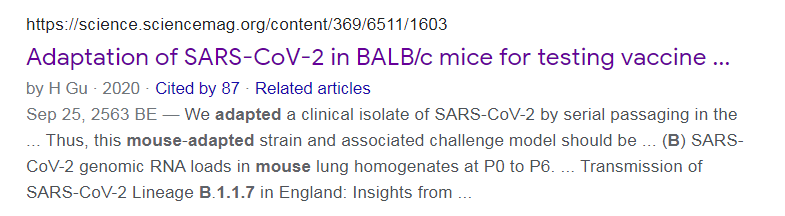
@NBA @StephenKissler @yhgrad We adapted a clinical isolate of SARS-CoV-2 by serial passaging in the ... Thus, this mouse-adapted strain and associated challenge model should be ... (B) SARS-CoV-2 genomic RNA loads in mouse lung homogenates at P0 to P6.
https://t.co/I90OOCJg7o
@NBA @StephenKissler @yhgrad 1. From Day 1, SARS-COV-2 was very well adapted to humans .....and transgenic hACE2 Mice
1. From Day 1, SARS-COV-2 was very well adapted to humans .....and transgenic hACE2 Mice
— Billy Bostickson \U0001f3f4\U0001f441&\U0001f441 \U0001f193 (@BillyBostickson) January 30, 2021
"we generated a mouse model expressing hACE2 by using CRISPR/Cas9 knockin technology. In comparison with wild-type C57BL/6 mice, both young & aged hACE2 mice sustained high viral loads... pic.twitter.com/j94XtSkscj
@NBA @StephenKissler @yhgrad 2. High Probability of serial passaging in Transgenic Mice expressing hACE2 in genesis of SARS-COV-2
1. High Probability of serial passaging in Transgenic Mice expressing hACE2 in genesis of SARS-COV-2!
— Billy Bostickson \U0001f3f4\U0001f441&\U0001f441 \U0001f193 (@BillyBostickson) January 2, 2021
2 papers:
Human\u2013viral molecular mimicryhttps://t.co/irfH0Zgrve
Molecular Mimicryhttps://t.co/yLQoUtfS6s https://t.co/lsCv2iMEQz
@NBA @StephenKissler @yhgrad B.1.1.7 has an unusually large number of genetic changes, ... found to date in mouse-adapted SARS-CoV2 and is also seen in ferret infections.
https://t.co/9Z4oJmkcKj
@NBA @StephenKissler @yhgrad We adapted a clinical isolate of SARS-CoV-2 by serial passaging in the ... Thus, this mouse-adapted strain and associated challenge model should be ... (B) SARS-CoV-2 genomic RNA loads in mouse lung homogenates at P0 to P6.
https://t.co/I90OOCJg7o