So you really don't KNOW who you cast your vote.
1/ I get questions frequently from people who have heard the SOS say that the BMD QR code ballots can be audited to tell who won. I'll explain why he is wrong.
Your BMD ballot vote is stored in the barcode. The text doesn't count. The computer reads only the QR code.
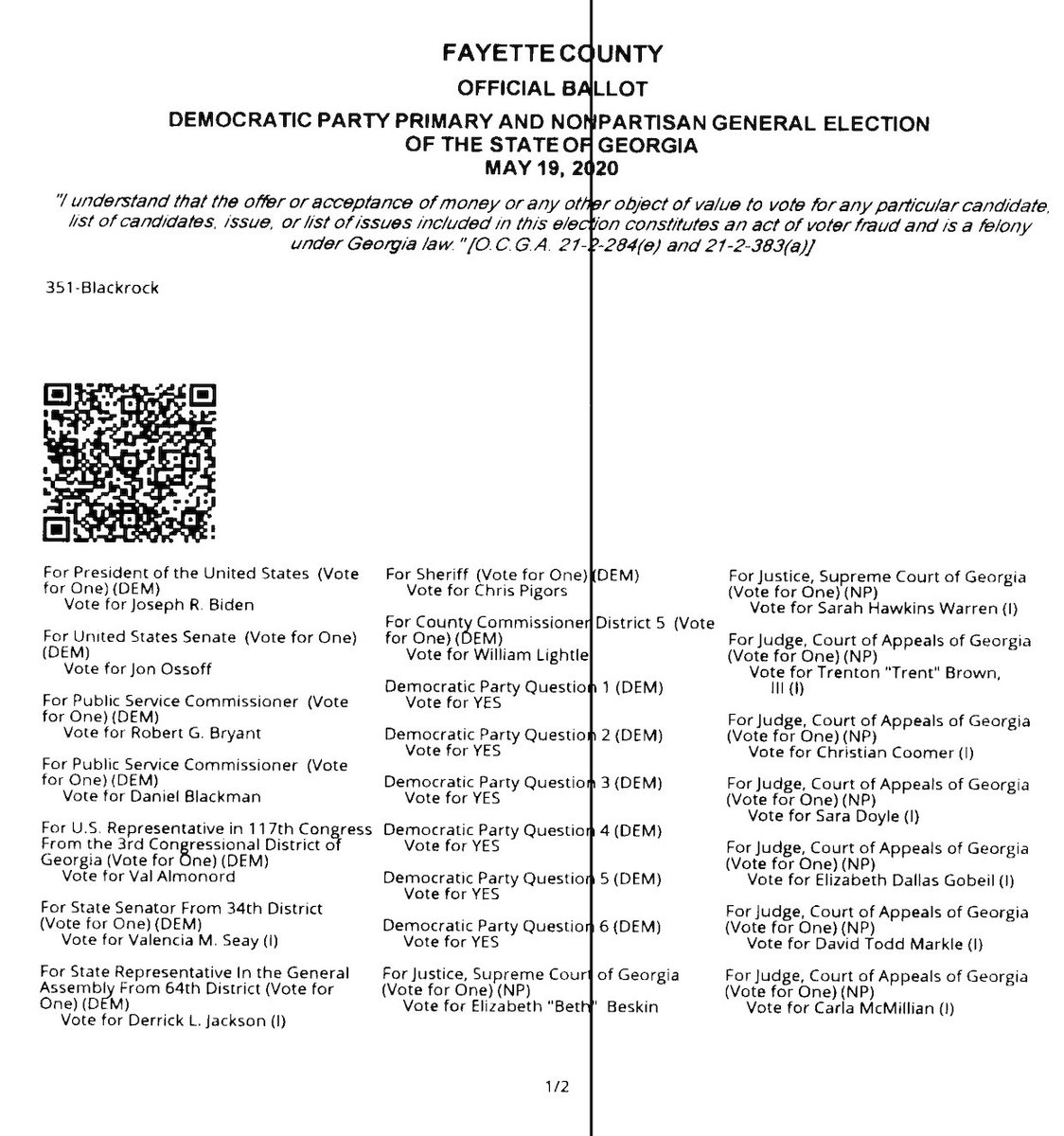
So you really don't KNOW who you cast your vote.
--every voter thoroughly and accurately checks before scanning to be sure that the printed list reflects his choices. (Hard to do, to remember all the contests), AND
--there is a thorough post election audit.
If you pressed the screen for candidate Sam, but the printout & QR code said "Mary," and you didn't check, then your Mary vote was not intended.
Most of us would never notice on our grocery receipt that it was $.45 more and said "organic."

The store's official records are for organic milk because the barcode was miscoded.

But your receipt could be wrong too. The barcode could be for organic milk, but the receipt may say regular milk in the text.
The official record (your vote) was for organic milk! (Which you hate!)

You May Also Like
I just finished Eric Adler's The Battle of the Classics, and wanted to say something about Joel Christiansen's review linked below. I am not sure what motivates the review (I speculate a bit below), but it gives a very misleading impression of the book. 1/x
The meat of the criticism is that the history Adler gives is insufficiently critical. Adler describes a few figures who had a great influence on how the modern US university was formed. It's certainly critical: it focuses on the social Darwinism of these figures. 2/x
Other insinuations and suggestions in the review seem wildly off the mark, distorted, or inappropriate-- for example, that the book is clickbaity (it is scholarly) or conservative (hardly) or connected to the events at the Capitol (give me a break). 3/x
The core question: in what sense is classics inherently racist? Classics is old. On Adler's account, it begins in ancient Rome and is revived in the Renaissance. Slavery (Christiansen's primary concern) is also very old. Let's say classics is an education for slaveowners. 4/x
It's worth remembering that literacy itself is elite throughout most of this history. Literacy is, then, also the education of slaveowners. We can honor oral and musical traditions without denying that literacy is, generally, good. 5/x
As someone\u2019s who\u2019s read the book, this review strikes me as tremendously unfair. It mostly faults Adler for not writing the book the reviewer wishes he had! https://t.co/pqpt5Ziivj
— Teresa M. Bejan (@tmbejan) January 12, 2021
The meat of the criticism is that the history Adler gives is insufficiently critical. Adler describes a few figures who had a great influence on how the modern US university was formed. It's certainly critical: it focuses on the social Darwinism of these figures. 2/x
Other insinuations and suggestions in the review seem wildly off the mark, distorted, or inappropriate-- for example, that the book is clickbaity (it is scholarly) or conservative (hardly) or connected to the events at the Capitol (give me a break). 3/x
The core question: in what sense is classics inherently racist? Classics is old. On Adler's account, it begins in ancient Rome and is revived in the Renaissance. Slavery (Christiansen's primary concern) is also very old. Let's say classics is an education for slaveowners. 4/x
It's worth remembering that literacy itself is elite throughout most of this history. Literacy is, then, also the education of slaveowners. We can honor oral and musical traditions without denying that literacy is, generally, good. 5/x