These are 10 of my favourite #UrbanEconomics articles published in 2020, in alphabetical order by author, continuing with a tradition from the last couple of years
These are 10 of my favourite #UrbanEconomics articles published in 2019, in alphabetical order by author (follow up on 2018 list: https://t.co/qr16DmIomY)
— Diego Puga (@ProfDiegoPuga) December 16, 2019
These are 10 of my favourite #UrbanEconomics articles published in 2018, in alphabetical order. Inspired by @ProfNoto's list of 10 Economics articles https://t.co/qS1bvAWVeW, so I won\u2019t repeat 2 outstanding spatial papers on his list (Chetty & @nhendren82, QJE; Donaldson, AER)
— Diego Puga (@ProfDiegoPuga) December 27, 2018
More from Economy




1/ To add a little texture to @NickHanauer's thread, it's important to recognize that there's a good reason why orthodox economists (& economic cosplayers) so vehemently oppose a $15 min wage:
The min wage is a wedge that threatens to undermine all of orthodox economic theory.
2/ Orthodox economics is grounded in two fundamental models: a systems model that describes the market as a closed equilibrium system, and a behavioral model that describes humans as rational, self-interested utility-maximizers. The modern min wage debate undermines both models.
3/ The assertion that a min wage kills jobs is so central to orthodox economics that it is often used as the textbook example of the Supply/Demand curve. Raise the cost of labor and businesses will buy less of it. It's literally Econ 101!
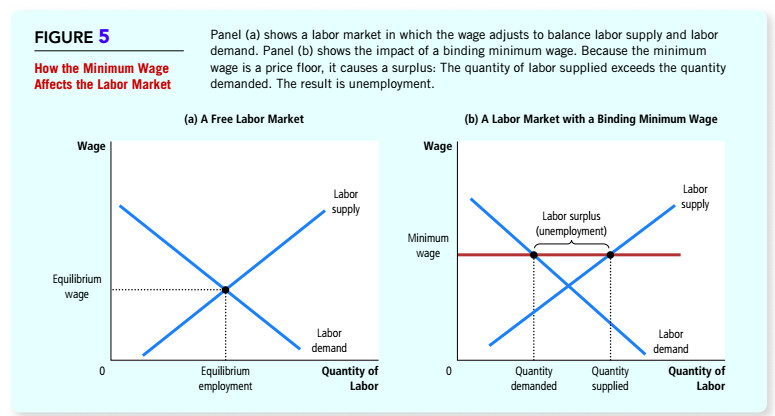
4/ Econ 101 insists that markets automatically set an efficient "equilibrium price" for labor & everything else. Mess with this price and bad things happen. Yet decades of empirical research has persuaded a majority of economists that this just isn't
5/ How can this be? Well, either the market is not a closed equilibrium system in which if you raise the price of labor employers automatically purchase less of it... OR the market is not automatically setting an efficient and fair equilibrium wage. Or maybe both. #FAIL
The min wage is a wedge that threatens to undermine all of orthodox economic theory.
1/4 Most people, especially academic economists, think that the controversy over the minimum wage is a contest over facts. It's not. It's a contest over power, status, and wealth. It is just like the contest over racial and gender justice.
— Nick Hanauer (@NickHanauer) January 17, 2021
2/ Orthodox economics is grounded in two fundamental models: a systems model that describes the market as a closed equilibrium system, and a behavioral model that describes humans as rational, self-interested utility-maximizers. The modern min wage debate undermines both models.
3/ The assertion that a min wage kills jobs is so central to orthodox economics that it is often used as the textbook example of the Supply/Demand curve. Raise the cost of labor and businesses will buy less of it. It's literally Econ 101!
4/ Econ 101 insists that markets automatically set an efficient "equilibrium price" for labor & everything else. Mess with this price and bad things happen. Yet decades of empirical research has persuaded a majority of economists that this just isn't
5/ How can this be? Well, either the market is not a closed equilibrium system in which if you raise the price of labor employers automatically purchase less of it... OR the market is not automatically setting an efficient and fair equilibrium wage. Or maybe both. #FAIL

Priyamvada Gopal is part of a class of elite academics in the imperial core who teach the ruling class, and use woke radlib rhetoric to justify current Western imperial aggression.
She echoes propaganda against Syria, Iran, and China and is silent about Venezuela, Nicaragua, etc
Anti-anti-imperialist Cambridge University Professor @PriyamvadaGopal smears opponents of the Western neocolonial war on Syria as "Assadists"
Would she ever call liberal imperialist Obama a "blood-soaked cretin"? He has exponentially more blood on
The CIA spent over a billion dollars per year arming and training "rebels" who massacred and ethnically cleansed Syrian civilians, especially religious minorities.
But anti-anti-imperialist @PriyamvadaGopal insists these CIA-backed contras are
This was elite anti-anti-imperialist Cambridge University gatekeeper @PriyamvadaGopal's response right after colonial powers the US, UK, and France bombed Syria in April 2018 on bogus lies that have since been
Of course anti-anti-imperialist Cambridge Professor @PriyamvadaGopal's is also a supporter of the neoliberal imperialist European Union -- one of the key institutions of European necolonialism
She echoes propaganda against Syria, Iran, and China and is silent about Venezuela, Nicaragua, etc
Far too much of the 'left' is into a joke version of "anti-imperialism" which denies state atrocities in the global south.
— Priyamvada Gopal (@PriyamvadaGopal) January 14, 2021
Anti-anti-imperialist Cambridge University Professor @PriyamvadaGopal smears opponents of the Western neocolonial war on Syria as "Assadists"
Would she ever call liberal imperialist Obama a "blood-soaked cretin"? He has exponentially more blood on
Let us be in no doubt: there is nothing anti-imperialist about supporting a blood-soaked cretin like Assad. https://t.co/nuzJE6xUy5?
— Priyamvada Gopal (@PriyamvadaGopal) February 21, 2018
The CIA spent over a billion dollars per year arming and training "rebels" who massacred and ethnically cleansed Syrian civilians, especially religious minorities.
But anti-anti-imperialist @PriyamvadaGopal insists these CIA-backed contras are
Deeming non-ISIS Syrian resistance CIA stooges: embarrassing, insulting and patronising
— Priyamvada Gopal (@PriyamvadaGopal) November 29, 2015
This was elite anti-anti-imperialist Cambridge University gatekeeper @PriyamvadaGopal's response right after colonial powers the US, UK, and France bombed Syria in April 2018 on bogus lies that have since been
Am truly glad that a lot of people are 'holding Syria in their thoughts' since last night. Was there a reason they weren't being 'held in your thoughts' since 2011 when Assad crushed a popular uprising and kept bombing his own people with Russian assistance?
— Priyamvada Gopal (@PriyamvadaGopal) April 14, 2018
Of course anti-anti-imperialist Cambridge Professor @PriyamvadaGopal's is also a supporter of the neoliberal imperialist European Union -- one of the key institutions of European necolonialism
Worth your realising that over this, over Syria, over Brexit, you are swiftly losing enthusiastic support we once offered you
— Priyamvada Gopal (@PriyamvadaGopal) November 9, 2016