

Wellll... A few weeks back I started working on a tutorial for our lab's Code Club on how to make shitty graphs. It was too dispiriting and I balked. A twitter workshop with figures and code:
When are you doing pie charts?
— #BlackLivesMatter (@surt_lab) October 13, 2020


More from Data science


To my JVM friends looking to explore Machine Learning techniques - you don’t necessarily have to learn Python to do that. There are libraries you can use from the comfort of your JVM environment. 🧵👇
https://t.co/EwwOzgfDca : Deep Learning framework in Java that supports the whole cycle: from data loading and preprocessing to building and tuning a variety deep learning networks.
https://t.co/J4qMzPAZ6u Framework for defining machine learning models, including feature generation and transformations, as directed acyclic graphs (DAGs).
https://t.co/9IgKkSxPCq a machine learning library in Java that provides multi-class classification, regression, clustering, anomaly detection and multi-label classification.
https://t.co/EAqn2YngIE : TensorFlow Java API (experimental)
https://t.co/EwwOzgfDca : Deep Learning framework in Java that supports the whole cycle: from data loading and preprocessing to building and tuning a variety deep learning networks.
https://t.co/J4qMzPAZ6u Framework for defining machine learning models, including feature generation and transformations, as directed acyclic graphs (DAGs).
https://t.co/9IgKkSxPCq a machine learning library in Java that provides multi-class classification, regression, clustering, anomaly detection and multi-label classification.
https://t.co/EAqn2YngIE : TensorFlow Java API (experimental)


1/ A ∞-wide NN of *any architecture* is a Gaussian process (GP) at init. The NN in fact evolves linearly in function space under SGD, so is a GP at *any time* during training. https://t.co/v1b6kndqCk With Tensor Programs, we can calculate this time-evolving GP w/o trainin any NN
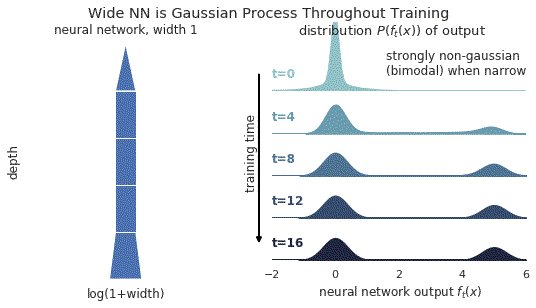
2/ In this gif, narrow relu networks have high probability of initializing near the 0 function (because of relu) and getting stuck. This causes the function distribution to become multi-modal over time. However, for wide relu networks this is not an issue.
3/ This time-evolving GP depends on two kernels: the kernel describing the GP at init, and the kernel describing the linear evolution of this GP. The former is the NNGP kernel, and the latter is the Neural Tangent Kernel (NTK).
4/ Once we have these two kernels, we can derive the GP mean and covariance at any time t via straightforward linear algebra.
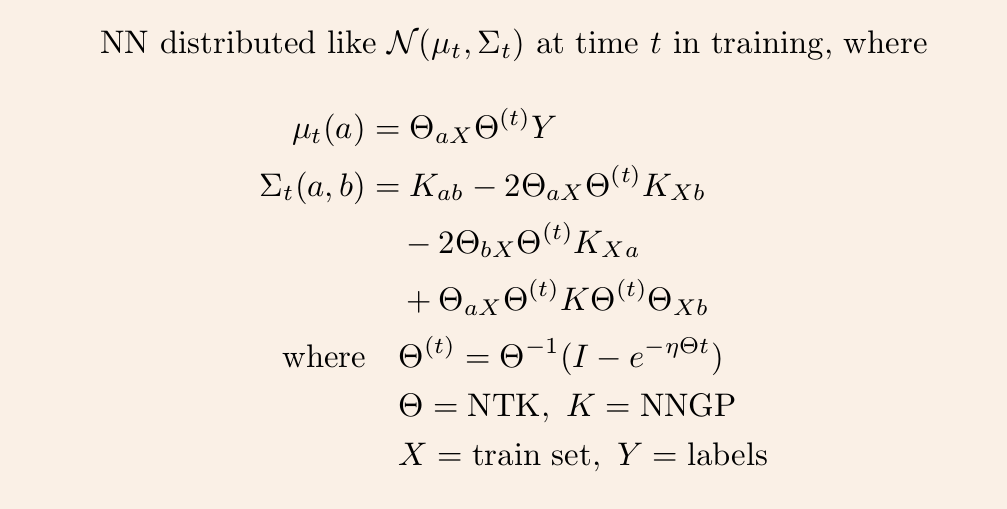
5/ So it remains to calculate the NNGP kernel and NT kernel for any given architecture. The first is described in https://t.co/cFWfNC5ALC and in this thread
2/ In this gif, narrow relu networks have high probability of initializing near the 0 function (because of relu) and getting stuck. This causes the function distribution to become multi-modal over time. However, for wide relu networks this is not an issue.
3/ This time-evolving GP depends on two kernels: the kernel describing the GP at init, and the kernel describing the linear evolution of this GP. The former is the NNGP kernel, and the latter is the Neural Tangent Kernel (NTK).
4/ Once we have these two kernels, we can derive the GP mean and covariance at any time t via straightforward linear algebra.
5/ So it remains to calculate the NNGP kernel and NT kernel for any given architecture. The first is described in https://t.co/cFWfNC5ALC and in this thread
You May Also Like

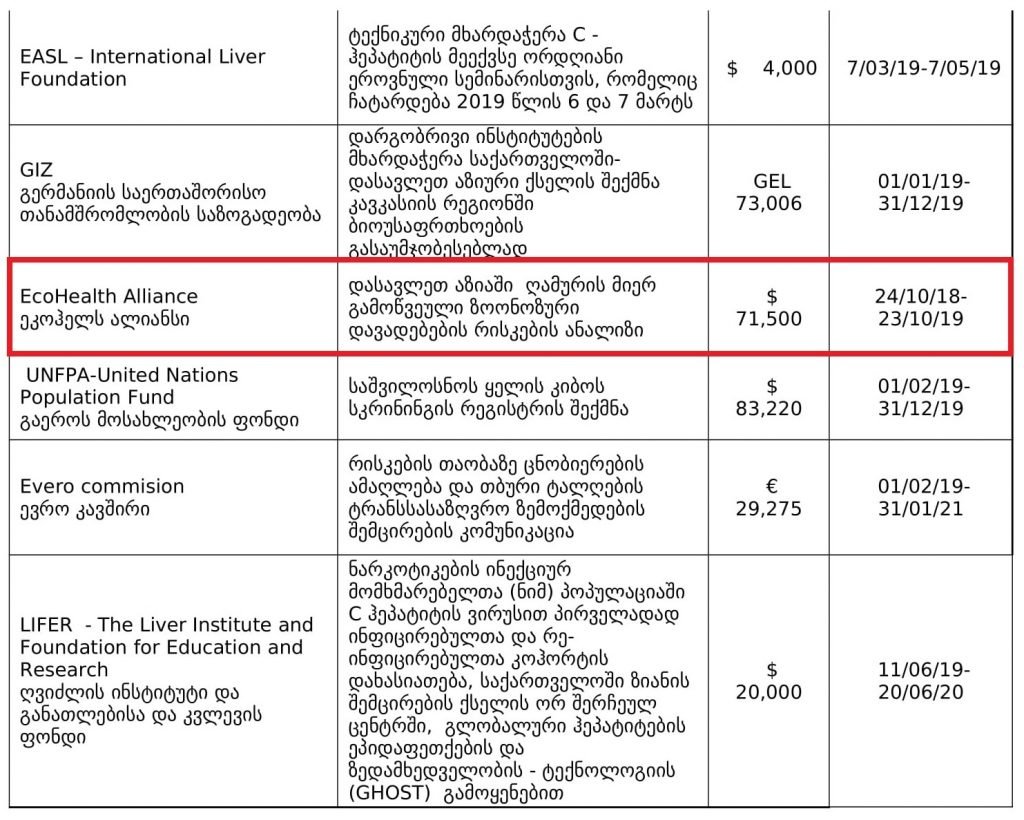
1. Project 1742 (EcoHealth/DTRA)
Risks of bat-borne zoonotic diseases in Western Asia
Duration: 24/10/2018-23 /10/2019
Funding: $71,500
@dgaytandzhieva
https://t.co/680CdD8uug
2. Bat Virus Database
Access to the database is limited only to those scientists participating in our ‘Bats and Coronaviruses’ project
Our intention is to eventually open up this database to the larger scientific community
https://t.co/mPn7b9HM48
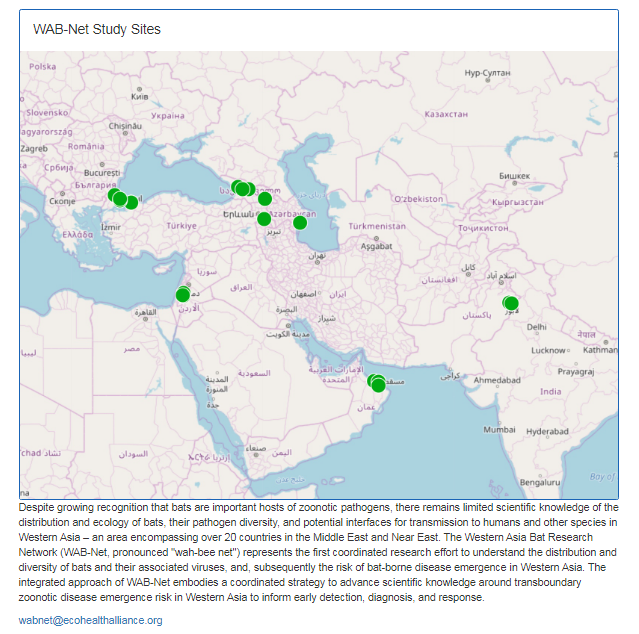
3. EcoHealth Alliance & DTRA Asking for Trouble
One Health research project focused on characterizing bat diversity, bat coronavirus diversity and the risk of bat-borne zoonotic disease emergence in the region.
https://t.co/u6aUeWBGEN
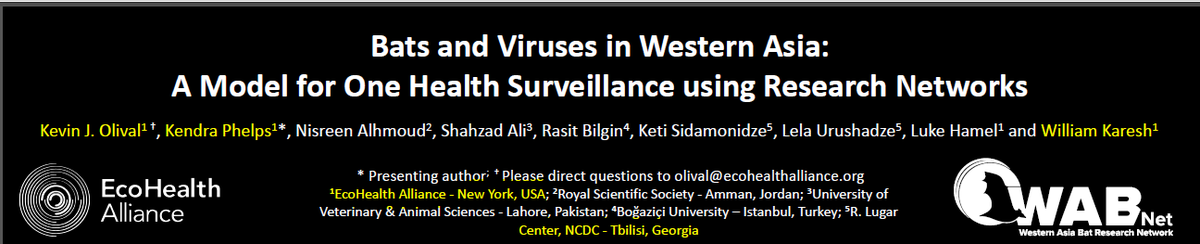
4. Phelps, Olival, Epstein, Karesh - EcoHealth/DTRA
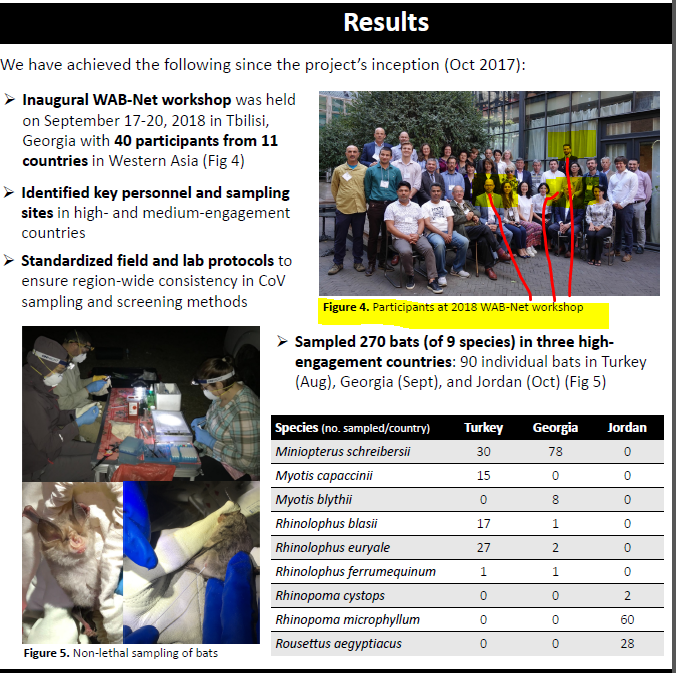
5, Methods and Expected Outcomes
(Unexpected Outcome = New Coronavirus Pandemic)
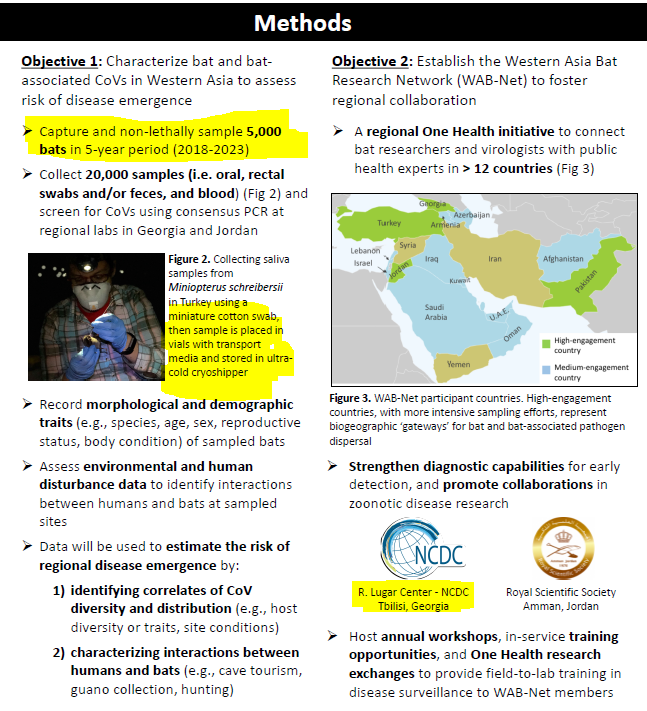
Risks of bat-borne zoonotic diseases in Western Asia
Duration: 24/10/2018-23 /10/2019
Funding: $71,500
@dgaytandzhieva
https://t.co/680CdD8uug
2. Bat Virus Database
Access to the database is limited only to those scientists participating in our ‘Bats and Coronaviruses’ project
Our intention is to eventually open up this database to the larger scientific community
https://t.co/mPn7b9HM48
3. EcoHealth Alliance & DTRA Asking for Trouble
One Health research project focused on characterizing bat diversity, bat coronavirus diversity and the risk of bat-borne zoonotic disease emergence in the region.
https://t.co/u6aUeWBGEN
4. Phelps, Olival, Epstein, Karesh - EcoHealth/DTRA
5, Methods and Expected Outcomes
(Unexpected Outcome = New Coronavirus Pandemic)





So the cryptocurrency industry has basically two products, one which is relatively benign and doesn't have product market fit, and one which is malignant and does. The industry has a weird superposition of understanding this fact and (strategically?) not understanding it.
The benign product is sovereign programmable money, which is historically a niche interest of folks with a relatively clustered set of beliefs about the state, the literary merit of Snow Crash, and the utility of gold to the modern economy.
This product has narrow appeal and, accordingly, is worth about as much as everything else on a 486 sitting in someone's basement is worth.
The other product is investment scams, which have approximately the best product market fit of anything produced by humans. In no age, in no country, in no city, at no level of sophistication do people consistently say "Actually I would prefer not to get money for nothing."
This product needs the exchanges like they need oxygen, because the value of it is directly tied to having payment rails to move real currency into the ecosystem and some jurisdictional and regulatory legerdemain to stay one step ahead of the banhammer.
If everyone was holding bitcoin on the old x86 in their parents basement, we would be finding a price bottom. The problem is the risk is all pooled at a few brokerages and a network of rotten exchanges with counter party risk that makes AIG circa 2008 look like a good credit.
— Greg Wester (@gwestr) November 25, 2018
The benign product is sovereign programmable money, which is historically a niche interest of folks with a relatively clustered set of beliefs about the state, the literary merit of Snow Crash, and the utility of gold to the modern economy.
This product has narrow appeal and, accordingly, is worth about as much as everything else on a 486 sitting in someone's basement is worth.
The other product is investment scams, which have approximately the best product market fit of anything produced by humans. In no age, in no country, in no city, at no level of sophistication do people consistently say "Actually I would prefer not to get money for nothing."
This product needs the exchanges like they need oxygen, because the value of it is directly tied to having payment rails to move real currency into the ecosystem and some jurisdictional and regulatory legerdemain to stay one step ahead of the banhammer.