
In keeping with year-end tradition, I wanted to share the best books I read in 2020 – a year unlike any other - with a list of reads heavily influenced by global events including…
Douglass was a self-educated slave who freed himself to become a tireless speaker, political leader & passionate reformer. Even reading his speeches today, you feel drawn to the power, drama & personal suffering of this great man.
Theologian, Pastor, Church Leader & spy/traitor. Quite a resume for an influential young German aristocrat. Details the rise of Hitler & pure evil unleashed in the face of the pure good of Christ as seen through Bonhoeffer’s eyes.
Jarring. We have so far to go as we confront the realities of systemic racism. Since reading I've sought out reverse mentors to try and learn more. Get comfortable with being uncomfortable. (Much profanity for those sensitive to such)
The church in America faces many challenges – but seeing a radical and aggressive approach to crossing unconventional social/ethnic lines as Christ did to build relationships and impact lives is what faith is all about.
Gripping retelling of the great pandemic of 1918. Much of our modern understanding of the immune system, viral/bacterial infections, and so much more was born in the urgency of dealing with the Influenza.
Combined w/ @ouraring this book changed my habits. Overall health impact of good night’s sleep is profound. I used to “thrive” on 5 hrs/night, this transformed how I think about God given benefits of sleep to overall health. Must read for achievers.
(https://t.co/tA3rlVn1se). Good call! Thanks.
Here are my top 10 reads of 2019: https://t.co/qRzJtJhApS
— Pat Gelsinger (@PGelsinger) December 30, 2019
It's not lost on me that these 10 books barely scratch the surface for what authors and topics have to share. Which one should I dive into next?
The ultimate renaissance man. He studied engineering, anatomy, nature - everything. His anatomical drawings were centuries ahead of his time. Had he published his findings, the world might be decades or centuries ahead of where it is today.
The greatest military leader of his era, w/ broad intrigue of history, arts & governance. Napoleonic wars are a study in strategy & tactics. His ability and lessons on inspiring the team should instruct leaders to this day.
A riveting story of what a team can do when entirely committed, acting with complete trust to each other and in pursuit of a singular goal – Olympic gold in the face of a ruthless dictator.
As a friend and colleague, it is truly impressive to see what @satyanadella has done at Microsoft. I deeply believe technologists have an inherent advantage running technology companies. Rebuilding a company is never a small task.
More from Culture



One of the authors of the Policy Exchange report on academic free speech thinks it is "ridiculous" to expect him to accurately portray an incident at Cardiff University in his study, both in the reporting and in a question put to a student sample.
Here is the incident Kaufmann incorporated into his study, as told by a Cardiff professor who was there. As you can see, the incident involved the university intervening to *uphold* free speech principles:
Here is the first mention of the Greer at Cardiff incident in Kaufmann's report. It refers to the "concrete case" of the "no-platforming of Germaine Greer". Any reasonable reader would assume that refers to an incident of no-platforming instead of its opposite.

Here is the next mention of Greer in the report. The text asks whether the University "should have overruled protestors" and "stepped in...and guaranteed Greer the right to speak". Again the strong implication is that this did not happen and Greer was "no platformed".
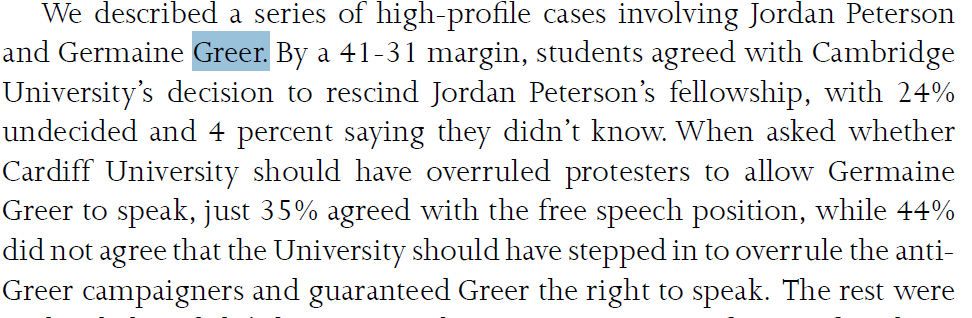
The authors could easily have added a footnote at this point explaining what actually happened in Cardiff. They did not.
This is ridiculous. Students were asked for their views on this example and several others. The study findings and conclusions were about student responses not the substance of each case. Could\u2019ve used hypotheticals. The responses not the cases were the basis of the conclusions.
— Eric Kaufmann (@epkaufm) February 17, 2021
Here is the incident Kaufmann incorporated into his study, as told by a Cardiff professor who was there. As you can see, the incident involved the university intervening to *uphold* free speech principles:
The UK govt\u2019s paper on free speech in Unis (with implications for Wales) is getting a lot of attention.
— Richard Wyn Jones (@RWynJones) February 16, 2021
Worth noting then that an important part of the evidence-base on which it rests relates to (demonstrably false) claims about my own institution
1/https://t.co/buoGE7ocG7
Here is the first mention of the Greer at Cardiff incident in Kaufmann's report. It refers to the "concrete case" of the "no-platforming of Germaine Greer". Any reasonable reader would assume that refers to an incident of no-platforming instead of its opposite.
Here is the next mention of Greer in the report. The text asks whether the University "should have overruled protestors" and "stepped in...and guaranteed Greer the right to speak". Again the strong implication is that this did not happen and Greer was "no platformed".
The authors could easily have added a footnote at this point explaining what actually happened in Cardiff. They did not.





You May Also Like














The entire discussion around Facebook’s disclosures of what happened in 2016 is very frustrating. No exec stopped any investigations, but there were a lot of heated discussions about what to publish and when.
In the spring and summer of 2016, as reported by the Times, activity we traced to GRU was reported to the FBI. This was the standard model of interaction companies used for nation-state attacks against likely US targeted.
In the Spring of 2017, after a deep dive into the Fake News phenomena, the security team wanted to publish an update that covered what we had learned. At this point, we didn’t have any advertising content or the big IRA cluster, but we did know about the GRU model.
This report when through dozens of edits as different equities were represented. I did not have any meetings with Sheryl on the paper, but I can’t speak to whether she was in the loop with my higher-ups.
In the end, the difficult question of attribution was settled by us pointing to the DNI report instead of saying Russia or GRU directly. In my pre-briefs with members of Congress, I made it clear that we believed this action was GRU.
The story doesn\u2019t say you were told not to... it says you did so without approval and they tried to obfuscate what you found. Is that true?
— Sarah Frier (@sarahfrier) November 15, 2018
In the spring and summer of 2016, as reported by the Times, activity we traced to GRU was reported to the FBI. This was the standard model of interaction companies used for nation-state attacks against likely US targeted.
In the Spring of 2017, after a deep dive into the Fake News phenomena, the security team wanted to publish an update that covered what we had learned. At this point, we didn’t have any advertising content or the big IRA cluster, but we did know about the GRU model.
This report when through dozens of edits as different equities were represented. I did not have any meetings with Sheryl on the paper, but I can’t speak to whether she was in the loop with my higher-ups.
In the end, the difficult question of attribution was settled by us pointing to the DNI report instead of saying Russia or GRU directly. In my pre-briefs with members of Congress, I made it clear that we believed this action was GRU.