The amazing thing about the era of filmmaking that ended with "Wonder Woman 1984" is that a script that dumb and joyless could get past dozens of people without anyone pumping the brakes before a firehose of funding was sprayed over the project.
More from John Hayward
More from Culture

I just finished Eric Adler's The Battle of the Classics, and wanted to say something about Joel Christiansen's review linked below. I am not sure what motivates the review (I speculate a bit below), but it gives a very misleading impression of the book. 1/x
The meat of the criticism is that the history Adler gives is insufficiently critical. Adler describes a few figures who had a great influence on how the modern US university was formed. It's certainly critical: it focuses on the social Darwinism of these figures. 2/x
Other insinuations and suggestions in the review seem wildly off the mark, distorted, or inappropriate-- for example, that the book is clickbaity (it is scholarly) or conservative (hardly) or connected to the events at the Capitol (give me a break). 3/x
The core question: in what sense is classics inherently racist? Classics is old. On Adler's account, it begins in ancient Rome and is revived in the Renaissance. Slavery (Christiansen's primary concern) is also very old. Let's say classics is an education for slaveowners. 4/x
It's worth remembering that literacy itself is elite throughout most of this history. Literacy is, then, also the education of slaveowners. We can honor oral and musical traditions without denying that literacy is, generally, good. 5/x
As someone\u2019s who\u2019s read the book, this review strikes me as tremendously unfair. It mostly faults Adler for not writing the book the reviewer wishes he had! https://t.co/pqpt5Ziivj
— Teresa M. Bejan (@tmbejan) January 12, 2021
The meat of the criticism is that the history Adler gives is insufficiently critical. Adler describes a few figures who had a great influence on how the modern US university was formed. It's certainly critical: it focuses on the social Darwinism of these figures. 2/x
Other insinuations and suggestions in the review seem wildly off the mark, distorted, or inappropriate-- for example, that the book is clickbaity (it is scholarly) or conservative (hardly) or connected to the events at the Capitol (give me a break). 3/x
The core question: in what sense is classics inherently racist? Classics is old. On Adler's account, it begins in ancient Rome and is revived in the Renaissance. Slavery (Christiansen's primary concern) is also very old. Let's say classics is an education for slaveowners. 4/x
It's worth remembering that literacy itself is elite throughout most of this history. Literacy is, then, also the education of slaveowners. We can honor oral and musical traditions without denying that literacy is, generally, good. 5/x


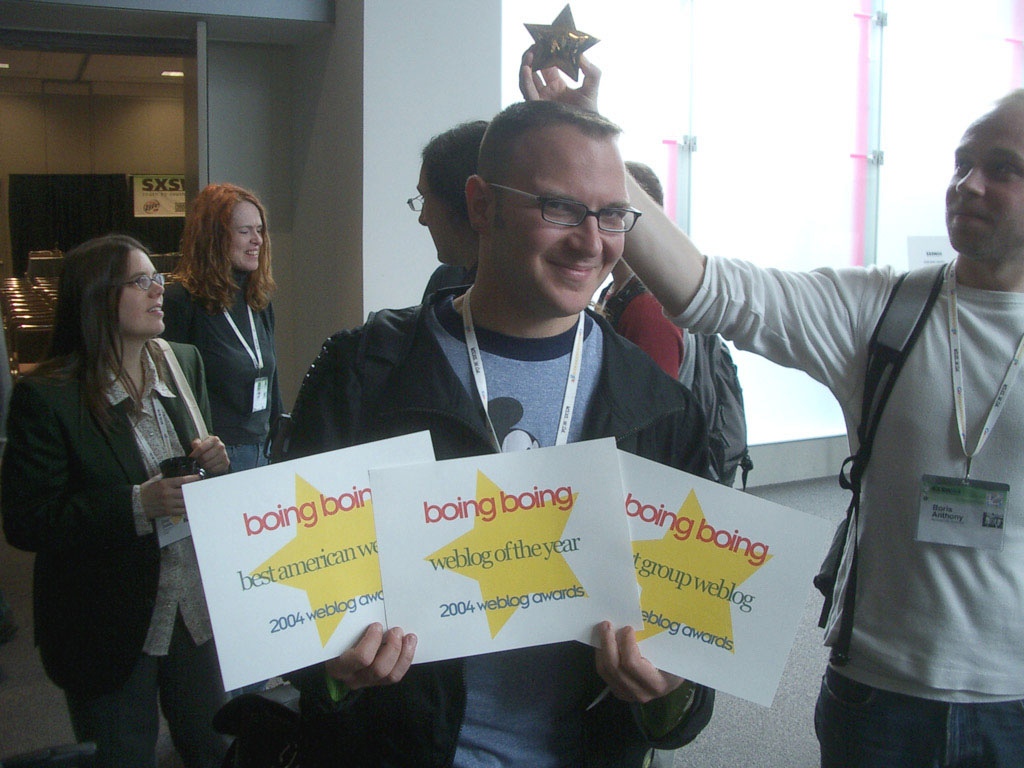

One of the authors of the Policy Exchange report on academic free speech thinks it is "ridiculous" to expect him to accurately portray an incident at Cardiff University in his study, both in the reporting and in a question put to a student sample.
Here is the incident Kaufmann incorporated into his study, as told by a Cardiff professor who was there. As you can see, the incident involved the university intervening to *uphold* free speech principles:
Here is the first mention of the Greer at Cardiff incident in Kaufmann's report. It refers to the "concrete case" of the "no-platforming of Germaine Greer". Any reasonable reader would assume that refers to an incident of no-platforming instead of its opposite.

Here is the next mention of Greer in the report. The text asks whether the University "should have overruled protestors" and "stepped in...and guaranteed Greer the right to speak". Again the strong implication is that this did not happen and Greer was "no platformed".
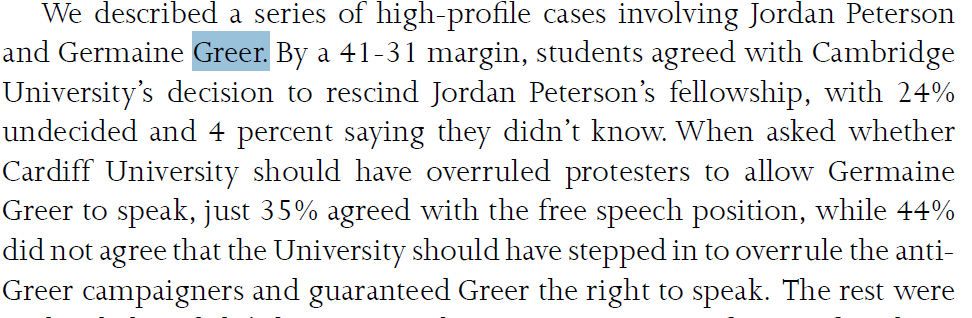
The authors could easily have added a footnote at this point explaining what actually happened in Cardiff. They did not.
This is ridiculous. Students were asked for their views on this example and several others. The study findings and conclusions were about student responses not the substance of each case. Could\u2019ve used hypotheticals. The responses not the cases were the basis of the conclusions.
— Eric Kaufmann (@epkaufm) February 17, 2021
Here is the incident Kaufmann incorporated into his study, as told by a Cardiff professor who was there. As you can see, the incident involved the university intervening to *uphold* free speech principles:
The UK govt\u2019s paper on free speech in Unis (with implications for Wales) is getting a lot of attention.
— Richard Wyn Jones (@RWynJones) February 16, 2021
Worth noting then that an important part of the evidence-base on which it rests relates to (demonstrably false) claims about my own institution
1/https://t.co/buoGE7ocG7
Here is the first mention of the Greer at Cardiff incident in Kaufmann's report. It refers to the "concrete case" of the "no-platforming of Germaine Greer". Any reasonable reader would assume that refers to an incident of no-platforming instead of its opposite.
Here is the next mention of Greer in the report. The text asks whether the University "should have overruled protestors" and "stepped in...and guaranteed Greer the right to speak". Again the strong implication is that this did not happen and Greer was "no platformed".
The authors could easily have added a footnote at this point explaining what actually happened in Cardiff. They did not.

A thread of very good, wonderful, truly Super Bowls.
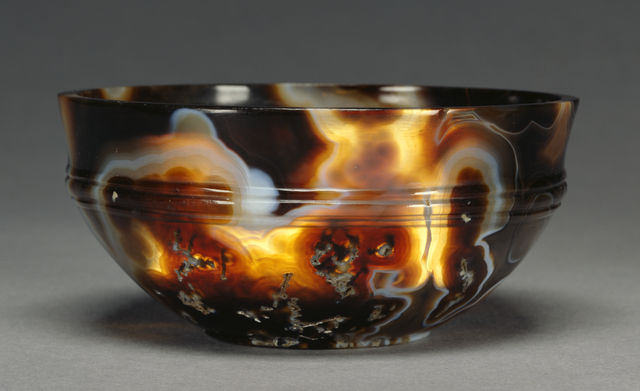
Translucent agate bowl with ornamental grooves and coffee-and-cream marbling. Found near Qift in southern Egypt. 300 - 1,000 BC. 📷 Getty Museum https://t.co/W1HfQZIG2V
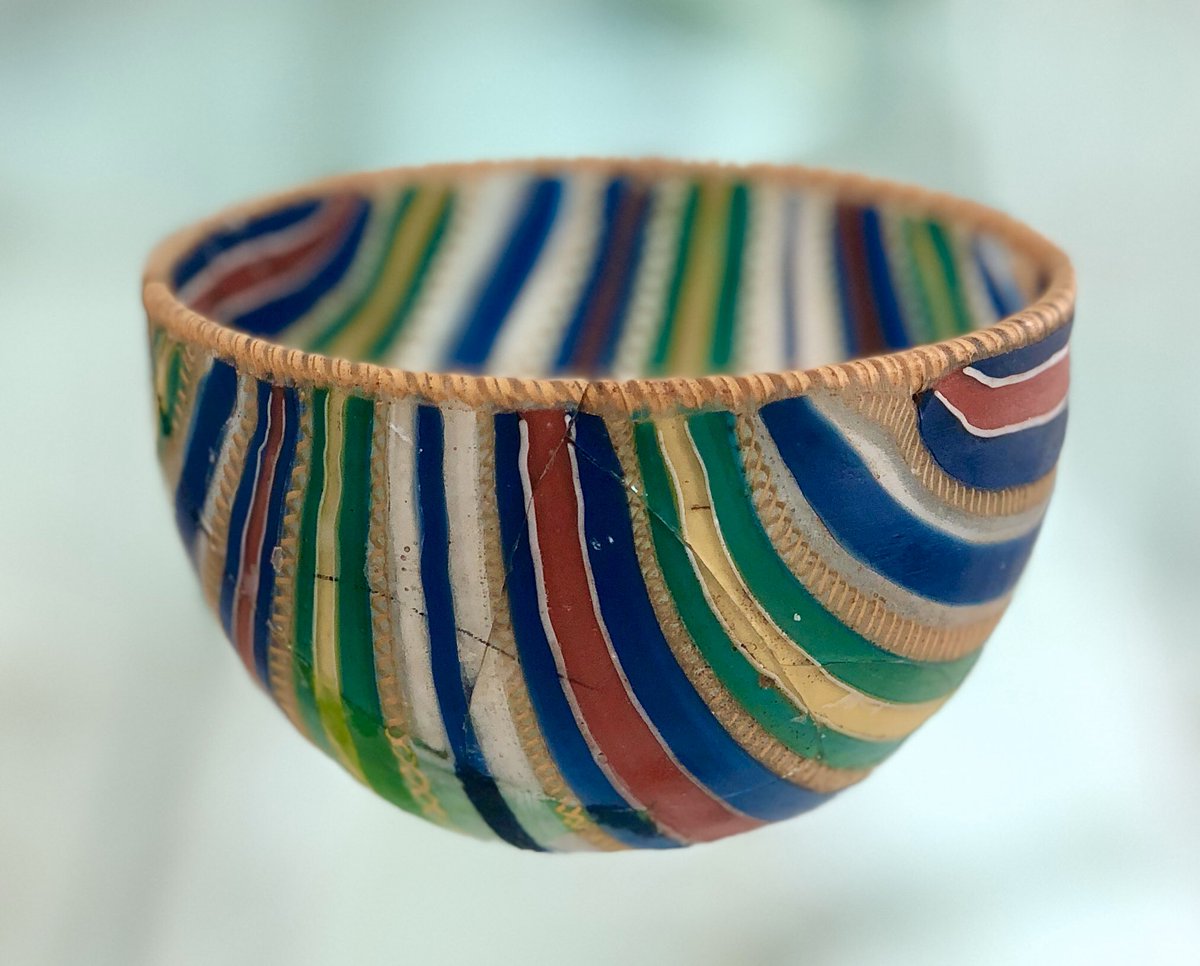
Technicolor dreambowl, found in a grave near Zadar on Croatia's Dalmatian Coast. Made by melding and winding thin bars of glass, each adulterated with different minerals to get different colors. 1st century AD. 📷 Zadar Museum of Ancient Glass https://t.co/H9VfNrXKQK
100,000-year-old abalone shells used to mix red ocher, marrow, charcoal, and water into a colorful paste. Possibly the oldest artist's palettes ever discovered. Blombos Cave, South Africa. 📷https://t.co/0fMeYlOsXG

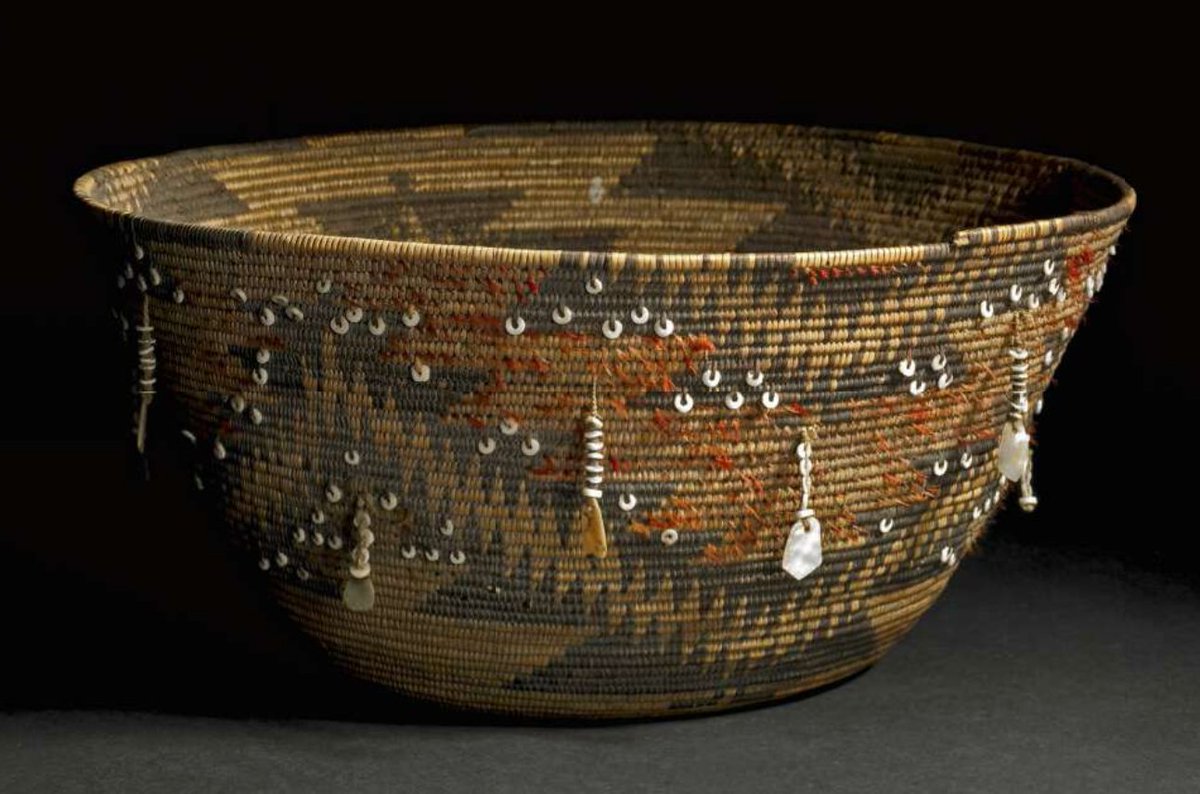
Reed basket bowl with shell and feather ornaments. Possibly from the Southern Pomo or Lake Miwok cultures. Found in Santa Barbara, CA, circa 1770. 📷 British Museum https://t.co/F4Ix0mXAu6
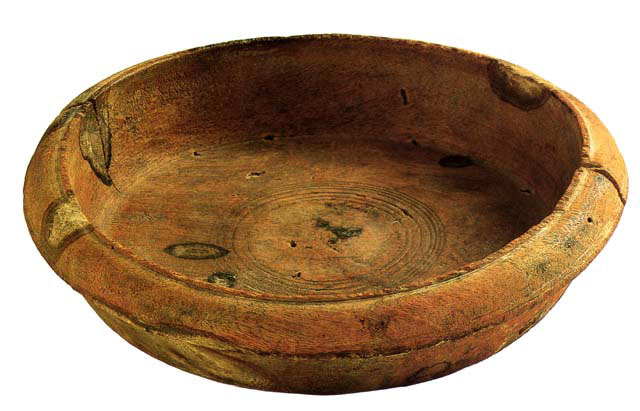
Wooden bowl with concentric circles and rounded rim, most likely made of umbrella thorn acacia (Vachellia/Acacia tortilis). Qumran. 1st Century BCE. 📷 https://t.co/XZCw67Ho03
Translucent agate bowl with ornamental grooves and coffee-and-cream marbling. Found near Qift in southern Egypt. 300 - 1,000 BC. 📷 Getty Museum https://t.co/W1HfQZIG2V
Technicolor dreambowl, found in a grave near Zadar on Croatia's Dalmatian Coast. Made by melding and winding thin bars of glass, each adulterated with different minerals to get different colors. 1st century AD. 📷 Zadar Museum of Ancient Glass https://t.co/H9VfNrXKQK
100,000-year-old abalone shells used to mix red ocher, marrow, charcoal, and water into a colorful paste. Possibly the oldest artist's palettes ever discovered. Blombos Cave, South Africa. 📷https://t.co/0fMeYlOsXG
Reed basket bowl with shell and feather ornaments. Possibly from the Southern Pomo or Lake Miwok cultures. Found in Santa Barbara, CA, circa 1770. 📷 British Museum https://t.co/F4Ix0mXAu6
Wooden bowl with concentric circles and rounded rim, most likely made of umbrella thorn acacia (Vachellia/Acacia tortilis). Qumran. 1st Century BCE. 📷 https://t.co/XZCw67Ho03
You May Also Like

@EricTopol @NBA @StephenKissler @yhgrad B.1.1.7 reveals clearly that SARS-CoV-2 is reverting to its original pre-outbreak condition, i.e. adapted to transgenic hACE2 mice (either Baric's BALB/c ones or others used at WIV labs during chimeric bat coronavirus experiments aimed at developing a pan betacoronavirus vaccine)
@NBA @StephenKissler @yhgrad 1. From Day 1, SARS-COV-2 was very well adapted to humans .....and transgenic hACE2 Mice
@NBA @StephenKissler @yhgrad 2. High Probability of serial passaging in Transgenic Mice expressing hACE2 in genesis of SARS-COV-2
@NBA @StephenKissler @yhgrad B.1.1.7 has an unusually large number of genetic changes, ... found to date in mouse-adapted SARS-CoV2 and is also seen in ferret infections.
https://t.co/9Z4oJmkcKj

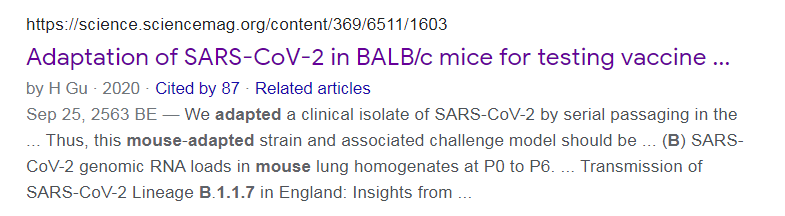
@NBA @StephenKissler @yhgrad We adapted a clinical isolate of SARS-CoV-2 by serial passaging in the ... Thus, this mouse-adapted strain and associated challenge model should be ... (B) SARS-CoV-2 genomic RNA loads in mouse lung homogenates at P0 to P6.
https://t.co/I90OOCJg7o
@NBA @StephenKissler @yhgrad 1. From Day 1, SARS-COV-2 was very well adapted to humans .....and transgenic hACE2 Mice
1. From Day 1, SARS-COV-2 was very well adapted to humans .....and transgenic hACE2 Mice
— Billy Bostickson \U0001f3f4\U0001f441&\U0001f441 \U0001f193 (@BillyBostickson) January 30, 2021
"we generated a mouse model expressing hACE2 by using CRISPR/Cas9 knockin technology. In comparison with wild-type C57BL/6 mice, both young & aged hACE2 mice sustained high viral loads... pic.twitter.com/j94XtSkscj
@NBA @StephenKissler @yhgrad 2. High Probability of serial passaging in Transgenic Mice expressing hACE2 in genesis of SARS-COV-2
1. High Probability of serial passaging in Transgenic Mice expressing hACE2 in genesis of SARS-COV-2!
— Billy Bostickson \U0001f3f4\U0001f441&\U0001f441 \U0001f193 (@BillyBostickson) January 2, 2021
2 papers:
Human\u2013viral molecular mimicryhttps://t.co/irfH0Zgrve
Molecular Mimicryhttps://t.co/yLQoUtfS6s https://t.co/lsCv2iMEQz
@NBA @StephenKissler @yhgrad B.1.1.7 has an unusually large number of genetic changes, ... found to date in mouse-adapted SARS-CoV2 and is also seen in ferret infections.
https://t.co/9Z4oJmkcKj
@NBA @StephenKissler @yhgrad We adapted a clinical isolate of SARS-CoV-2 by serial passaging in the ... Thus, this mouse-adapted strain and associated challenge model should be ... (B) SARS-CoV-2 genomic RNA loads in mouse lung homogenates at P0 to P6.
https://t.co/I90OOCJg7o