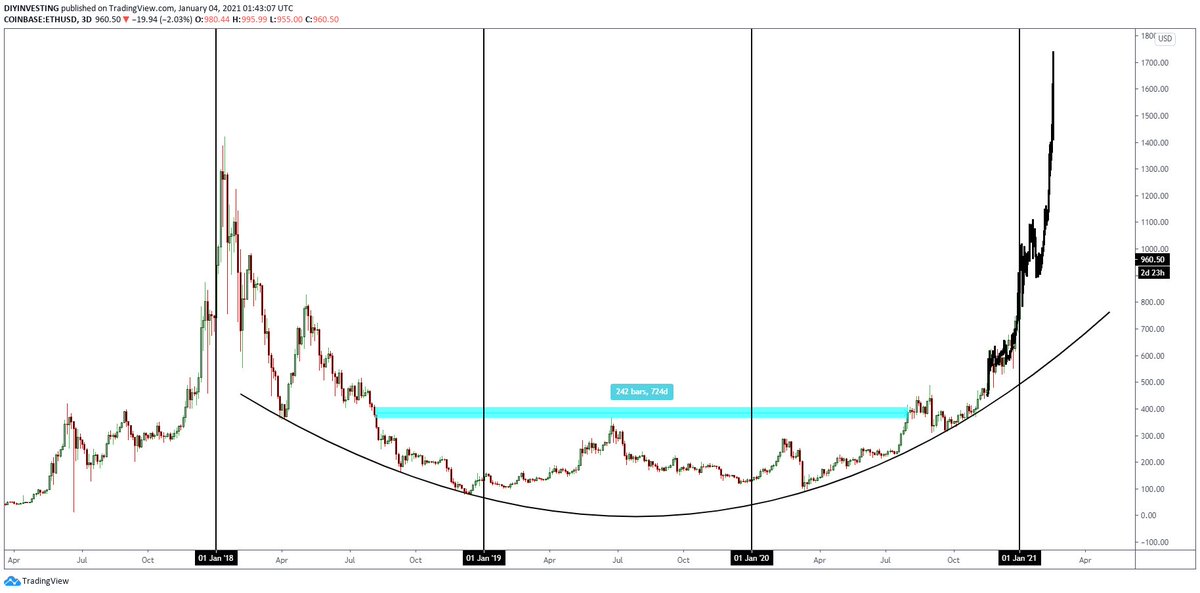
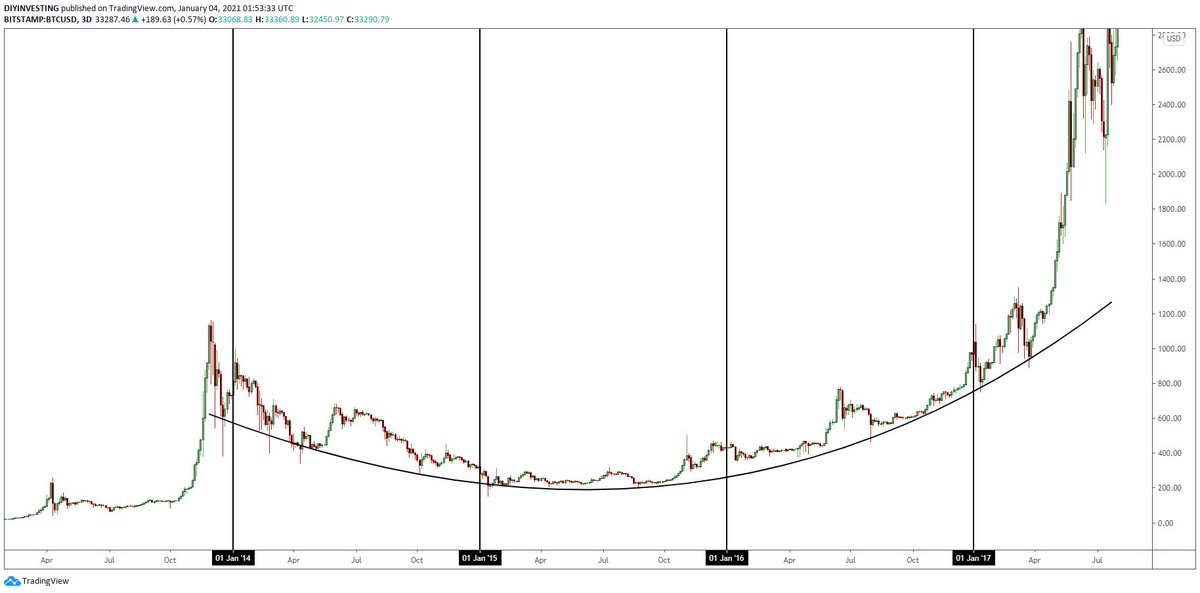
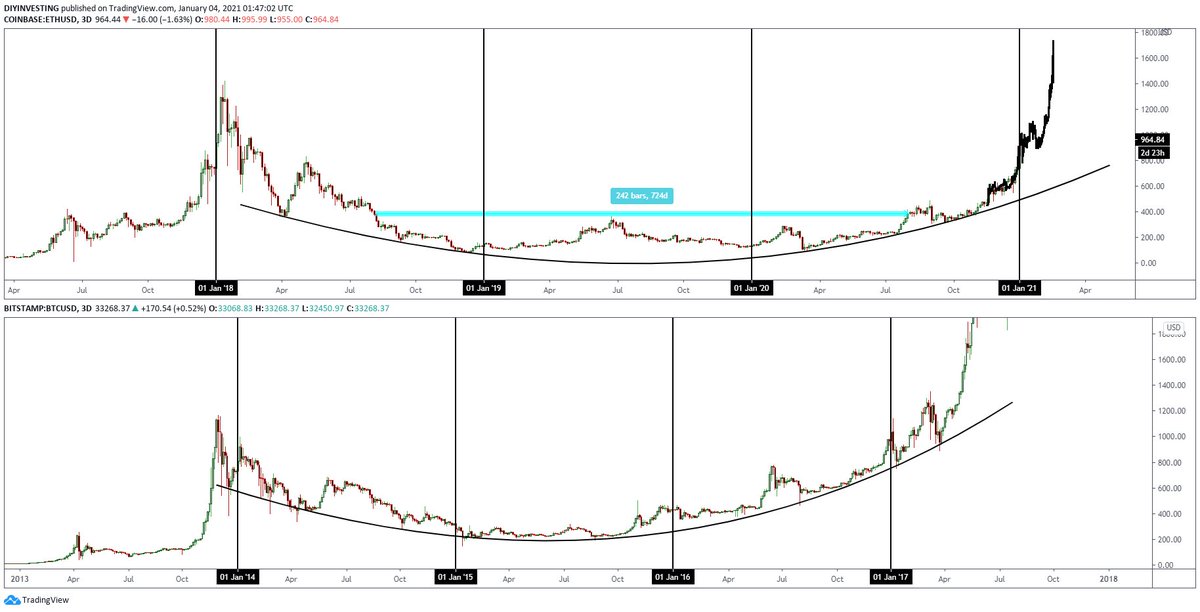
2020 was a game changer for Ethereum.

The vast majority of its success was fueled by #DeFi.

Here's what happened in 5 Tweets 🔽

1) Governance Tokens 🪙

Projects gave complete ownership of billion dollar protocols to their users, often using retroactive airdrops.

Early adopters earned tokens for past usage, and token-based voting now dictates all technical upgrades.

https://t.co/uzR8NW5AyD
2) Liquidity Mining ⛏️

Power users were the first to earn on-going distribution by providing liquidity.

$COMP sparked the wave, with $BAL coining the term a few weeks later.

https://t.co/BGqUNjc0kC
3) Yield Faming 🌾

Projects coupled liquidity mining and governance tokens to boost 'yields' by combining lending rates with an incentive layer.

APYs peaked as high as 1M% during 'DeFi summer', leading to a 'food coin' craze like $YAM and $SUSHI

https://t.co/59pCAav7pk
4) Fair Launches ✅

Who needs investment when you can launch using yield farming?

@iearnfinance debuted $YFI with no formal funding, seeding a community treasury for self-sustainability.

The notion of a core team and community became one and the same.

https://t.co/OuTWjSrcjd
5) Meta-governance 🗳️

Delegation and indexes allowed projects to vote on other protocols using assets under management.

$DPI is the best example, using its $COMP and $UNI to vote based on $INDEX sentiment.

https://t.co/XLjrtRau3w
Key Takeaways:

- Early adopters got paid
- Putting capital to work netted the highest returns
- Liquidity allowed teams to seed a community treasury.
- Treasuries accrued tokens, used to govern other protocols.

Most importantly, team and community merged together.
What's Next?

Composability will flourish, and projects will win liquidity based on cash flows, rather than short-lived APYs.

Governance incentives will boost participation, leading to a vibrant number of protocol politicians.

Curation will thrive.
https://t.co/dxw2P0roQL
This was without a doubt my most exciting year in crypto.

If you're new to #DeFi, take time to learn more with great outlets like @DefiantNews @DeFiRate @BanklessHQ and @Yield_TV.

S/o Daily Gwei by @sassal0x and Daily Ape by @Darrenlautf 💪

Until then, keep up the honest work!

More from Crypto

Back with another #FreeLoveFriday. Last time, we covered how Mastercoin/@Omni_Layer pioneered digital asset issuance on blockchains. Today, let’s discuss @Chainlink and the vital role it plays in connecting blockchains to the real world.


I have said repeatedly that digital asset issuance is the killer application for blockchains. The next frontier is bringing real world assets to networks like @AvalancheAVAX, but we often face a significant problem:

Namely, how do you get data from the real world onto blockchains and into applications running on them? More critically, how do you achieve that securely and transparently in real-time? Smart contracts are tamper-proof, but they're only as reliable as their input data.

Enter ChainLink in September 2017, with a whitepaper outlining a vision for a decentralized network of “oracles,” entities that inject facts from the external world into blockchains in a suitable format for smart contracts.

Until ChainLink, oracles were trusted and centralized. This is a huge problem for high-value assets and smart contracts. High value projects, such as @CelsiusNetwork, @synthetix_io, @Aaveaave and others depend critically on oracle data.

You May Also Like

The YouTube algorithm that I helped build in 2011 still recommends the flat earth theory by the *hundreds of millions*. This investigation by @RawStory shows some of the real-life consequences of this badly designed AI.


This spring at SxSW, @SusanWojcicki promised "Wikipedia snippets" on debated videos. But they didn't put them on flat earth videos, and instead @YouTube is promoting merchandising such as "NASA lies - Never Trust a Snake". 2/


A few example of flat earth videos that were promoted by YouTube #today:
https://t.co/TumQiX2tlj 3/

https://t.co/uAORIJ5BYX 4/

https://t.co/yOGZ0pLfHG 5/