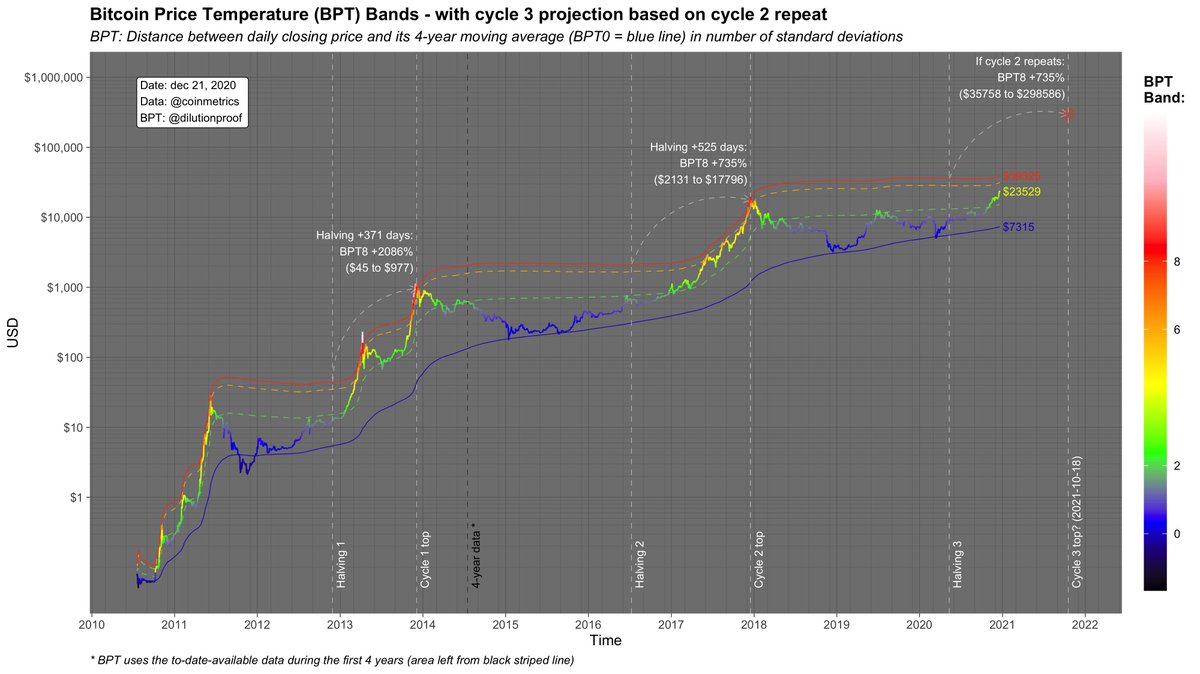
1/10 A rough prediction using the #Bitcoin Price Temperature (BPT) Bands:
If the current #Bitcoin post-halving bull run has a similar growth & volatility as the last one, this cycle could top at around $300k in October 2021 👀
Q&A with interpretation & nuances in this thread 👇
More from Crypto
I'm sure someone else has explained this, but it is just so cool and I want to explain how this works.
So Curve is awesome for swaps between similar assets, right? The fact that they trade very close to each other is a key part about how Curve works, using it's custom swap invariant function.
That's step 1
Step 2 is that Synthetix is awesome for creating "synthetic assets" (aka synths) which are assets that trade like other assets, that are backed by another, entirely different asset. Basically, a plastic banana that I can buy and sell like a real banana.
Synthetix has a feature that lets you swap between any two synths with zero slippage and a flat fee. That's because it is simply converting the sythentic asset into another synthetic asset, the backing for the synth doesn't change it just uses a different price oracle now.
This is important. Absolutely no slippage, at any size
Swap $1m sUSD for $1m sBTC? flat 0.3% fee
Swap $10m sUSD for $10m sBTC? flat 0.3% fee
swap $100m sUSD for $100m sBTC? Well, there isn't that many synths in Curve, yet but you get the point. The only limit is the pool depth
— Andre Cronje (@AndreCronjeTech) January 15, 2021
So Curve is awesome for swaps between similar assets, right? The fact that they trade very close to each other is a key part about how Curve works, using it's custom swap invariant function.
That's step 1
Step 2 is that Synthetix is awesome for creating "synthetic assets" (aka synths) which are assets that trade like other assets, that are backed by another, entirely different asset. Basically, a plastic banana that I can buy and sell like a real banana.
Synthetix has a feature that lets you swap between any two synths with zero slippage and a flat fee. That's because it is simply converting the sythentic asset into another synthetic asset, the backing for the synth doesn't change it just uses a different price oracle now.
This is important. Absolutely no slippage, at any size
Swap $1m sUSD for $1m sBTC? flat 0.3% fee
Swap $10m sUSD for $10m sBTC? flat 0.3% fee
swap $100m sUSD for $100m sBTC? Well, there isn't that many synths in Curve, yet but you get the point. The only limit is the pool depth
1/9 #BSC Daily from
2/9 #BSC Daily from
#PancakeSwap Welcomes @SoteriaFinance to Syrup Pool
— PancakeSwap \U0001f95e #BSC (@PancakeSwap) January 20, 2021
Stake $CAKE, Earn\xa0$wSOTE!https://t.co/liMimqoGDy
2/9 #BSC Daily from
Learn how to trade your #BinanceSmartChain assets on the @OpenOceanGlobal DEX aggregator, from within the @TrustWalletApp DApp browser.
— Trust - Crypto Wallet (@TrustWalletApp) January 20, 2021
Combine the best rates for your trades, from 3-4 different exchanges \U0001f680
Step-by-step how-to guide, here \U0001f447
"Blockchain technology is energy-intensive..." => No, it doesn't have to be.
Let's look at Proof-Of-Stake, an alternative to the energy-intensive Proof-Of-Work algorithm.
🧵🔽
1️⃣ A Quick Recap On Proof-Of-Work
A Proof-Of-Work algorithm requires miners to do a certain amount of work that is compute-intensive to gain access to a service or the right to do something. This algorithm, by design, also requires that the work done shall not ...
... be reusable for anything else than what it was performed for. This lies at the core of the security concept of a blockchain. To gain the right to append a new block to a chain and to get some currency as a reward, there is work to be done, and this work must be verifyable.
That work is a race between different miners. Many miners try to compete and to be the first to find the answer to a problem presented to them. This implies that a lot of energy is wasted as only the first correct solution is accepted.
You can find a more detailed thread on Proof-Of-Work
Let's look at Proof-Of-Stake, an alternative to the energy-intensive Proof-Of-Work algorithm.
🧵🔽
1️⃣ A Quick Recap On Proof-Of-Work
A Proof-Of-Work algorithm requires miners to do a certain amount of work that is compute-intensive to gain access to a service or the right to do something. This algorithm, by design, also requires that the work done shall not ...
... be reusable for anything else than what it was performed for. This lies at the core of the security concept of a blockchain. To gain the right to append a new block to a chain and to get some currency as a reward, there is work to be done, and this work must be verifyable.
That work is a race between different miners. Many miners try to compete and to be the first to find the answer to a problem presented to them. This implies that a lot of energy is wasted as only the first correct solution is accepted.
You can find a more detailed thread on Proof-Of-Work
Proof-Of-Work is the name of a cryptographic algorithm that is used for some blockchains when new blocks are to be appended to the chain.
— Oliver Jumpertz (@oliverjumpertz) April 3, 2021
Let's take a higher-level look at how this one works, shall we?
\U0001f9f5\U0001f53d