As a “lifelong” technician, I am finding that bitcoin lends itself well to technical analysis. Here is my take on the recent price action. (THREAD)
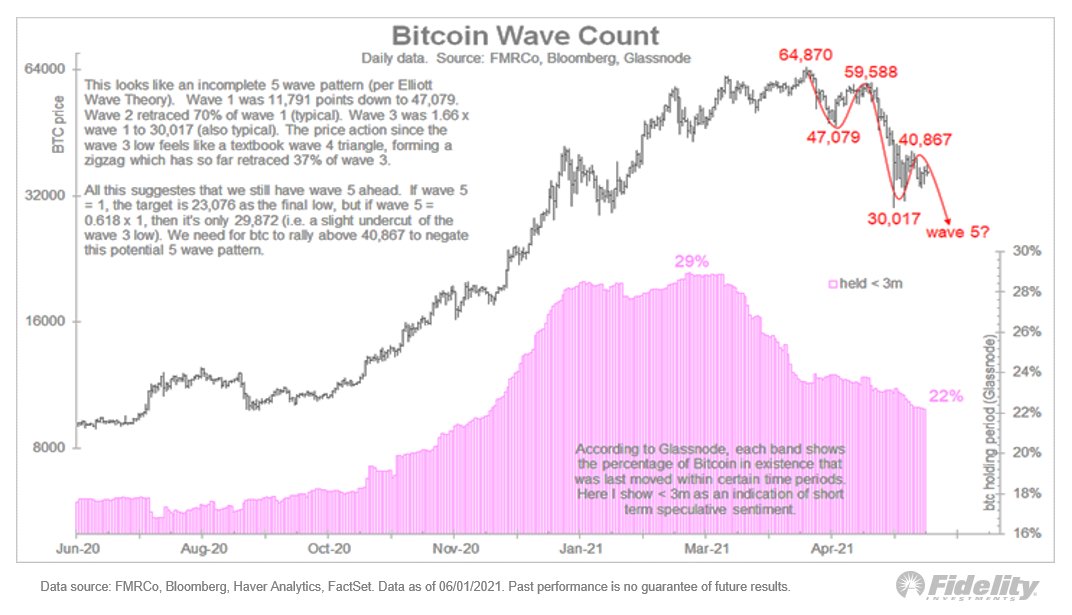
Elliott Wave Theory: Looking at the chart pattern since the recent high of 64,870, I can't help but notice that a textbook 5-wave decline may be unfolding. According to EWT, primary trends move in 5 waves and corrections are 3 waves. /2
The typical progression is that wave 1 is generally dismissed as noise, then wave 2 is a sharp and deep retracement of wave 1 (at least 62% but sometimes 75% or more), which creates the false comfort that it was indeed just a minor correction. /3
Then wave 3 comes & that's the big one. It's called the recognition wave & is typically the longest & most impulsive wave (usually 1.618x wave 1). /4
After the wave 3 low, the 4th wave is often a triangle or "zigzag" (a triangle pattern that retraces much less of wave 3 than wave 2 did of wave 1). A rule of thumb is 38%. Finally we get wave 5, which is often equal to wave 1, but often also less (0.618x). /5
Let's apply this to the bitcoin chart. So far it looks like wave 1 down was from 64,870 to 47,079 for 11,791 points. Wave 2 went up to 59,588, which is a 70% retracement of wave 1. Wave 3 was an impulsive 29,571 points down to 30,017, which equates to 1.66x wave 1. /6
So far the recovery from the wave 3 low looks like a 4th wave zigzag retracing 37% of wave 3. In other words, everything about this wave pattern so far appears to be textbook, which suggests that a wave 5 decline could still lie ahead. /7
If wave 5 = wave 1, it projects down to 23,076 as a final low. If it's only 0.618x wave 1, we may only slightly undercut the current low and bottom at 29,872. So to me that’s the range of outcomes for a potential 5th wave sequence. /8
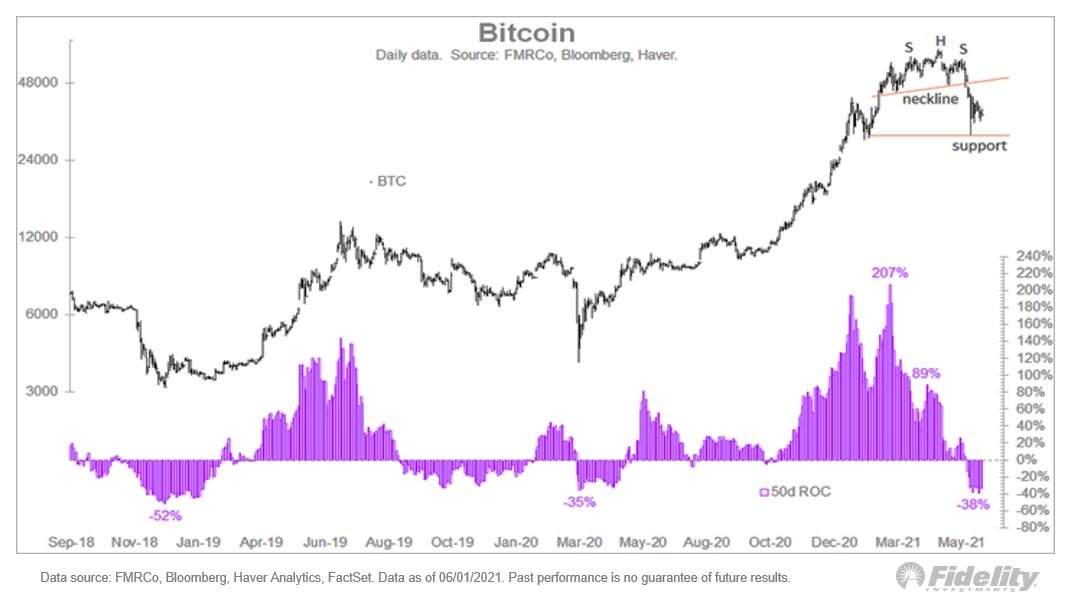
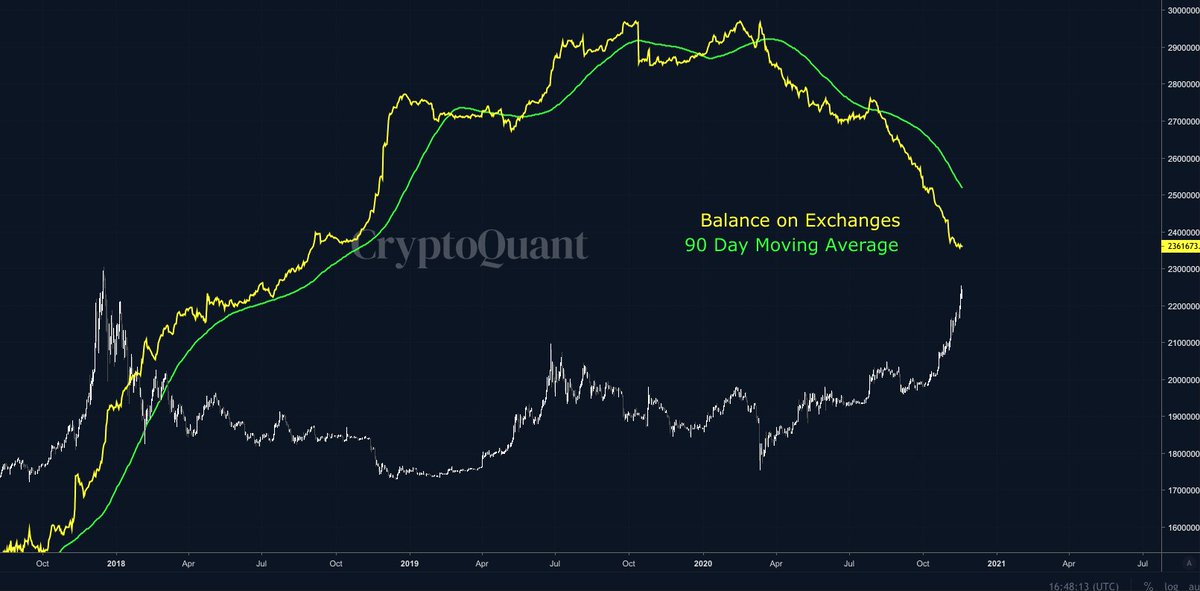
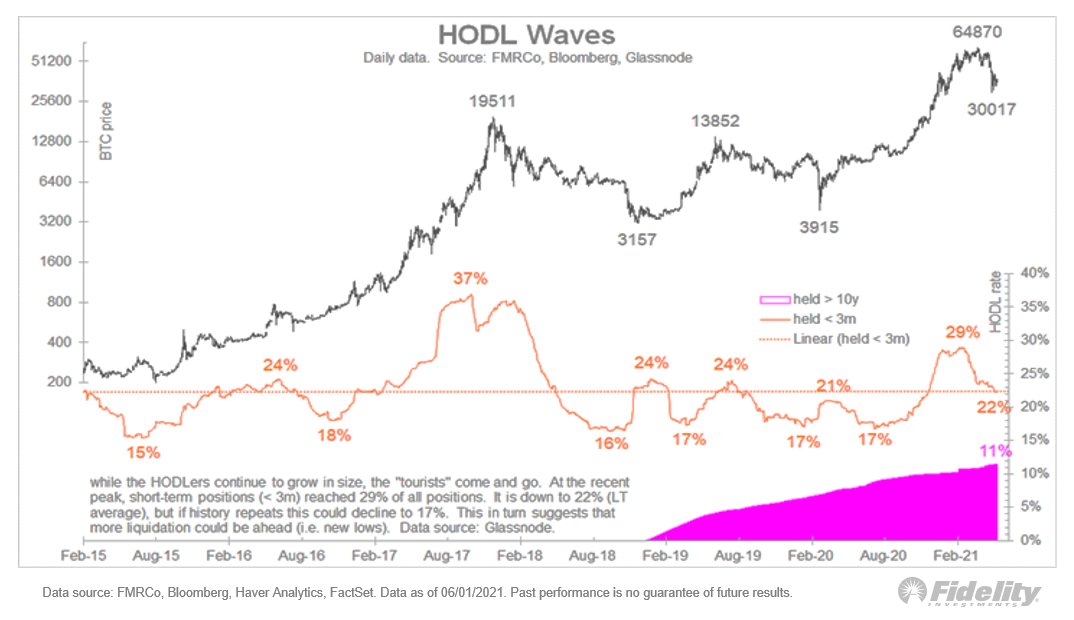
Here is the chart. In the bottom panel I show a series from Glassnode, which shows the percentage of positions held less than 3 months. To me, that’s one indication of where the short-term momentum traders may be at. /9
All this is just a hunch of course (& one of the pitfalls of EWT is that everything looks like one thing until it doesn’t). What would negate the 5 wave sequence? A sustained rally above 41k should do it, in which case we could think of the current retest as a “failed 5th.” /10
Here is a longer view of the Glassnode series. To me, it looks like short-term traders have not capitulated enough. The chart shows that the low end of the range for short-term positions is around 17%. Meanwhile, the percentage of HODLers (> 10 years) is growing steadily. /11
FWIW, my hunch is that the low will be closer to 30k than 23k, per the head & shoulders price target below. The distance from the head to the neckline was 17k, which measured from the neckline is 30k. Technical Analysis 101 says that this is the minimum target of a H&S top. /12
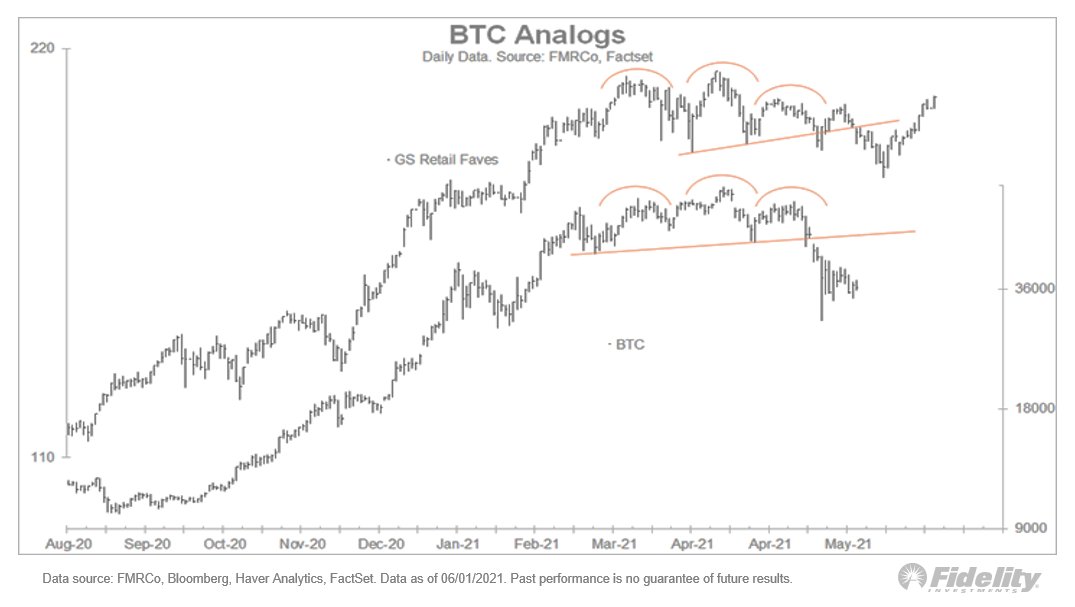
Finally, an analog to the BTC correction is the correction in meme stocks (lagged by a month). This also suggests that there could be one more down-leg before we see a sustained recovery (although the GS retail favorites index does not show a discernable 5 wave pattern). /13
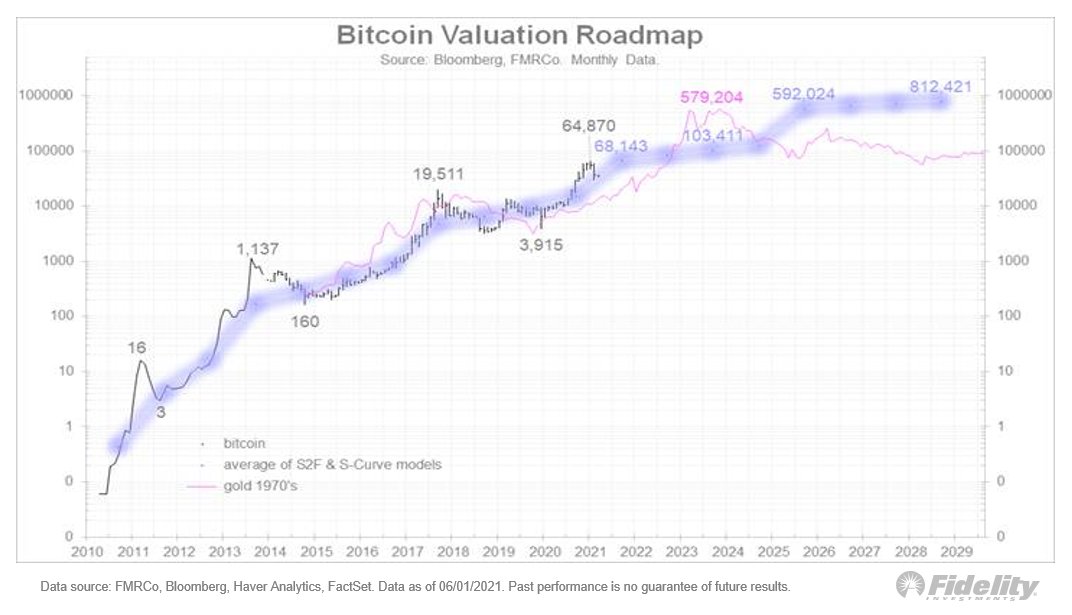
Don’t get me wrong: I remain a secular bull, but according to my version of the S2F model & S-Curve model (& the analog of gold during the 1970s), the trip to 64k was a bit too much too fast, prematurely reaching my year-end target of 68k in April. /14
Bull markets are more sustainable when the tree gets occasionally shaken, and my best guess is that this is what we are seeing now. (END)

More from Crypto

1/ @MIT discussing the need for blockchain gateways to achieve interoperability across different blockchain networks, and to support the cross-blockchain mobility of virtual assets

https://t.co/PbjQkSlTT3

@quant_network are collaborating with MIT in the creation of ODAP

$QNT

2/ "In order for blockchain-based services to scale globally, blockchain networks must be able to interoperate with one another following a standardized protocol and interfaces (APIs)"

Gilbert founded ISO TC307 which 60 countries are working towards standardizing the interfaces


3/ "We believe that a blockchain gateway is needed for blockchain networks to interoperate in a manner similar
to border gateway routers in IP networks. Just as border gateway routers use the BGPv4 protocol to interact with one another in a peered fashion we believe that a...

4/ blockchain gateway protocol will be needed to permit the movement of virtual assets and related information across blockchain networks in a secure and privacy-preserving manner"

You can read more about the gateway protocol ODAP in this 21 tweet


5/
"We motivate the need for blockchain gateways and blockchain gateway protocols in the following summary:

✅Enables blockchain interoperability:
Blockchain gateways provide an interface for the interoperability between blockchain/DLT systems that operate distinct consensus...
I'm sure someone else has explained this, but it is just so cool and I want to explain how this works.


So Curve is awesome for swaps between similar assets, right? The fact that they trade very close to each other is a key part about how Curve works, using it's custom swap invariant function.

That's step 1

Step 2 is that Synthetix is awesome for creating "synthetic assets" (aka synths) which are assets that trade like other assets, that are backed by another, entirely different asset. Basically, a plastic banana that I can buy and sell like a real banana.

Synthetix has a feature that lets you swap between any two synths with zero slippage and a flat fee. That's because it is simply converting the sythentic asset into another synthetic asset, the backing for the synth doesn't change it just uses a different price oracle now.

This is important. Absolutely no slippage, at any size

Swap $1m sUSD for $1m sBTC? flat 0.3% fee

Swap $10m sUSD for $10m sBTC? flat 0.3% fee

swap $100m sUSD for $100m sBTC? Well, there isn't that many synths in Curve, yet but you get the point. The only limit is the pool depth

You May Also Like

#ज्योतिष_विज्ञान #मंत्र_विज्ञान

ज्योतिषाचार्य अक्सर ग्रहों के दुष्प्रभाव के समाधान के लिए मंत्र जप, अनुष्ठान इत्यादि बताते हैं।

व्यक्ति के जन्म के समय ग्रहों की स्थिति ही उसकी कुंडली बन जाती है जैसे कि फ़ोटो खींच लिया हो और एडिट करना सम्भव नही है। इसे ही "लग्न" कुंडली कहते हैं।


लग्न के समय ग्रहों की इस स्थिति से ही जीवन भर आपको किस ग्रह की ऊर्जा कैसे प्रभावित करेगी का निर्धारिण होता है। साथ साथ दशाएँ, गोचर इत्यादि चलते हैं पर लग्न कुंडली का रोल सबसे महत्वपूर्ण है।


पृथ्वी से अरबों खरबों दूर ये ग्रह अपनी ऊर्जा से पृथ्वी/व्यक्ति को प्रभावित करते हैं जैसे हमारे सबसे निकट ग्रह चंद्रमा जोकि जल का कारक है पृथ्वी और शरीर के जलतत्व पर पूर्ण प्रभाव रखता है।
पूर्णिमा में उछाल मारता समुद्र का जल इसकी ऊर्जा के प्रभाव को दिखाता है।


अमावस्या में ऊर्जा का स्तर कम होने पर वही समुद्र शांत होकर पीछे चला जाता है। जिसे ज्वार-भाटा कहते हैं। इसी तरह अन्य ग्रहों की ऊर्जा के प्रभाव होते हैं जिन्हें यहां समझाना संभव नहीं।
चंद्रमा की ये ऊर्जा शरीर को (अगर खराब है) water retention, बैचेनी, नींद न आना आदि लक्षण दिखाती है


मंत्र क्या हैं-
मंत्र इन ऊर्जाओं के सटीक प्रयोग करने के पासवर्ड हैं। जिनके जप से संबंधित ग्रह की ऊर्जा को जातक की ऊर्जा से कनेक्ट करके उन ग्रहों के दुष्प्रभाव को कम किया और शुभ प्रभाव को बढ़ाया जाता है।
This is a pretty valiant attempt to defend the "Feminist Glaciology" article, which says conventional wisdom is wrong, and this is a solid piece of scholarship. I'll beg to differ, because I think Jeffery, here, is confusing scholarship with "saying things that seem right".


The article is, at heart, deeply weird, even essentialist. Here, for example, is the claim that proposing climate engineering is a "man" thing. Also a "man" thing: attempting to get distance from a topic, approaching it in a disinterested fashion.


Also a "man" thing—physical courage. (I guess, not quite: physical courage "co-constitutes" masculinist glaciology along with nationalism and colonialism.)


There's criticism of a New York Times article that talks about glaciology adventures, which makes a similar point.


At the heart of this chunk is the claim that glaciology excludes women because of a narrative of scientific objectivity and physical adventure. This is a strong claim! It's not enough to say, hey, sure, sounds good. Is it true?