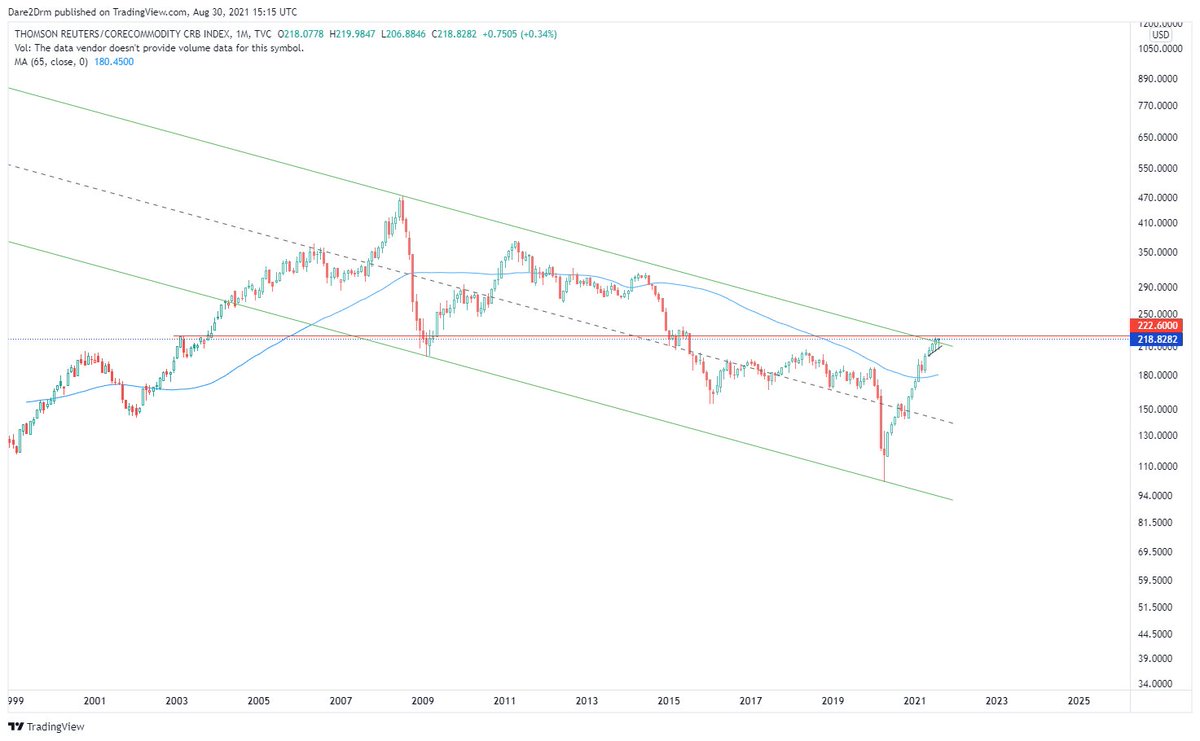
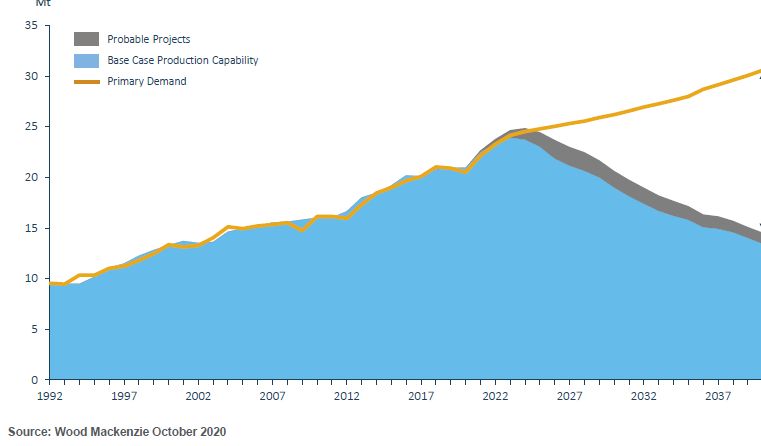
A classic early sign of a commodity cycle.

Mining industry nonfarm payrolls near historical lows.

This happened in early 1970s & 2000s.
Both marked the onset of a commodities bull market.

Labor & capital constraints are the amplifiers of bull market in resource stocks.

👇👇👇

Energy & soft commodities are obviously not mining related.

See below the nonfarm payrolls for oil & gas extraction which is also at historical lows.

To recall:

The green agenda hasn’t even started.
The decline in agricultural workers look even more severe.

To be fair, this is not a domestic problem.
We’re are experiencing similar issues worldwide.
This pandemic has truly magnified a long-term trend of labor reduction and under investments in the commodities space.

Resource companies have been facing a deep recession for some time now with not enough workers willing to enter this industry.
On top of it:

Government policies seem to be discouraging folks from return to the labor market.

People continue to leave the labor force like never before.
The supply shortage problem is much more permanent than most realize.

This upward pressure in consumer prices is probably just getting started.
See a few examples:

“Coke Cola will raise prices to offset higher commodity costs”

https://t.co/ke4CgsPm70
“Higher commodity costs lead to price hikes from Kimberly-Clark and other consumer giants”

https://t.co/434i1TTtTx
More broadly:

“Finance chiefs look to price increases to offset higher commodities costs”

https://t.co/5Eo7vgDHlb

More from Commodities

You May Also Like

I’m torn on how to approach the idea of luck. I’m the first to admit that I am one of the luckiest people on the planet. To be born into a prosperous American family in 1960 with smart parents is to start life on third base. The odds against my very existence are astronomical.


I’ve always felt that the luckiest people I know had a talent for recognizing circumstances, not of their own making, that were conducive to a favorable outcome and their ability to quickly take advantage of them.

In other words, dumb luck was just that, it required no awareness on the person’s part, whereas “smart” luck involved awareness followed by action before the circumstances changed.

So, was I “lucky” to be born when I was—nothing I had any control over—and that I came of age just as huge databases and computers were advancing to the point where I could use those tools to write “What Works on Wall Street?” Absolutely.

Was I lucky to start my stock market investments near the peak of interest rates which allowed me to spend the majority of my adult life in a falling rate environment? Yup.