



Learn JavaScript Recursion

The Complete Guide:

Thread 🧵

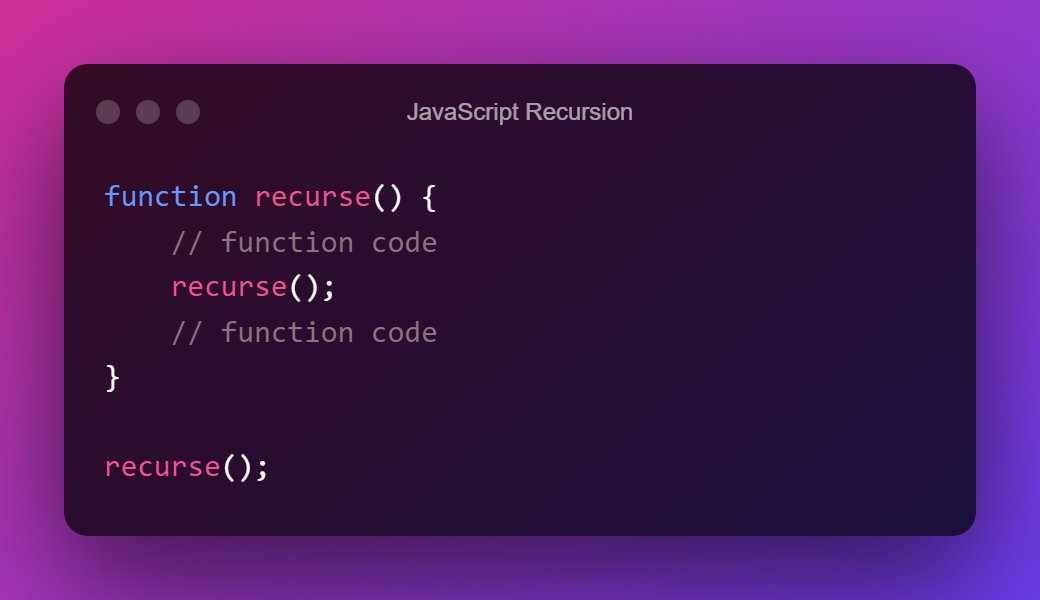
Recursion is a process of calling itself. A function that calls itself is called a recursive function.

syntax -
A recursive function must have a condition to stop calling itself. Otherwise, the function is called indefinitely.

A simple example of a recursive function would be to count down the value to 1.
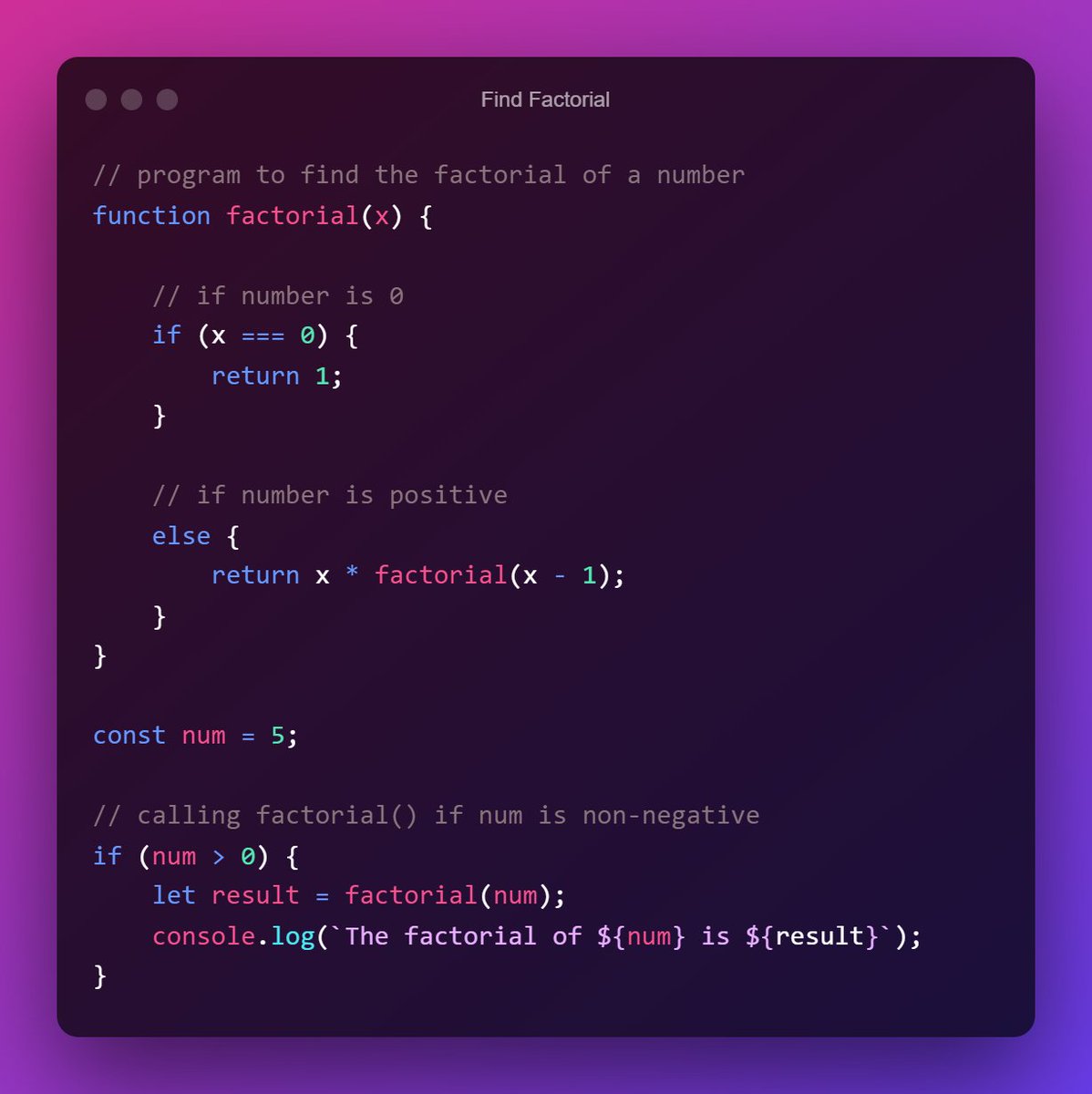
Example 2: Find Factorial
If you enjoyed reading this thread, please do the following:
1. Like the thread❤️
2. Retweet the first tweet.🔃
3. Follow me and enable notifications: ✅
@CodeMarch
Thank you for reading all the way through.
Download our free JavaScript Resources ebook Here:

https://t.co/miV7BM7fD0

More from Catagory jee

Top 10 Threads of the week 📈

Learn about Linkedin, Tools, Websites, Css, Youtube, Business, Presentation, Copywriting... And much more 🧵

1️⃣ 10 Free websites that feel illegal to use:

Topics: Tools, Websites, Website, Productivity, Web.
By: Ben Kelly


2️⃣ 9 CSS generators can save you from writing CSS Code...

Topics: Css, Frontend, Generators, Cssgenerators, Design.
By: Pratham


3️⃣ Even the most well-informed internet user wouldn't...

Topics: Websites, Tools, Website, Useful, Sites.
By: Alex Brogan


4️⃣ CSS generators can save you a lot of time and...

Topics: Css, Tools, Dev, Webdev, Generators.
By: Marko ⚡ Denic

You May Also Like

A brief analysis and comparison of the CSS for Twitter's PWA vs Twitter's legacy desktop website. The difference is dramatic and I'll touch on some reasons why.

Legacy site *downloads* ~630 KB CSS per theme and writing direction.

6,769 rules
9,252 selectors
16.7k declarations
3,370 unique declarations
44 media queries
36 unique colors
50 unique background colors
46 unique font sizes
39 unique z-indices

https://t.co/qyl4Bt1i5x


PWA *incrementally generates* ~30 KB CSS that handles all themes and writing directions.

735 rules
740 selectors
757 declarations
730 unique declarations
0 media queries
11 unique colors
32 unique background colors
15 unique font sizes
7 unique z-indices

https://t.co/w7oNG5KUkJ


The legacy site's CSS is what happens when hundreds of people directly write CSS over many years. Specificity wars, redundancy, a house of cards that can't be fixed. The result is extremely inefficient and error-prone styling that punishes users and developers.

The PWA's CSS is generated on-demand by a JS framework that manages styles and outputs "atomic CSS". The framework can enforce strict constraints and perform optimisations, which is why the CSS is so much smaller and safer. Style conflicts and unbounded CSS growth are avoided.