#SLE_IanDunt 30 minutes to the start of our "Evening with Ian Dunt". Information here: https://t.co/9bLxOtCr56
Log-in tickets from https://t.co/iKcwmQh7gZ. See you soon!
Export using groupage; each shipment is on a lorry containing many shipments. Wrong documentation on one of them stops the whole thing.
Safety regulation: complex and laborious
Documentation by custom brokers: not enough to go round
SBS: Health checks; documentation is hardest - export health certificate - relies on having enough vets - which we don't have
Fish rot very quickly. Form filling is very difficult.
E.g. one lorry stopped because one lorry was 1.5kg out in weight.
Also, can't get the health certificates done.
Importers in Europe are looking for other sources of goods; they may never go back to UK supply.
Covid reducing freight to about 10% of normal; when it gets back to normal rates, it's going to be chaos.
We shouldn't say "I told you so"; these are potential converts; convince them that they have been conned and betrayed.
Tories want a culture war; Starmer needs to avoid that. So he needs to suppress talk of rejoin right now. For now, build better relations step by step.
Aim to get back in by 2030.
Make the case that business is being strangled
Spirit: encourage people to feel European
A: Plenty of stuff that was missed out; it was the result of talking to experts!
A: nothing is inevitable. But we are now a separate territory to NI. Problem for Scottish independence: problems with Brexit shows what could happen of Scotland separates.
A: So many to choose from! How about: "reduction of red tape"? "No border in the Irish Sea?"; had signed a document that said the opposite!
A: I love the UK, one of the most diverse populations in the World. Would not say to give the anti-immigration people the satisfaction of succeeding.
A: Yes, London's resources mean it will stay as world number 1
A: Biden will continue to consider the UK as very important. Have lost some of the special relationship; done for insane reasons. Fawned over Trump; went down v badly with the Democrats.
A: Not many. Has quelled Euroscepticism in the rest of Europe. There are some EU policies that aren't good, e.g. CAP. But these are miniscule.
Britain was part of a movement to reduce the chance of war by working together.
A: 2016 campaign had no heart. Failed to see that the electoral dynamics were different. Must fight with heart!
A: Electoral reform; 2019; more votes for parties that wanted another referendum; FPTP causes grotesque, arbitrary outcomes. Need electoral reform more than anything else, particularly if Scotland leaves.
A: Not bad; wouldn't win though. Lib Dem position strange.
Needs an outcome of progressive internationalism.
A: Tinned foods etc. are OK. Fresh produce is the problem. But you can't stockpile them! Some drugs (medicines) could be problematic.
More from Brexit


What's in the EU-UK Brexit deal on energy?
It may be Boxing day, but I've had a quick look
Title VIII: Energy is the key section (page 156 onwards)
▶️ Standard stuff on commitment to competition, unbundling and customer choice
▶️ UK Capacity Market no longer needs to try to integrate overseas Capacity providers & vice versa
(Article ENER.6, Clause 3, page. 160)
2/

▶️ Existing "exemptions" for selected interconnectors will continue to apply.
This means that these interconnectors can continue to sell capacity rights ahead of time, rather than all through close to real-time markets.
(Article ENER.11, page 162)
3/

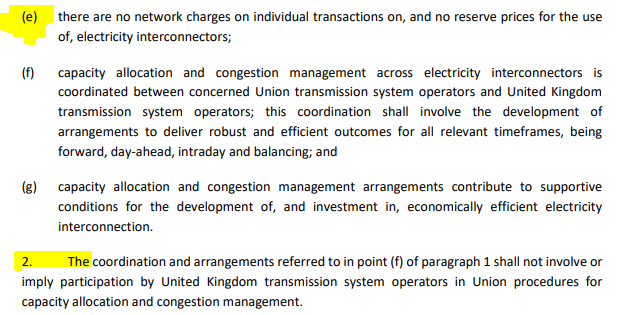
▶️ No network charges on individual interconnector transactions (as now)
▶️ But, UK cannot participate in EU procedures for capacity allocation and congestion management (more on this later)
(Article ENER.13, page 163)
4/
Gas trading: looks like the UK stays in the existing PRISMA gas trading platform.
Not my specialist area, but is this because PRISMA isn't an EU institution (unlike electricity market coupling)?
https://t.co/5GQJtZDpTa
(Article ENER. 15, page 164)
5/
It may be Boxing day, but I've had a quick look
Title VIII: Energy is the key section (page 156 onwards)
▶️ Standard stuff on commitment to competition, unbundling and customer choice
▶️ UK Capacity Market no longer needs to try to integrate overseas Capacity providers & vice versa
(Article ENER.6, Clause 3, page. 160)
2/
▶️ Existing "exemptions" for selected interconnectors will continue to apply.
This means that these interconnectors can continue to sell capacity rights ahead of time, rather than all through close to real-time markets.
(Article ENER.11, page 162)
3/
▶️ No network charges on individual interconnector transactions (as now)
▶️ But, UK cannot participate in EU procedures for capacity allocation and congestion management (more on this later)
(Article ENER.13, page 163)
4/
Gas trading: looks like the UK stays in the existing PRISMA gas trading platform.
Not my specialist area, but is this because PRISMA isn't an EU institution (unlike electricity market coupling)?
https://t.co/5GQJtZDpTa
(Article ENER. 15, page 164)
5/


Been waiting for 👇 🚨
Important story on what a “tariff-free” deal means in practice and why it’s not enough for two economies as closely integrated.
Tariffs are removed on goods that meet rules of origin. This is a complex and nuanced area of customs.
/1
Important to remember that trade deals (FTAs) weren't designed with such a high degree of economic integration in mind.
So some of the standard RoO provisions will seem incredibly restrictive under the UK-EU deal.
/2
Minimal operations or insufficient processing is a standard part of an FTA. Most, if not all FTAs, include a provision on minimal processing – processing not considered sufficient to confer originating status even if rules of origin have been met.
/3
It is standard procedure not to apply cumulation when goods have only been subject to minimal processing.
To be able to cumulate origin and consider the final product of UK origin, the processing carried out in the UK needs to exceed minimal operations.
/4
The level of integration between the UK and the EU means that this will have significant consequences for a number of industries.
For example, in supply chains where goods are brought into the UK from the EU and reassembled, sorted or repackaged and re-exported to ROI.
/5
Important story on what a “tariff-free” deal means in practice and why it’s not enough for two economies as closely integrated.
Tariffs are removed on goods that meet rules of origin. This is a complex and nuanced area of customs.
/1
\U0001f6a8\U0001f6a8\U0001f6a8\U0001f1ea\U0001f1fa\U0001f1ec\U0001f1e7\U0001f69b\U0001f692\U0001f1ea\U0001f1fa\U0001f1ec\U0001f1e7\U0001f6a8\U0001f6a8\U0001f6a8 serious #brexit story alert - companies now starting to see penny drop on what rules of origin does to supply chains (food for example) but Brussels seems deaf to both EU & U.K. pleading. A bellwether? \U0001f62c Stay with me. 1/
— Peter Foster (@pmdfoster) January 6, 2021
https://t.co/HoDSDxhKaL
Important to remember that trade deals (FTAs) weren't designed with such a high degree of economic integration in mind.
So some of the standard RoO provisions will seem incredibly restrictive under the UK-EU deal.
/2
Minimal operations or insufficient processing is a standard part of an FTA. Most, if not all FTAs, include a provision on minimal processing – processing not considered sufficient to confer originating status even if rules of origin have been met.
/3
It is standard procedure not to apply cumulation when goods have only been subject to minimal processing.
To be able to cumulate origin and consider the final product of UK origin, the processing carried out in the UK needs to exceed minimal operations.
/4
The level of integration between the UK and the EU means that this will have significant consequences for a number of industries.
For example, in supply chains where goods are brought into the UK from the EU and reassembled, sorted or repackaged and re-exported to ROI.
/5

A not-so-little thread on how post-Brexit work permit regulations will apply in Scottish football and why it’s, broadly, not a good thing...
1) Work permit calculations are based on the points formula from this site - https://t.co/sjqx8Df7Zg
As things stand, while this article deals with England, the system applies to Scotland also.
The goal is 15 points and the article shows various ways to get there. Essentially, play regularly internationally or in a top 5 league and you’re in. But read the article because it’s a bit trickier than that.
2) There are elements of this I’d dispute. For example, here’s the banding of leagues and, lower down, it’s an absolute mess - Denmark (ranked 14 in coefficient table) and Serbia (16) banded lower than Croatia (20), Greece (18) and Czechs (19)? It’s wholly random.
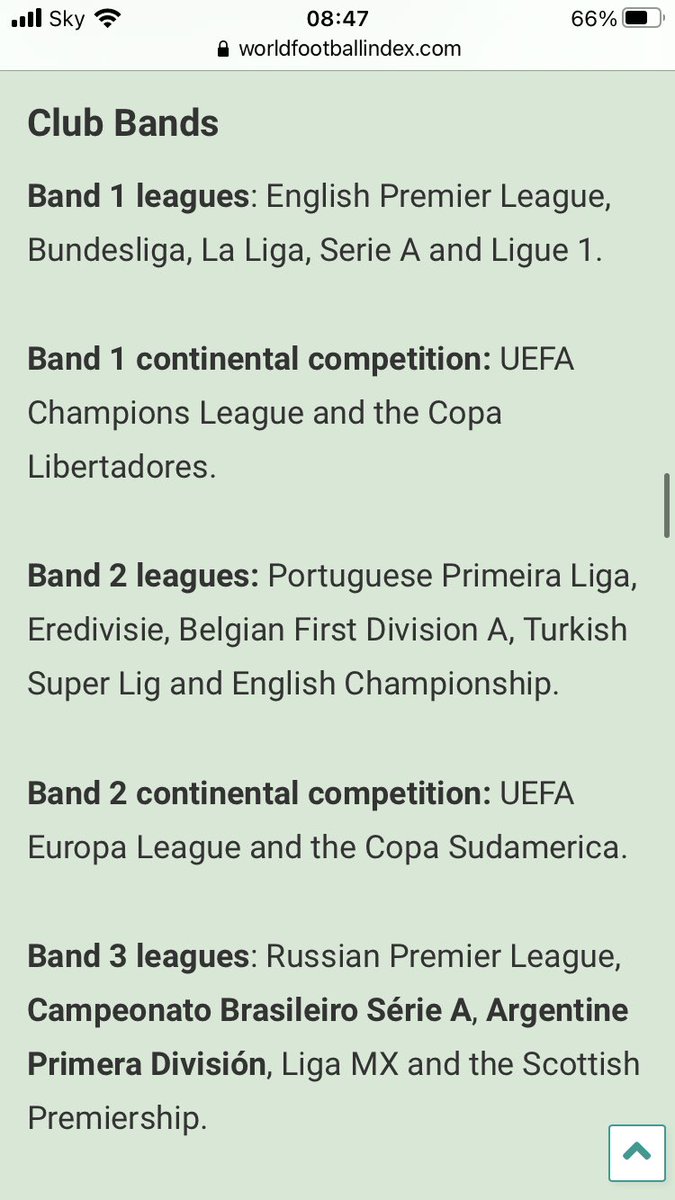
I get the point that leagues should be banded, but there doesn’t seem to have been loads of sense applied to how these things are actually banded, rather they’ve just shoved a bunch of leagues together and hoped for the best.
1) Work permit calculations are based on the points formula from this site - https://t.co/sjqx8Df7Zg
As things stand, while this article deals with England, the system applies to Scotland also.
The goal is 15 points and the article shows various ways to get there. Essentially, play regularly internationally or in a top 5 league and you’re in. But read the article because it’s a bit trickier than that.
2) There are elements of this I’d dispute. For example, here’s the banding of leagues and, lower down, it’s an absolute mess - Denmark (ranked 14 in coefficient table) and Serbia (16) banded lower than Croatia (20), Greece (18) and Czechs (19)? It’s wholly random.
I get the point that leagues should be banded, but there doesn’t seem to have been loads of sense applied to how these things are actually banded, rather they’ve just shoved a bunch of leagues together and hoped for the best.