1./ Dear Funto,
Please leave my husband alone.
Depending on your personality, you think you know me. You assume you understand the situation. Gbenro has probably told you that we have a difficult marriage. He’s explained to you that I don’t understand him.
Has Gbenro told you that the money belongs to me? Did he explain to you that although he is the CEO of the company that I am in fact the owner
Why am I a suburban housewife? This is the life I have chosen. I decided early on that I want to stay at home
You wonder why I stay at home and allow Gbenro to get away with his infidelities? Why don’t I walk away? In your opinion; you know you wouldn’t stand for it. He wouldn’t dare it with you? These are your thoughts? Am I correct?
I have decided I can live with his flaw and I love him enough to ask you to leave him alone.
Gbenro like many human beings wants to eat his cake and have it. If he wanted out of this marriage, he would have left before now.
You want the suave, sophisticated Gbenro he projects to the world.
Oh; I’m sure you think he’s such a generous man. How will you give up such sweet generosity?
Yes he is; but generous with whose money? My trust fund is so tightly stitched up despite what you think,
Oh, but he’s so well-endowed & such a great lover. You don’t want to lose that. (Wry smile). Indeed he is. He is all these things& more. This and other reasons I won’t go into is why I will fight to keep him.
I love my husband and my children love their father. They know nothing about his infidelities and I would go to great lengths to keep them in the dark because we are a happy family.
More from Book









You May Also Like


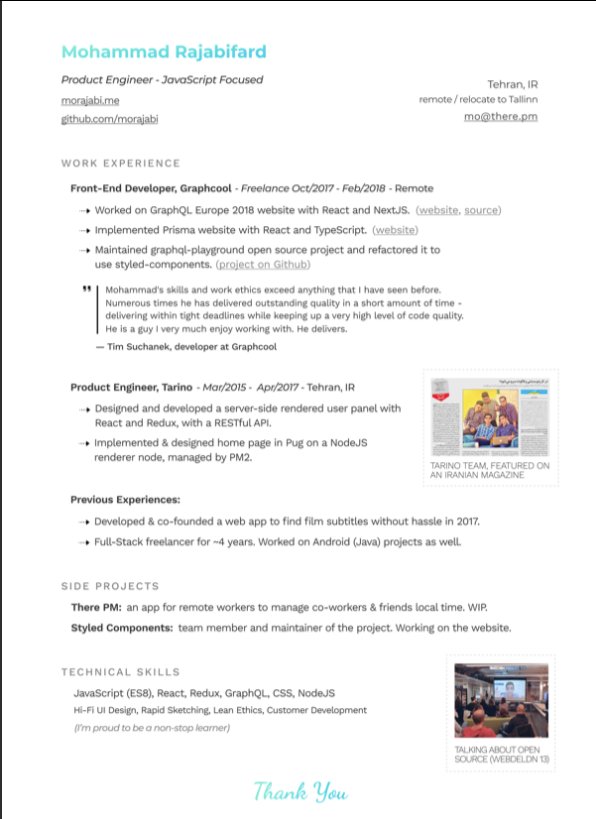
👨💻 Last resume I sent to a startup one year ago, sharing with you to get ideas:
- Forget what you don't have, make your strength bold
- Pick one work experience and explain what you did in detail w/ bullet points
- Write it towards the role you apply
- Give social proof
/thread
"But I got no work experience..."
Make a open source lib, make a small side project for yourself, do freelance work, ask friends to work with them, no friends? Find friends on Github, and Twitter.
Bonus points:
- Show you care about the company: I used the company's brand font and gradient for in the resume for my name and "Thank You" note.
- Don't list 15 things and libraries you worked with, pick the most related ones to the role you're applying.
-🙅♂️"copy cover letter"
"I got no firends, no work"
One practical way is to reach out to conferences and offer to make their website for free. But make sure to do it good. You'll get:
- a project for portfolio
- new friends
- work experience
- learnt new stuff
- new thing for Twitter bio
If you don't even have the skills yet, why not try your chance for @LambdaSchool? No? @freeCodeCamp. Still not? Pick something from here and learn https://t.co/7NPS1zbLTi
You'll feel very overwhelmed, no escape, just acknowledge it and keep pushing.
- Forget what you don't have, make your strength bold
- Pick one work experience and explain what you did in detail w/ bullet points
- Write it towards the role you apply
- Give social proof
/thread
"But I got no work experience..."
Make a open source lib, make a small side project for yourself, do freelance work, ask friends to work with them, no friends? Find friends on Github, and Twitter.
Bonus points:
- Show you care about the company: I used the company's brand font and gradient for in the resume for my name and "Thank You" note.
- Don't list 15 things and libraries you worked with, pick the most related ones to the role you're applying.
-🙅♂️"copy cover letter"
"I got no firends, no work"
One practical way is to reach out to conferences and offer to make their website for free. But make sure to do it good. You'll get:
- a project for portfolio
- new friends
- work experience
- learnt new stuff
- new thing for Twitter bio
If you don't even have the skills yet, why not try your chance for @LambdaSchool? No? @freeCodeCamp. Still not? Pick something from here and learn https://t.co/7NPS1zbLTi
You'll feel very overwhelmed, no escape, just acknowledge it and keep pushing.