
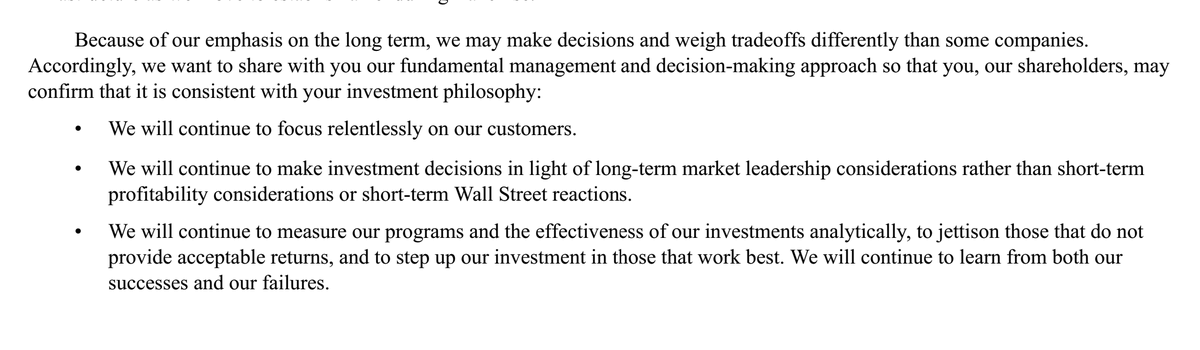
Total case study in expectation-setting by @JeffBezos.
If you want to understand how to communicate directly & candidly with employees, customers, partners, just read this...
More from Alex Lieberman ☕️




Introducing "The Balloon Effect"
Many businesses & creators have experienced a similar pattern of success.
From @MrBeastYT and @MorningBrew to @oatly and @Rovio.
Let's break down what "The Balloon Effect" is and examples of it in real life.
Keep reading 👇

1/ What is "The Balloon Effect"?
It is a particular pattern of growth.
It is not Instagram's growth trajectory.
It is not https://t.co/5axsTUKek6's growth trajectory.
"The Balloon Effect" is defined by several years of hard work & grit complemented by slow, linear growth.
2/ And then one day, one month, or one quarter...everything changes.
A business hits a tipping point and its trajectory shifts entirely.
Gradual growth turns to exponential growth & your brand and your size explode.
Like a step function.
3/ Now, you're probably wondering.
Why is it called "The Balloon Effect"?
Because filling/popping a water balloon follows the exact pattern I just described (and so many businesses experience).
Long unsexy slog 👉 Exponential tipping point.
4/ Initially, you turn on the faucet & water takes up space in the empty balloon.
Through effort you open the faucet, yet the results are unexciting.
But it's what must be done for water (or growth) to happen at all.
It's not sexy, but it's necessary.
Many businesses & creators have experienced a similar pattern of success.
From @MrBeastYT and @MorningBrew to @oatly and @Rovio.
Let's break down what "The Balloon Effect" is and examples of it in real life.
Keep reading 👇
1/ What is "The Balloon Effect"?
It is a particular pattern of growth.
It is not Instagram's growth trajectory.
It is not https://t.co/5axsTUKek6's growth trajectory.
"The Balloon Effect" is defined by several years of hard work & grit complemented by slow, linear growth.
2/ And then one day, one month, or one quarter...everything changes.
A business hits a tipping point and its trajectory shifts entirely.
Gradual growth turns to exponential growth & your brand and your size explode.
Like a step function.
3/ Now, you're probably wondering.
Why is it called "The Balloon Effect"?
Because filling/popping a water balloon follows the exact pattern I just described (and so many businesses experience).
Long unsexy slog 👉 Exponential tipping point.
4/ Initially, you turn on the faucet & water takes up space in the empty balloon.
Through effort you open the faucet, yet the results are unexciting.
But it's what must be done for water (or growth) to happen at all.
It's not sexy, but it's necessary.
Amazon Web Services (AWS) is a $54 billion behemoth.
It's bigger than Marriott, Netflix, and Twitter...combined.
Yet 99% of us don't actually understand the business.
THREAD: The story of AWS & lessons we can learn from it
AWS is electricity for the internet.
It is the largest provider of on-demand, cloud computing services in the world.
With 33% of a $150 billion global cloud market, AWS makes our digital lives possible.
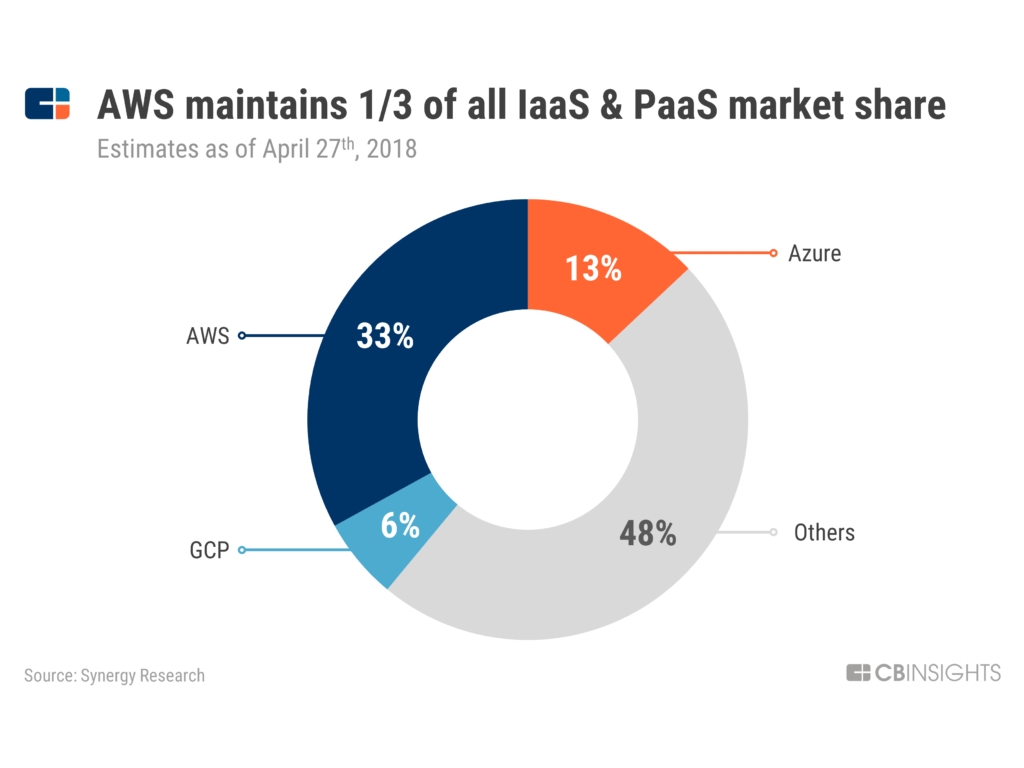
While you may not be AWS's customer, you sure as hell use it every day.
Here are some of its clients:
- Netflix
- Zoom
- Verizon Wireless
- Coinbase
- Vanguard
- https://t.co/Dqrc2Fvb9B
- Morning Brew
- GoPro
- Samsung
- Pinterest
- Snap
- FanDuel
So now, you hopefully buy why AWS important.
But how did it start?
Let's hop in our tweet thread time machine....

It's 2003.
You're Jeff Bezos & your business is growing like a weed.
1999: $1.64 billion (revenue)
2000: $2.76 billion
2001: $3.12 billion
2002: $3.93 billion
2003: $5.26 billion
But you have a serious problem...
It's bigger than Marriott, Netflix, and Twitter...combined.
Yet 99% of us don't actually understand the business.
THREAD: The story of AWS & lessons we can learn from it
AWS is electricity for the internet.
It is the largest provider of on-demand, cloud computing services in the world.
With 33% of a $150 billion global cloud market, AWS makes our digital lives possible.
While you may not be AWS's customer, you sure as hell use it every day.
Here are some of its clients:
- Netflix
- Zoom
- Verizon Wireless
- Coinbase
- Vanguard
- https://t.co/Dqrc2Fvb9B
- Morning Brew
- GoPro
- Samsung
- Snap
- FanDuel
So now, you hopefully buy why AWS important.
But how did it start?
Let's hop in our tweet thread time machine....
It's 2003.
You're Jeff Bezos & your business is growing like a weed.
1999: $1.64 billion (revenue)
2000: $2.76 billion
2001: $3.12 billion
2002: $3.93 billion
2003: $5.26 billion
But you have a serious problem...


You May Also Like

https://t.co/6cRR2B3jBE
Viruses and other pathogens are often studied as stand-alone entities, despite that, in nature, they mostly live in multispecies associations called biofilms—both externally and within the host.
https://t.co/FBfXhUrH5d

Microorganisms in biofilms are enclosed by an extracellular matrix that confers protection and improves survival. Previous studies have shown that viruses can secondarily colonize preexisting biofilms, and viral biofilms have also been described.

...we raise the perspective that CoVs can persistently infect bats due to their association with biofilm structures. This phenomenon potentially provides an optimal environment for nonpathogenic & well-adapted viruses to interact with the host, as well as for viral recombination.

Biofilms can also enhance virion viability in extracellular environments, such as on fomites and in aquatic sediments, allowing viral persistence and dissemination.

Viruses and other pathogens are often studied as stand-alone entities, despite that, in nature, they mostly live in multispecies associations called biofilms—both externally and within the host.
https://t.co/FBfXhUrH5d
Microorganisms in biofilms are enclosed by an extracellular matrix that confers protection and improves survival. Previous studies have shown that viruses can secondarily colonize preexisting biofilms, and viral biofilms have also been described.
...we raise the perspective that CoVs can persistently infect bats due to their association with biofilm structures. This phenomenon potentially provides an optimal environment for nonpathogenic & well-adapted viruses to interact with the host, as well as for viral recombination.
Biofilms can also enhance virion viability in extracellular environments, such as on fomites and in aquatic sediments, allowing viral persistence and dissemination.




I just finished Eric Adler's The Battle of the Classics, and wanted to say something about Joel Christiansen's review linked below. I am not sure what motivates the review (I speculate a bit below), but it gives a very misleading impression of the book. 1/x
The meat of the criticism is that the history Adler gives is insufficiently critical. Adler describes a few figures who had a great influence on how the modern US university was formed. It's certainly critical: it focuses on the social Darwinism of these figures. 2/x
Other insinuations and suggestions in the review seem wildly off the mark, distorted, or inappropriate-- for example, that the book is clickbaity (it is scholarly) or conservative (hardly) or connected to the events at the Capitol (give me a break). 3/x
The core question: in what sense is classics inherently racist? Classics is old. On Adler's account, it begins in ancient Rome and is revived in the Renaissance. Slavery (Christiansen's primary concern) is also very old. Let's say classics is an education for slaveowners. 4/x
It's worth remembering that literacy itself is elite throughout most of this history. Literacy is, then, also the education of slaveowners. We can honor oral and musical traditions without denying that literacy is, generally, good. 5/x
As someone\u2019s who\u2019s read the book, this review strikes me as tremendously unfair. It mostly faults Adler for not writing the book the reviewer wishes he had! https://t.co/pqpt5Ziivj
— Teresa M. Bejan (@tmbejan) January 12, 2021
The meat of the criticism is that the history Adler gives is insufficiently critical. Adler describes a few figures who had a great influence on how the modern US university was formed. It's certainly critical: it focuses on the social Darwinism of these figures. 2/x
Other insinuations and suggestions in the review seem wildly off the mark, distorted, or inappropriate-- for example, that the book is clickbaity (it is scholarly) or conservative (hardly) or connected to the events at the Capitol (give me a break). 3/x
The core question: in what sense is classics inherently racist? Classics is old. On Adler's account, it begins in ancient Rome and is revived in the Renaissance. Slavery (Christiansen's primary concern) is also very old. Let's say classics is an education for slaveowners. 4/x
It's worth remembering that literacy itself is elite throughout most of this history. Literacy is, then, also the education of slaveowners. We can honor oral and musical traditions without denying that literacy is, generally, good. 5/x

