

1/ Let's start with something controversial: the music industry is inverting.
1 / Let\u2019s start with something controversial: Money managers are a commodity.
— \u1d05\u1d00\u1d20\u026a\u1d05 \u1d18\u1d07\u0280\u1d07\u029f\u029f \u270c (@david_perell) December 5, 2017
If you wanted to hear him play, you had to listen in person. Fans had personal relationships with their favorite musicians.
For the first time, music was infinitely replicable and could last forever. Since fans didn’t have to listen to music live, they could support their favorite musicians in new ways.
Artists lacked the skills and capital required to distribute their music. They had to live in NY, LA, or Nashville, where they did favors for industry insiders and paid their dues.
Small groups of “expert” executives called the shots.
Their business models depended on mass market reach and distribution, so they financed music for people with “average” taste.
The big got bigger, but it was hard for small artists to break in.
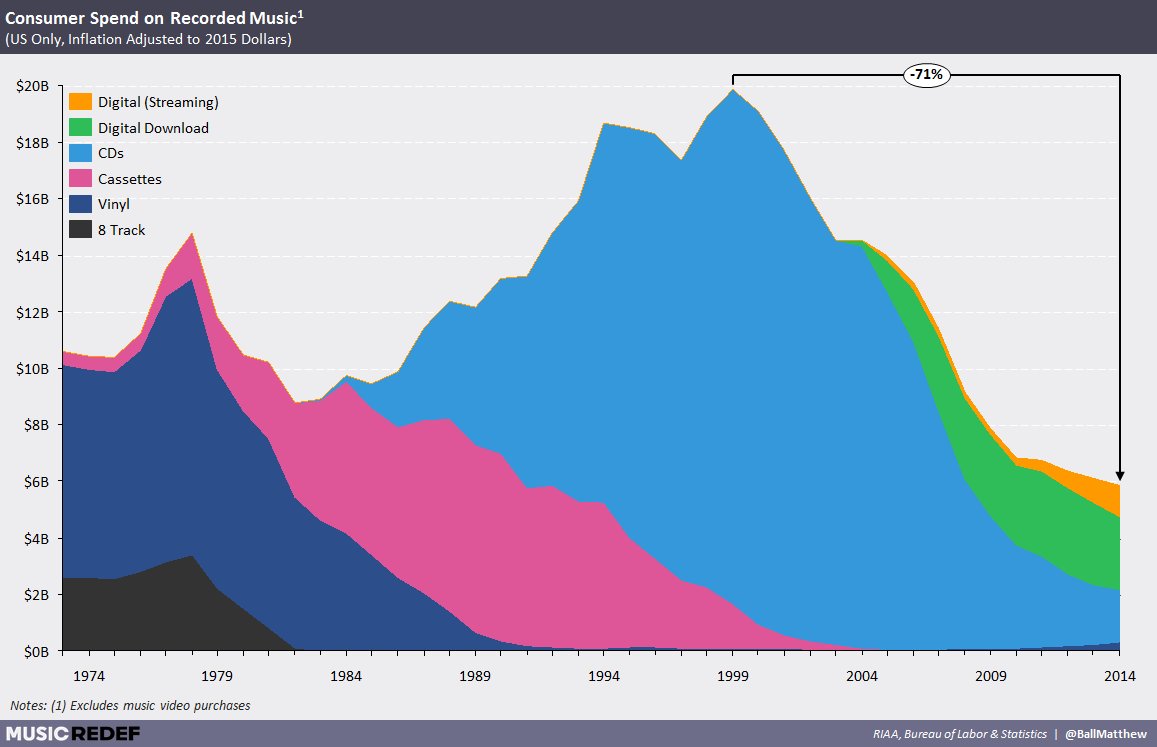
The internet changed things. Consumer spend on recorded music plummeted, falling 71% from 1999 to 2014.
He used to make Top 40 playlists and upload them to torrent sites. Then, he slipped his own track in there and people thought it was a hit.
Perception became reality when I started dancing to it at Bar Mitzvahs 😂😂

The laws of supply and demand no longer work when there’s infinite supply and replication is easy.
The music industry needs a new revenue stream.
Today, 87% of revenue now comes from concerts versus recorded music. Live music is the bedrock of artists’ income streams.
Playlists trump albums and there's a new set of rules:
1) Release music more often.
2) Focus more on singles, and less on albums.
3) Record videos to connect with fans.
1) Playlists
2) Viral videos and memes
Power has shifted from gatekeepers to the wisdom of the crowd.
Why?
Each song generated millions of social media impressions, downloads, and streams. No song left behind.

They’re brilliant community builders — they’re real, accessible, and engage fans directly.
Gangnam Style was so popular that tourism to South Korea increased more than 15% the year after it was released.

Music used to be the bottom of the funnel, but now, it’s the top of the funnel.
With brand deals, startups, and merchandise sales, artists are building a portfolio of revenue streams. People don’t just buy music — they buy the brand.
Artists are building passionate communities.
Fans have direct relationships with their favorite artists.


More from All





How can we use language supervision to learn better visual representations for robotics?
Introducing Voltron: Language-Driven Representation Learning for Robotics!
Paper: https://t.co/gIsRPtSjKz
Models: https://t.co/NOB3cpATYG
Evaluation: https://t.co/aOzQu95J8z
🧵👇(1 / 12)
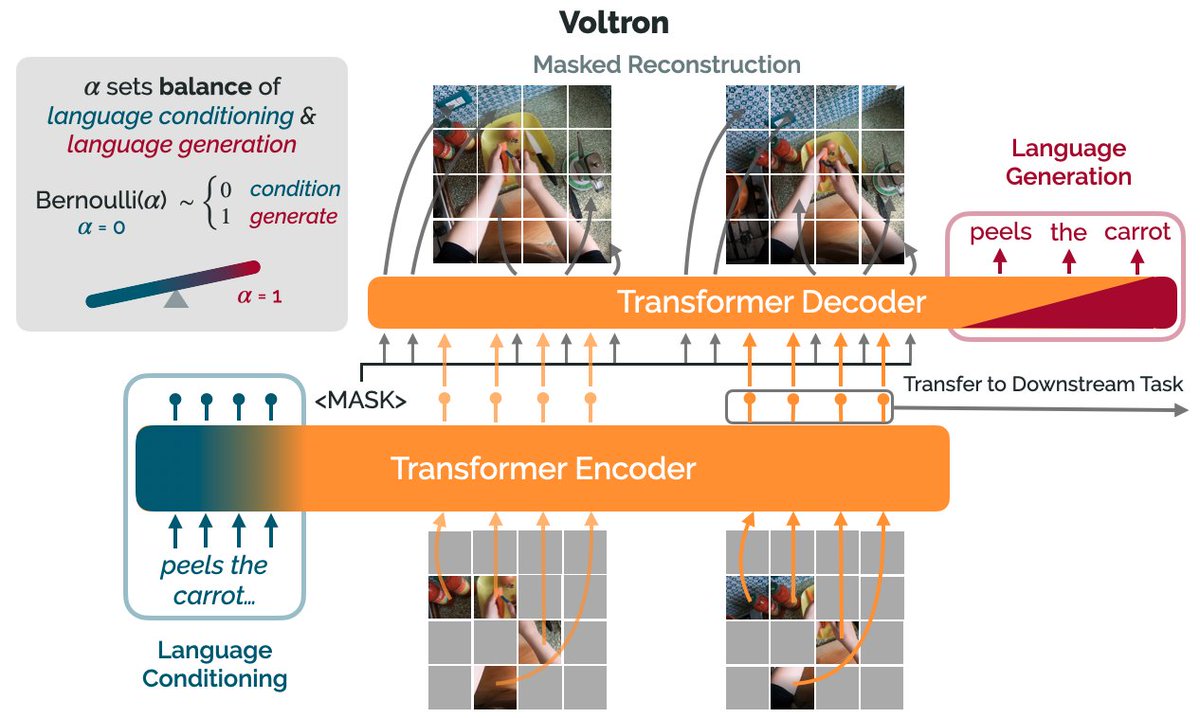
Videos of humans performing everyday tasks (Something-Something-v2, Ego4D) offer a rich and diverse resource for learning representations for robotic manipulation.
Yet, an underused part of these datasets are the rich, natural language annotations accompanying each video. (2/12)
The Voltron framework offers a simple way to use language supervision to shape representation learning, building off of prior work in representations for robotics like MVP (https://t.co/Pb0mk9hb4i) and R3M (https://t.co/o2Fkc3fP0e).
The secret is *balance* (3/12)
Starting with a masked autoencoder over frames from these video clips, make a choice:
1) Condition on language and improve our ability to reconstruct the scene.
2) Generate language given the visual representation and improve our ability to describe what's happening. (4/12)
By trading off *conditioning* and *generation* we show that we can learn 1) better representations than prior methods, and 2) explicitly shape the balance of low and high-level features captured.
Why is the ability to shape this balance important? (5/12)
Introducing Voltron: Language-Driven Representation Learning for Robotics!
Paper: https://t.co/gIsRPtSjKz
Models: https://t.co/NOB3cpATYG
Evaluation: https://t.co/aOzQu95J8z
🧵👇(1 / 12)
Videos of humans performing everyday tasks (Something-Something-v2, Ego4D) offer a rich and diverse resource for learning representations for robotic manipulation.
Yet, an underused part of these datasets are the rich, natural language annotations accompanying each video. (2/12)
The Voltron framework offers a simple way to use language supervision to shape representation learning, building off of prior work in representations for robotics like MVP (https://t.co/Pb0mk9hb4i) and R3M (https://t.co/o2Fkc3fP0e).
The secret is *balance* (3/12)
Starting with a masked autoencoder over frames from these video clips, make a choice:
1) Condition on language and improve our ability to reconstruct the scene.
2) Generate language given the visual representation and improve our ability to describe what's happening. (4/12)
By trading off *conditioning* and *generation* we show that we can learn 1) better representations than prior methods, and 2) explicitly shape the balance of low and high-level features captured.
Why is the ability to shape this balance important? (5/12)
You May Also Like


Trading view scanner process -
1 - open trading view in your browser and select stock scanner in left corner down side .
2 - touch the percentage% gain change ( and u can see higest gainer of today)
3. Then, start with 6% gainer to 20% gainer and look charts of everyone in daily Timeframe . (For fno selection u can choose 1% to 4% )
4. Then manually select the stocks which are going to give all time high BO or 52 high BO or already given.
5. U can also select those stocks which are going to give range breakout or already given range BO
6 . If in 15 min chart📊 any stock sustaing near BO zone or after BO then select it on your watchlist
7 . Now next day if any stock show momentum u can take trade in it with RM
This looks very easy & simple but,
U will amazed to see it's result if you follow proper risk management.
I did 4x my capital by trading in only momentum stocks.
I will keep sharing such learning thread 🧵 for you 🙏💞🙏
Keep learning / keep sharing 🙏
@AdityaTodmal
1 - open trading view in your browser and select stock scanner in left corner down side .
2 - touch the percentage% gain change ( and u can see higest gainer of today)
Making thread \U0001f9f5 on trading view scanner by which you can select intraday and btst stocks .
— Vikrant (@Trading0secrets) October 22, 2021
In just few hours (Without any watchlist)
Some manual efforts u have to put on it.
Soon going to share the process with u whenever it will be ready .
"How's the josh?"guys \U0001f57a\U0001f3b7\U0001f483
3. Then, start with 6% gainer to 20% gainer and look charts of everyone in daily Timeframe . (For fno selection u can choose 1% to 4% )
4. Then manually select the stocks which are going to give all time high BO or 52 high BO or already given.
5. U can also select those stocks which are going to give range breakout or already given range BO
6 . If in 15 min chart📊 any stock sustaing near BO zone or after BO then select it on your watchlist
7 . Now next day if any stock show momentum u can take trade in it with RM
This looks very easy & simple but,
U will amazed to see it's result if you follow proper risk management.
I did 4x my capital by trading in only momentum stocks.
I will keep sharing such learning thread 🧵 for you 🙏💞🙏
Keep learning / keep sharing 🙏
@AdityaTodmal


