Imagine for a moment the most obscurantist, jargon-filled, po-mo article the politically correct academy might produce. Pure SJW nonsense. Got it? Chances are you're imagining something like the infamous "Feminist Glaciology" article from a few years back.
https://t.co/NRaWNREBvR
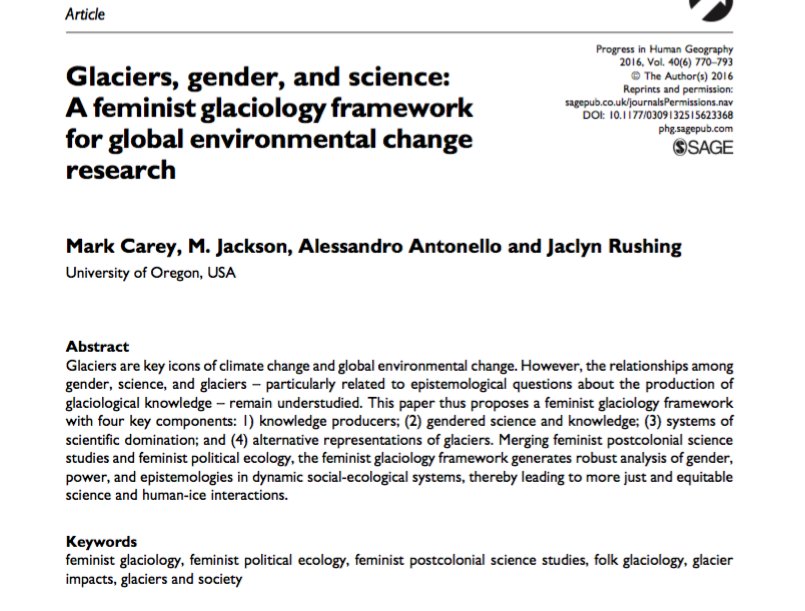
I'm dredging this article up now because for many people, it is the ne plus ultra of bad humanities writing, the archetypal example of "Grievance Studies" scholarship that adds nothing of value to human knowledge, and in fact may actively detract from it.

They're wrong.
Warning: This thread is going to be long and extremely insider baseball. You may want to mute. However, @Inframethod asked me to do this some time ago, so here we go.
First, some contemporary coverage:

"In the you-can’t-make-this-stuff-up pile today comes word of an academic paper that ponders the notion of gender as it relates to … blocks of ice." ~ The College Fix

"Academic gibberish" ~ Powerline

"A new low in climate 'science'" ~ NYPost
And here's how Robby Soave concluded his analysis over at Reason. Grim stuff!

https://t.co/rhhKpzBO7O
I have two goals here: 1) To persuade you that the piece, while far from flawless and certainly not my personal cup of tea, does have real merit; and 2) To show that many people criticized the paper for doing precisely what, in other contexts, they are eager for scholars to do.
OK, so what does "feminist glaciology" actually claim? In short, that the academic study of glaciers has been and continues to be dominated by men, and that this dominance shapes the research questions, methods, policy proposals, and public reception of glaciologists.
This is not an unreasonable set of claims. Indeed, any conservative who has ever complained about how the academy's leftwing bias distorts research agendas or undermines public trust in the academy should sympathize with this point enormously.
The first third explains why glaciology was historically dominated by men: 1) It emerged out of mountaineering and polar exploration, which women were excluded from pursuing; and 2) It required long excursions and seclusion, where women were/are judged to be a sexual distraction.
The next third explores the consequences of this gender imbalance for glaciology: 1) The public associates authority on glaciers with masculinity, such that glaciologists must present themselves as "adventurers" in order to be taken seriously on issues like, say, climate change.
This has had real costs for glaciology. In one case, the field adopted a mistaken theory of glacial flow because its proponent was a "man's man" who had accomplished many heroic mountain ascents, whereas the proponent of the correct view was not.
2) Women face major obstacles breaking into the field, in part because they do not comport to this "adventuring" image. Considering how much glaciology takes place in the lab, this amounts to a significant distortion of reality.
3) Scholarship on the social impact of glaciers often ignores the place of women. E.g. how women in the Andes are disproportionately likely to engage in agriculture or grazing around glaciers, and therefore their livelihoods are especially vulnerable to ice melt.
In other words, if you are interested in any of the following questions...

a) Why is a particular scientific field dominated by men?
b) How does this affect public perceptions of that field?
c) How does it shape policy choices?

...then there's something here for you.
The last third of the paper proposes solutions and alternatives to the masculinity of glaciology. This is the section that attracted the most ridicule, as it emphasizes the importance of women's and postcolonial knowledge that many critics dismiss as useless.
And to be fair, the jargon here is especially thick. But the core point is more reasonable than you might think. Essentially, the claim is that when we think about glaciology, we should not *only* think about scientific knowledge, but also artistic, religious, or folk knowledge.
Don't snicker! Studying this sort of knowledge can tell us something important about what glaciers mean to the people who live on and around them, or the ways that they affect nearby communities. If you're a policymaker, this is knowledge you should care about!
What can we say about the article in general? Well, it doesn't break any new empirical ground, but rather synthesizes the work of others and organizes them together around the concept of gender. The article is quite clear about this at the outset.
It is also not an *act* of glaciology per se, but rather a study of how glaciology is pursued. Again, the article is quite explicit about this. The lead author, Mark Carey, is an environmental and scientific historian, not a scientist himself.

https://t.co/1Sr63qTB2w
But none of this should be held against the paper or the broader mode of inquiry it represents. On the contrary, this is a good example of scholars doing the kind of work that many critics of the academy claim to desperately want. That is to say:
An interdisciplinary work that draws connections between multiple fields in order to establish a broad theoretical framework. If you've ever rolled your eyes at yet another incredibly narrow and specialized book or article, this is probably what you're after.
And judging from the popularity of books like these, there's a real hunger among the public for scholarship that presents the historical, political, economic, literary, artistic, AND YES gendered and racial story of material things.
Some contemporary coverage:

"Kurlansky finds the world in a grain of salt." ~ NYTimes, on "Salt"

“One of the 25 Best Books of the Year.” ~ The New York Public Library, on "Cod"

“Required reading.” ~ NYPost, on "Banana"
No, "Glaciers, gender, and science" is not going to become a runaway bestseller anytime soon, but so what? It wasn't meant to. It does its own thing for its own audience, and it does it relatively well. There's value there, for those charitable enough to give it a fair chance.

More from All

APIs in general are so powerful.

Best 5 public APIs you can use to build your next project:

1. Number Verification API

A RESTful JSON API for national and international phone number validation.

🔗
https://t.co/fzBmCMFdIj


2. OpenAI API

ChatGPT is an outstanding tool. Build your own API applications with OpenAI API.

🔗 https://t.co/TVnTciMpML


3. Currency Data API

Currency Data API provides a simple REST API with real-time and historical exchange rates for 168 world currencies

🔗 https://t.co/TRj35IUUec


4. Weather API

Real-Time & historical world weather data API.

Retrieve instant, accurate weather information for
any location in the world in lightweight JSON format.

🔗 https://t.co/DCY8kXqVIK

You May Also Like

A brief analysis and comparison of the CSS for Twitter's PWA vs Twitter's legacy desktop website. The difference is dramatic and I'll touch on some reasons why.

Legacy site *downloads* ~630 KB CSS per theme and writing direction.

6,769 rules
9,252 selectors
16.7k declarations
3,370 unique declarations
44 media queries
36 unique colors
50 unique background colors
46 unique font sizes
39 unique z-indices

https://t.co/qyl4Bt1i5x


PWA *incrementally generates* ~30 KB CSS that handles all themes and writing directions.

735 rules
740 selectors
757 declarations
730 unique declarations
0 media queries
11 unique colors
32 unique background colors
15 unique font sizes
7 unique z-indices

https://t.co/w7oNG5KUkJ


The legacy site's CSS is what happens when hundreds of people directly write CSS over many years. Specificity wars, redundancy, a house of cards that can't be fixed. The result is extremely inefficient and error-prone styling that punishes users and developers.

The PWA's CSS is generated on-demand by a JS framework that manages styles and outputs "atomic CSS". The framework can enforce strict constraints and perform optimisations, which is why the CSS is so much smaller and safer. Style conflicts and unbounded CSS growth are avoided.