Blitzscaling your company isn’t easy; if it were, everyone would do it. Like most things of value in this world, blitzscaling is contrarian and unique.
Traditional business strives for order and regularity in management, operations, and financial results. But when you're blitzscaling, the focus on order needs to be replaced with a willingness to embrace a level of chaos that would horrify most MBAs.
You need managers and executives who are “just right” for the current phase of growth. After all, you won’t have to worry about that next phase if your team can’t actually get you there.
When your org is growing 300% per year, you might have to promote people before they’re ready, and then swap them out if they sink rather than swim. You don’t have time to wait for things to “work out”. You have to act quickly and decisively.
Between (A) getting to market quickly with an imperfect product or (B) getting to market slowly with a “perfect” product, choose (A) nearly every time. Getting to market fast allows you to start getting the feedback to improve it.
One of the ways that blitzscaling entrepreneurs can stay alive is by deciding to let certain fires burn so they can focus on the fires that, if allowed to rage unchecked, really will destroy the company.
A hack that takes a tenth of the time may be more useful than an elegantly engineered solution, even if it has to be thrown away later.
The fundamental rule of customer service has long been “The customer is always right.” But for many blitzscalers, the key rule is “Provide whatever customer service you can as long as it doesn’t slow you down... and that may mean no service!”
“Excess” cash allows you to better account for the unforeseeable—and the only thing that’s foreseeable about blitzscaling is that you will at some point encounter the unforeseeable.
While the personalities of the founding team play a critical role in defining an organization’s culture, it is more accurate to say that an organization’s culture emerges over time based on the actions of many people, not just the founders.
More from All













1. Mini Thread on Conflicts of Interest involving the authors of the Nature Toilet Paper:
https://t.co/VUYbsKGncx
Kristian G. Andersen
Andrew Rambaut
Ian Lipkin
Edward C. Holmes
Robert F. Garry
2. Thanks to @newboxer007 for forwarding the link to the research by an Australian in Taiwan (not on
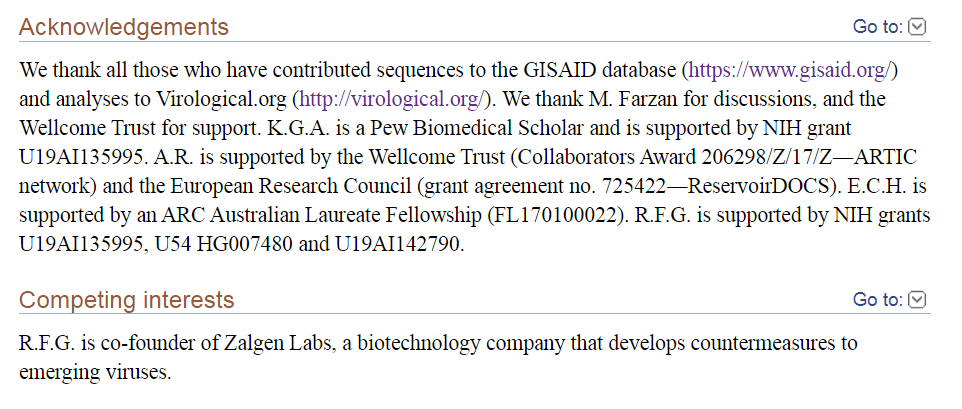
3. K.Andersen didn't mention "competing interests"
Only Garry listed Zalgen Labs, which we will look at later.
In acknowledgements, Michael Farzan, Wellcome Trust, NIH, ERC & ARC are mentioned.
Author affiliations listed as usual.
Note the 328 Citations!
https://t.co/nmOeohM89Q
4. Kristian Andersen (1)
Andersen worked with USAMRIID & Fort Detrick scientists on research, with Robert Garry, Jens Kuhn & Sina Bavari among
5. Kristian Andersen (2)
Works at Scripps Research Institute, which WAS in serious financial trouble, haemorrhaging 20 million $ a year.
But just when the first virus cases were emerging, they received great news.
They issued a press release dated November 27, 2019:
https://t.co/VUYbsKGncx
Kristian G. Andersen
Andrew Rambaut
Ian Lipkin
Edward C. Holmes
Robert F. Garry
2. Thanks to @newboxer007 for forwarding the link to the research by an Australian in Taiwan (not on
3. K.Andersen didn't mention "competing interests"
Only Garry listed Zalgen Labs, which we will look at later.
In acknowledgements, Michael Farzan, Wellcome Trust, NIH, ERC & ARC are mentioned.
Author affiliations listed as usual.
Note the 328 Citations!
https://t.co/nmOeohM89Q
4. Kristian Andersen (1)
Andersen worked with USAMRIID & Fort Detrick scientists on research, with Robert Garry, Jens Kuhn & Sina Bavari among
Our Hans Kristian Andersen working with Jens H. Kuhn, Sina Bavari, Robert F. Garry, Stuart T. Nichol,Gustavo Palacios, Sheli R. Radoshitzky from USAMRIID and Fort Detrick to tell more fairy tales? Full emails listed for queries...https://t.co/kLRoQTxiGD pic.twitter.com/uHNuGraPP2
— Billy Bostickson \U0001f3f4\U0001f441&\U0001f441 \U0001f193 (@BillyBostickson) August 26, 2020
5. Kristian Andersen (2)
Works at Scripps Research Institute, which WAS in serious financial trouble, haemorrhaging 20 million $ a year.
But just when the first virus cases were emerging, they received great news.
They issued a press release dated November 27, 2019: