Option Buying Strategies (Long Volatility Strategies)
These Strategies to be followed when you expect Big moves or increase in Volatility.

A Thread🧵:

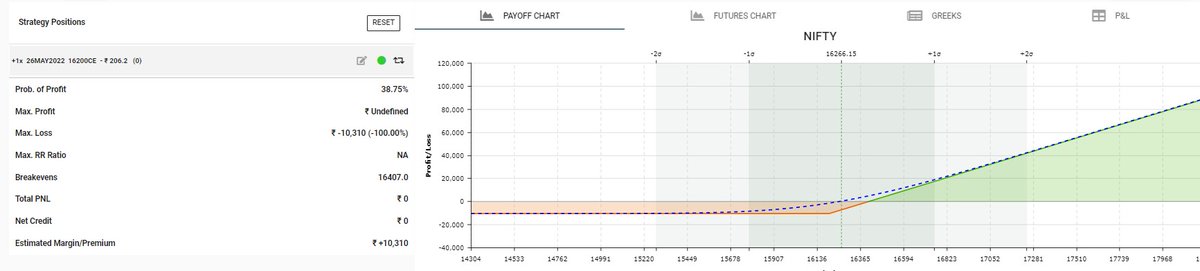
Simple Long Call:

View: Very Bullish
Strike: Can be ATM, ITM or max 1 Strike OTM.
I don't recommend buying deep OTM options, it is pure gambling or Lottery buying.
Reward: Unlimited upside
Risk: Premium paid
POP: Low
Simple Long Put:

View: Very Bearish
Strike: Can be ATM, ITM or max 1 Strike OTM.
I don't recommend buying deep OTM options, it is pure gambling or Lottery buying.
Reward: Unlimited downside
Risk: Premium paid
POP: Low
Simple Long Call:

View: Very Bullish
Strike: Can be ATM, ITM or max 1 Strike OTM.
I don't recommend buying deep OTM options, it is pure gambling or Lottery buying.
Reward: Unlimited
Risk: Premium paid
POP: Low
Call Debit Spread:

View: Bullish
Strike: Should be selected such that max profit is at least 2x of max risk
Reward: Limited
Risk: Limited to the net premium paid
POP: higher than pure call buy
Margin: approx 18k per lot required
Put Debit Spread
View: Bearish
Strike: Should be selected such that max profit is at least 2x of max risk
Reward: Limited
Risk: Limited to the net premium paid
POP: higher than pure Put buy
Margin: approx 18k per lot required
Long Straddle:
View: Big move in either direction
When to make: When market is rangebound for long time and big move is expected or an event is upcoming
Reward: Unlimited
Risk: Limited to the net premium paid (high)
POP: high
Long Strangle:
View: Big move in either direction
When to make: When market is rangebound for long time and big move is expected or an event is upcoming
Reward: Unlimited
Risk: Limited to the net premium paid (Lower than Straddle)
POP: Lower than Straddle
Long Guts:
Similar to Strangle but buying ITM options
View: Big move in either direction
When to make: When market is rangebound for long time and big move is expected or an event is upcoming
Rwrd: Unlmtd
Risk: Lmtd to the net premium paid (< Straddle)
POP:
Strip:
Buy 2 lots of ATM Put and Buy 1 lot of ATM Call
View: Big move in either direction (Bearish Bias)
When to make: When market is rangebound for long time and big move is expected or an event is upcoming
Reward: Unlimited
Risk: Lmtd to the net premium paid (high)
POP: high
Strap:
Buy 2 lots of ATM Calls & Buy 1 lot of ATM Put
View: Big move in either direction (Bullish Bias)
When to make: When market is rangebound for long time and big move is expected or an event is upcoming
Reward: Unlimited
Risk: Lmtd to the net premium paid (high)
POP: high
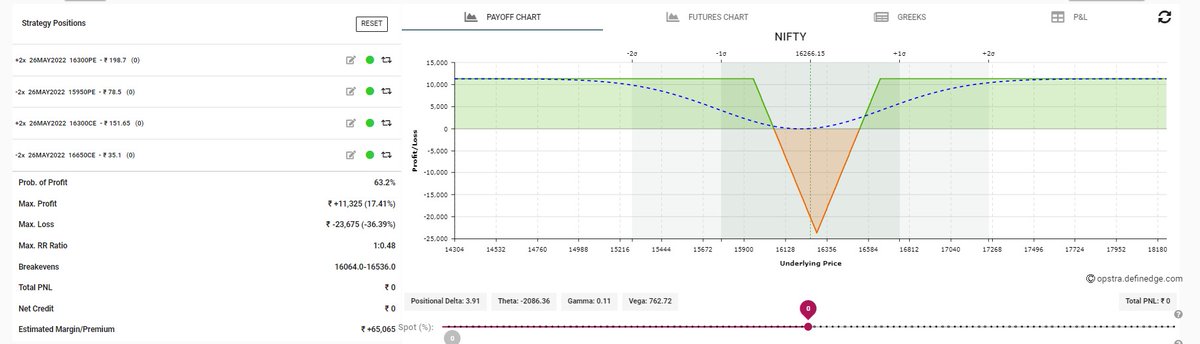
Long Iron Fly

View: Move expected in either direction
When to make: When market is rangebound for long time & move is expected or an event is upcoming
Reward: Limited
Risk: Limited
POP: Very High
Long Call ButterFly (Same as Long ironfly but made only from Calls)
But sometimes better rewards
View: Move expected in either direction
When to make: When market is rangebound for long time & move is expected or an event is upcoming
Reward: Limited
Risk: Limited
POP: Very High
Long Put ButterFly (Same as Long ironfly but made only from Puts)
But sometimes better rewards
View: Move expected in either direction
When to make: When market is rangebound for long time & move is expected or an event is upcoming
Reward: Limited
Risk: Limited
POP: Very High
Long Iron Condor
View:, Big Move expected in either direction
When to make: When market is rangebound for long time & Big move is expected or an event is upcoming
Reward: Bigger
Risk: < IronFly
POP:
(also have Similar results for Long Call Condor & Long Put Condor)
Bullish Long Call Ratio Spread
Short ATM Call & Buy 2 OTM Calls less than half price of ATM Call
View: Bullish
When to make: When market is rangebound for long time & move is expected upside
Reward: Unlmtd upside & Limited downside
Risk: Lmtd if market is rangeboud
POP: Very High
Bearish Long Put Ratio Spread
Short ATM Put & Buy 2 OTM Put less than half price of ATM Put
View: Bearish
When to make: When market is rangebound for long time & move is expected upside
Reward: Unlmtd downside & Limited upside
Risk: Lmtd if market is rangeboud
POP: Very High
Strangled Strip
Buy 2lots of OTM Put & Buy 1lot of OTM Call
View: Big move in either direction (Bearish Bias)
When to make: When market is rangebound for long time and big move is expected or an event is upcoming
Reward: Unlimited
Risk: Lmtd to the net premium paid (low)
POP: low
Strangled Strap
Buy 2lots of OTM Call & Buy 1lot of OTM Put
View: Big move in either direction (Bullish Bias)
When to make: When market is rangebound for long time and big move is expected or an event is upcoming
Reward: Unlimited
Risk: Lmtd to the net premium paid (low)
POP: low

More from All

https://t.co/6cRR2B3jBE
Viruses and other pathogens are often studied as stand-alone entities, despite that, in nature, they mostly live in multispecies associations called biofilms—both externally and within the host.

https://t.co/FBfXhUrH5d


Microorganisms in biofilms are enclosed by an extracellular matrix that confers protection and improves survival. Previous studies have shown that viruses can secondarily colonize preexisting biofilms, and viral biofilms have also been described.


...we raise the perspective that CoVs can persistently infect bats due to their association with biofilm structures. This phenomenon potentially provides an optimal environment for nonpathogenic & well-adapted viruses to interact with the host, as well as for viral recombination.


Biofilms can also enhance virion viability in extracellular environments, such as on fomites and in aquatic sediments, allowing viral persistence and dissemination.

You May Also Like

1/“What would need to be true for you to….X”

Why is this the most powerful question you can ask when attempting to reach an agreement with another human being or organization?

A thread, co-written by @deanmbrody:


2/ First, “X” could be lots of things. Examples: What would need to be true for you to

- “Feel it's in our best interest for me to be CMO"
- “Feel that we’re in a good place as a company”
- “Feel that we’re on the same page”
- “Feel that we both got what we wanted from this deal

3/ Normally, we aren’t that direct. Example from startup/VC land:

Founders leave VC meetings thinking that every VC will invest, but they rarely do.

Worse over, the founders don’t know what they need to do in order to be fundable.

4/ So why should you ask the magic Q?

To get clarity.

You want to know where you stand, and what it takes to get what you want in a way that also gets them what they want.

It also holds them (mentally) accountable once the thing they need becomes true.

5/ Staying in the context of soliciting investors, the question is “what would need to be true for you to want to invest (or partner with us on this journey, etc)?”

Multiple responses to this question are likely to deliver a positive result.
Great article from @AsheSchow. I lived thru the 'Satanic Panic' of the 1980's/early 1990's asking myself "Has eveyrbody lost their GODDAMN MINDS?!"


The 3 big things that made the 1980's/early 1990's surreal for me.

1) Satanic Panic - satanism in the day cares ahhhh!

2) "Repressed memory" syndrome

3) Facilitated Communication [FC]

All 3 led to massive abuse.

"Therapists" -and I use the term to describe these quacks loosely - would hypnotize people & convince they they were 'reliving' past memories of Mom & Dad killing babies in Satanic rituals in the basement while they were growing up.

Other 'therapists' would badger kids until they invented stories about watching alligators eat babies dropped into a lake from a hot air balloon. Kids would deny anything happened for hours until the therapist 'broke through' and 'found' the 'truth'.

FC was a movement that started with the claim severely handicapped individuals were able to 'type' legible sentences & communicate if a 'helper' guided their hands over a keyboard.
1/ Some initial thoughts on personal moats:

Like company moats, your personal moat should be a competitive advantage that is not only durable—it should also compound over time.

Characteristics of a personal moat below:


2/ Like a company moat, you want to build career capital while you sleep.

As Andrew Chen noted:


3/ You don’t want to build a competitive advantage that is fleeting or that will get commoditized

Things that might get commoditized over time (some longer than


4/ Before the arrival of recorded music, what used to be scarce was the actual music itself — required an in-person artist.

After recorded music, the music itself became abundant and what became scarce was curation, distribution, and self space.

5/ Similarly, in careers, what used to be (more) scarce were things like ideas, money, and exclusive relationships.

In the internet economy, what has become scarce are things like specific knowledge, rare & valuable skills, and great reputations.