Thread on @AnthropicAI's cool new paper on how large models are both predictable (scaling laws) and surprising (capability jumps).
1. That there’s a capability jump in 3-digit addition for GPT3 (left) is unsurprising. Good challenge to better predict when such jump will occur.
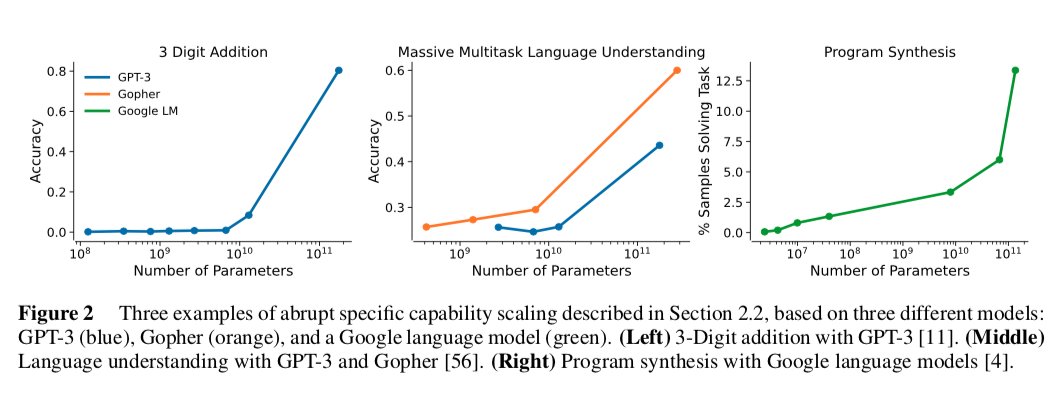
2. The MMLU capability jump (center) is very different b/c it’s many diverse knowledge questions with no simple algorithm like addition.
This jump is surprising and I’d like to understand better why it happens at all.
3. Program Synthesis jump (right) feels like it should be in between 1 and 2. Less diversity than 2 and we can also imagine models grokking certain concepts in programming leading to a jump.
I’d love to see more work on this topic of predictability and surprise and how they relate to forecasting alignment/risk.
Related work:
1. @gwern's list of capability jumps and classic article on scaling
https://t.co/C8qljJa13A
https://t.co/er791mhbjP
2. @JacobSteinhardt's insightful blog series. https://t.co/0ckLgOgBiV
3. Lukas Finnveden's post on GPT-n extrapolation /scaling on different task shttps://www.lesswrong.com/posts/k2SNji3jXaLGhBeYP/extrapolating-gpt-n-performance

More from All

You May Also Like

1/“What would need to be true for you to….X”

Why is this the most powerful question you can ask when attempting to reach an agreement with another human being or organization?

A thread, co-written by @deanmbrody:


2/ First, “X” could be lots of things. Examples: What would need to be true for you to

- “Feel it's in our best interest for me to be CMO"
- “Feel that we’re in a good place as a company”
- “Feel that we’re on the same page”
- “Feel that we both got what we wanted from this deal

3/ Normally, we aren’t that direct. Example from startup/VC land:

Founders leave VC meetings thinking that every VC will invest, but they rarely do.

Worse over, the founders don’t know what they need to do in order to be fundable.

4/ So why should you ask the magic Q?

To get clarity.

You want to know where you stand, and what it takes to get what you want in a way that also gets them what they want.

It also holds them (mentally) accountable once the thing they need becomes true.

5/ Staying in the context of soliciting investors, the question is “what would need to be true for you to want to invest (or partner with us on this journey, etc)?”

Multiple responses to this question are likely to deliver a positive result.