
A Long thread begins, but it is worth it.
Revenge of the Nagavanshis and the 5 Kings
(A tale unknown to many in Southern India)
Long long ago, during the 7th century a prosperous kingdom was attacked and ruthlessly plundered by a warring horde of invaders from the West. (1/n)
His family was humiliated! You know what I mean! The menfolk and children of the kingdom were killed and the women trafficked to be sold as sex slaves. (5/n)
How? Let me tell you.. (6/n)
The Buddhist kingdoms were vulnerable to defeat because of their reclusive faith and peace-loving soldiers who wouldn’t fight the enemy. (11/n)
Now, the holy man conveys to his chosen Kings that the time is ripe. A grand alliance is formed to repulse and avenge the atrocities committed by those invaders sitting in Sindh. (15/n)
Now where is Khorasan? (16/n)
And after this humiliating defeat the invaders never dared to cast an evil eye at Bharat for more than 350 years. (17/n)
The King who gained martyrdom at the hands of Mohd bin Qasim’s Ummayad Caliphate army was none other Raja Dahir Sen of Sindh, which is now in Pakistan.
(18/n)
1) Bappa Rawal of Mewar Guhilot-Rajput Dynasty
2) Nagabhatt II of Gurjara Pratihara Dynasty whose soldier Takshak commanded a guerilla battalion of night raiders. Takshak is rumoured to be the refugee son of Raja Dahir’s brave general. (19/n)
4) Lalitaditya Muktapida of Karkota Dynasty of Kashmir
5) Yashovarman of Varman Dynasty
And the holy Brahman was none other than Jagadguru Adi Shankaracharya (20/n)
Satyameva Jayate!
Truth Alone Triumphs! That’s what it means isn’t it?
How many of us knew these Truths, this part of our history from 7th century to 1st millenia?
Many of us did not know, Am I right?
(24/n)
OR that Nairs of Travancore under Maharaja Martanda Varma were the first Asian kingdom to defeat a major European colonial power – The Dutch?
OR ... (25/n)
More from All










How can we use language supervision to learn better visual representations for robotics?
Introducing Voltron: Language-Driven Representation Learning for Robotics!
Paper: https://t.co/gIsRPtSjKz
Models: https://t.co/NOB3cpATYG
Evaluation: https://t.co/aOzQu95J8z
🧵👇(1 / 12)
Videos of humans performing everyday tasks (Something-Something-v2, Ego4D) offer a rich and diverse resource for learning representations for robotic manipulation.
Yet, an underused part of these datasets are the rich, natural language annotations accompanying each video. (2/12)
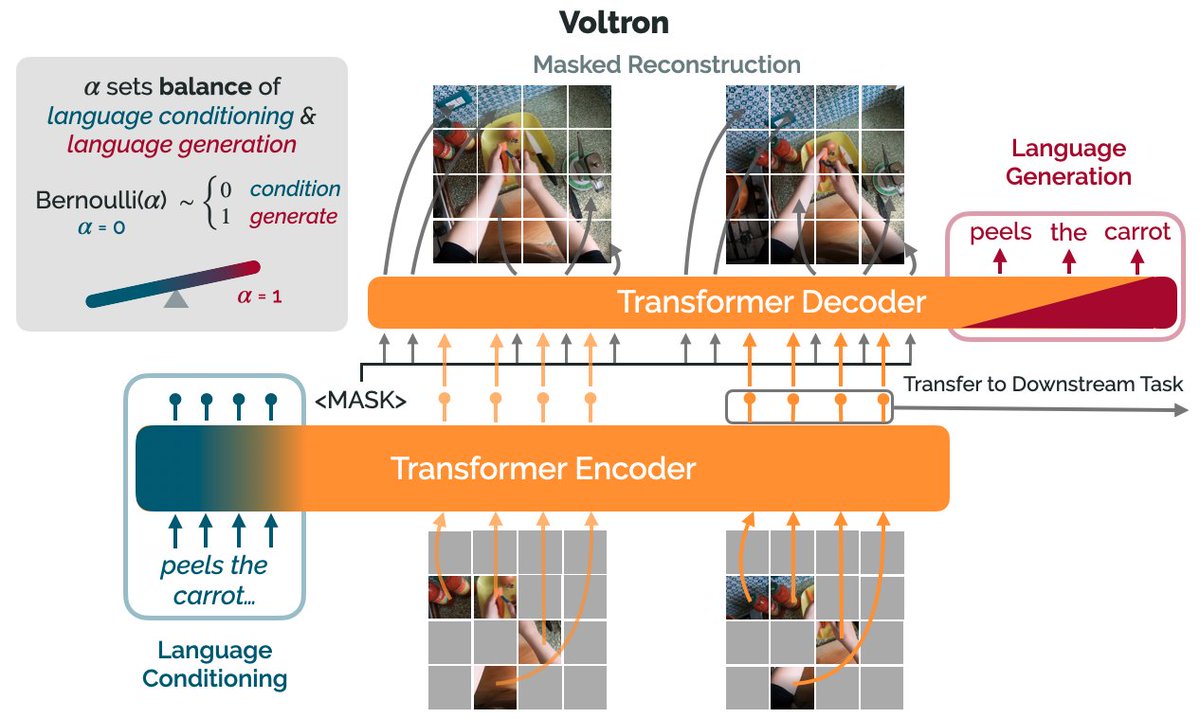
The Voltron framework offers a simple way to use language supervision to shape representation learning, building off of prior work in representations for robotics like MVP (https://t.co/Pb0mk9hb4i) and R3M (https://t.co/o2Fkc3fP0e).
The secret is *balance* (3/12)
Starting with a masked autoencoder over frames from these video clips, make a choice:
1) Condition on language and improve our ability to reconstruct the scene.
2) Generate language given the visual representation and improve our ability to describe what's happening. (4/12)
By trading off *conditioning* and *generation* we show that we can learn 1) better representations than prior methods, and 2) explicitly shape the balance of low and high-level features captured.
Why is the ability to shape this balance important? (5/12)
Introducing Voltron: Language-Driven Representation Learning for Robotics!
Paper: https://t.co/gIsRPtSjKz
Models: https://t.co/NOB3cpATYG
Evaluation: https://t.co/aOzQu95J8z
🧵👇(1 / 12)
Videos of humans performing everyday tasks (Something-Something-v2, Ego4D) offer a rich and diverse resource for learning representations for robotic manipulation.
Yet, an underused part of these datasets are the rich, natural language annotations accompanying each video. (2/12)
The Voltron framework offers a simple way to use language supervision to shape representation learning, building off of prior work in representations for robotics like MVP (https://t.co/Pb0mk9hb4i) and R3M (https://t.co/o2Fkc3fP0e).
The secret is *balance* (3/12)
Starting with a masked autoencoder over frames from these video clips, make a choice:
1) Condition on language and improve our ability to reconstruct the scene.
2) Generate language given the visual representation and improve our ability to describe what's happening. (4/12)
By trading off *conditioning* and *generation* we show that we can learn 1) better representations than prior methods, and 2) explicitly shape the balance of low and high-level features captured.
Why is the ability to shape this balance important? (5/12)


