*Reproducible deep learning*
Lectures 3 and 4 are out!

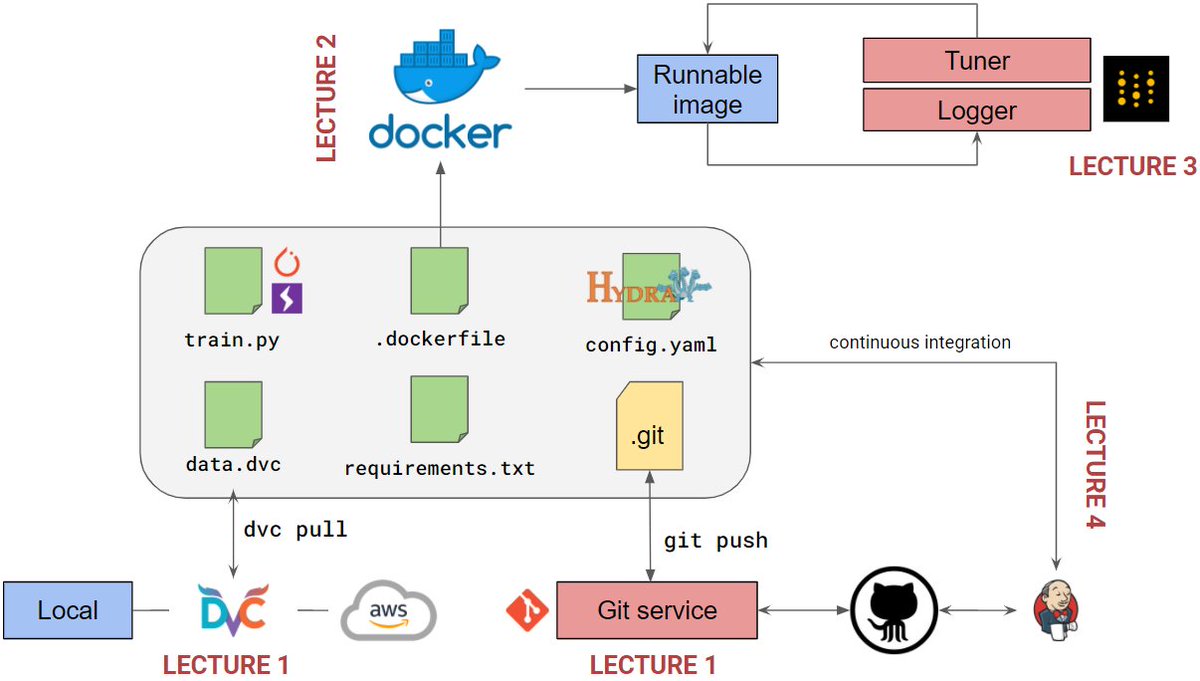
With code versioning out of the way, it is time to look at data versioning (@DVCorg) and environment isolation (@Docker).

All information in a small thread. 👇 /n

If you know Git, you (almost) know @DVCorg!

A fantastic tool to secure your data in a number of remotes, or to create "data repositories" from which to immediately get folders and artifacts.

My intro to DVC: https://t.co/2m3cXGAPN6

/n
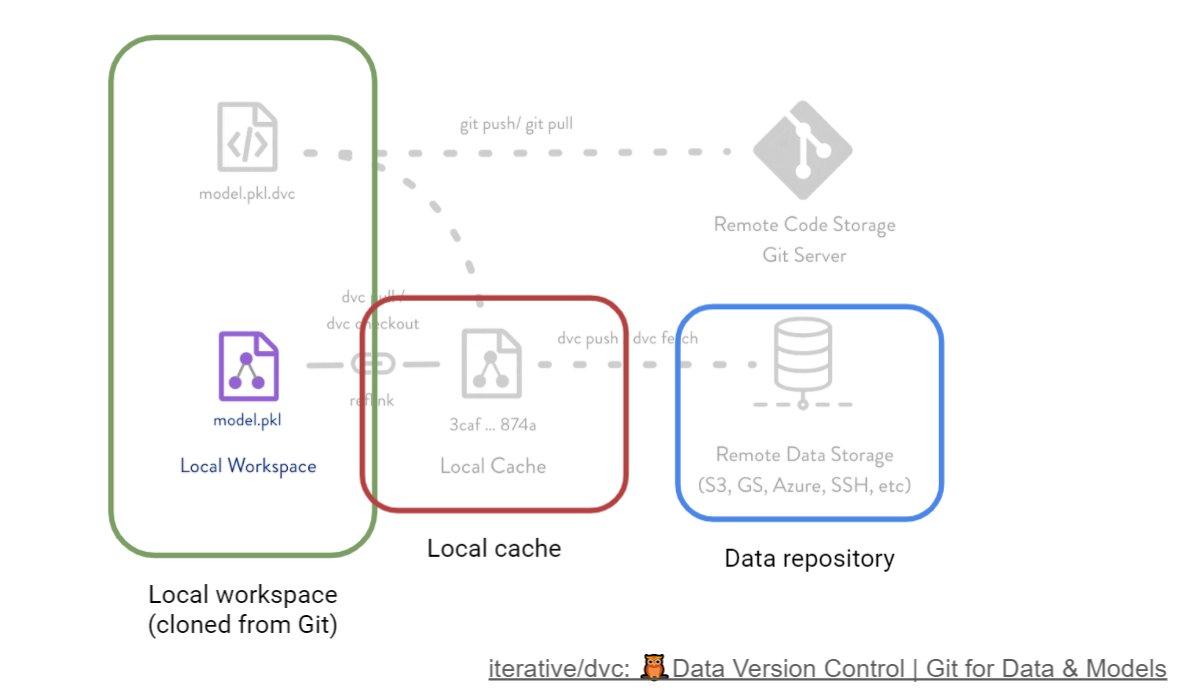
For the course, I created a simple exercise tasking you with initializing DVC on the repository, and syncing the data locally and remotely.

To simulate an S3-like interface, we use a small https://t.co/91bFj7KSPG server and boto3.

Code: https://t.co/KDSX80aqJs

/n
Next up, it is time to "dockerize" your environment!

Docker has become an almost de-facto standard, and knowing it is practically indispensable today.

A very quick introduction, glossing over a number of details: https://t.co/XSrUZNhd3g

/n
In the corresponding exercise, you will learn about creating a working environment in Docker, packaging the entire training loop, and pushing/pulling an image from the Hub.

Code is here: https://t.co/YAAN3YB4tV

/n
That's it for today!

Next week, we conclude with an overview of @weights_biases, continuous integration, Git hooks, and unit tests.

The full code (divided into branches) is here: https://t.co/zBcwOeJhRy

Credits to the fantastic documentation from both @DVCorg @Docker 🙃

More from All

You May Also Like

@EricTopol @NBA @StephenKissler @yhgrad B.1.1.7 reveals clearly that SARS-CoV-2 is reverting to its original pre-outbreak condition, i.e. adapted to transgenic hACE2 mice (either Baric's BALB/c ones or others used at WIV labs during chimeric bat coronavirus experiments aimed at developing a pan betacoronavirus vaccine)

@NBA @StephenKissler @yhgrad 1. From Day 1, SARS-COV-2 was very well adapted to humans .....and transgenic hACE2 Mice


@NBA @StephenKissler @yhgrad 2. High Probability of serial passaging in Transgenic Mice expressing hACE2 in genesis of SARS-COV-2


@NBA @StephenKissler @yhgrad B.1.1.7 has an unusually large number of genetic changes, ... found to date in mouse-adapted SARS-CoV2 and is also seen in ferret infections.
https://t.co/9Z4oJmkcKj


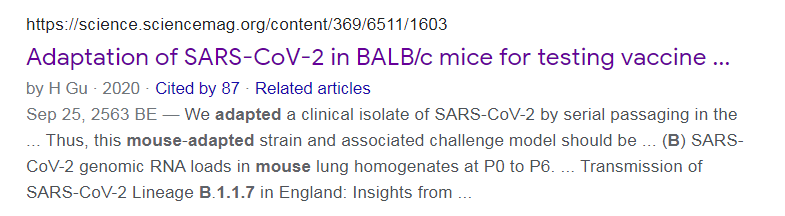
@NBA @StephenKissler @yhgrad We adapted a clinical isolate of SARS-CoV-2 by serial passaging in the ... Thus, this mouse-adapted strain and associated challenge model should be ... (B) SARS-CoV-2 genomic RNA loads in mouse lung homogenates at P0 to P6.
https://t.co/I90OOCJg7o