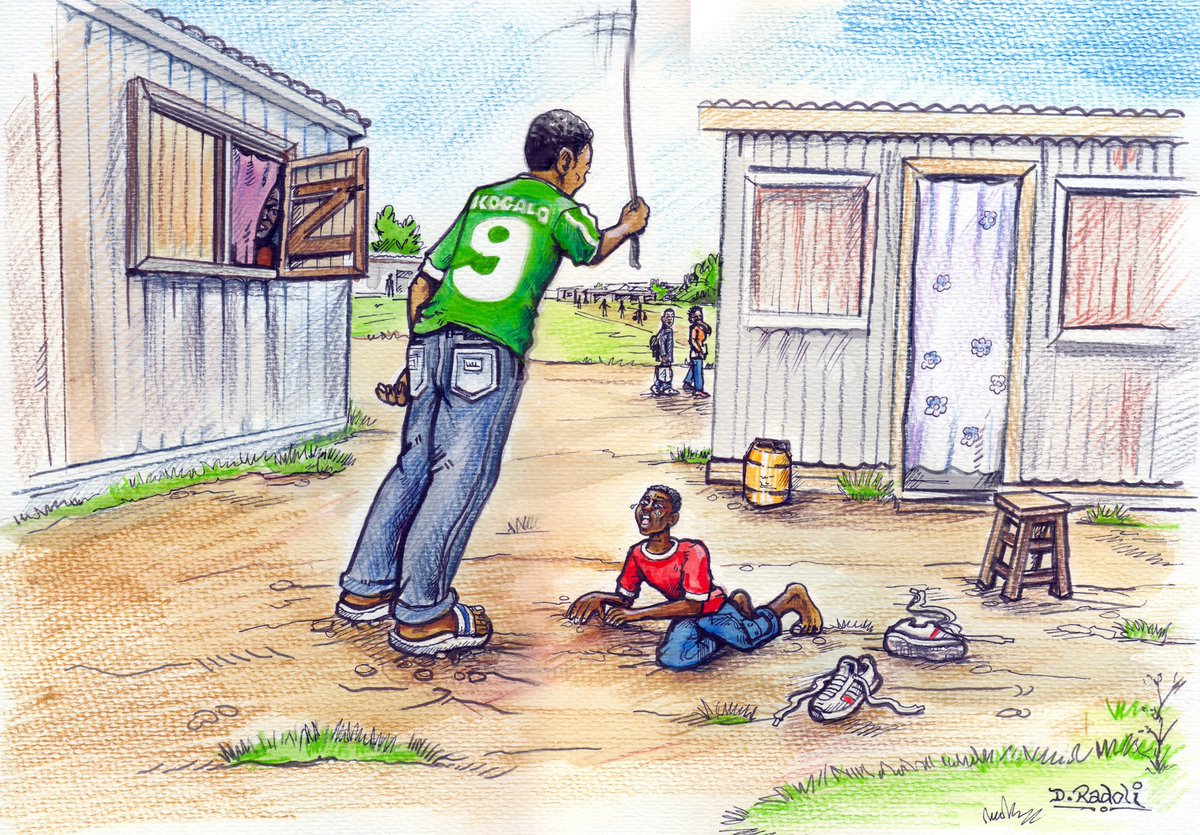
Instead of caning our kids can we start to understand the science of the #PairofACEs and begin to develop #traumainformed practices for our schools, our teachers and our children.

#traumainformedKE @GSNAfrica

2/ What does it mean to develop trauma-informed schools?

Being trauma-informed in schools means being informed about and sensitive to trauma, and providing a safe, stable, and understanding environment for students and staff.

#traumainformedKE
3/ As we have listened to Kenyans stories of childhood and schooling we have heard how the #PairofACEs is a national crisis especially in our schools.

#Traumainformed schools have become essential to successfully addressing the broadening spectrum of #ACEs globally. @GSNAfrica
4/ What could #traumainformed schools look like in Kenya?

First what if all our teachers started to see young people, not as 'bad' and 'indisciplined' kids - but start to ask "What has happened to this child?" or "What kind of life has this child had?"

#traumainformedKE
5/ Not all kids have come from a traumatic home/environment. But what if we supported all kids w social-emotional learning skills?

Promoting the #traumainformed school approaches in Kenya has the greatest potential to #positively impact all students, regardless of their traumas.
6/ Adverse experiences in the lives of Kenyan children are very common.

Trauma and toxic stress impact learning, behavior, and relationships at home, in school, and in the larger community.

Caning children will only cause more trauma not reduce it.

#traumainformedKE
7/ The impacts of trauma can be pervasive & take many forms, & the way in which a child who has experienced traumatic events presents herself may mask - rather than reveal - her difficulties.

It is not what is wrong with the child but what has happened to him.
#traumainformedKE
8/ Our Kenyan schools must address students' needs in holistic ways. Taking into account their relationships, self-regulation, academic competence, & physical & emotional wellbeing.

How can a senior public officer say publically the answer to our schooling crisis is violence?
10/The loss of a sense of safety resulting from traumatic events can cause a child to disconnect from those around her. Typically, children who have experienced traumatic events are looking to those at school to restore their feeling of security & to help reconnect them w society
9/ A #traumainformed school explicitly connects students to the school community and provides multiple opportunities to practice newly developing skills.
#traumainformedKE

More from All

॥ॐ॥
अस्य श्री गायत्री ध्यान श्लोक:
(gAyatri dhyAna shlOka)
• This shloka to meditate personified form of वेदमाता गायत्री was given by Bhagwaan Brahma to Sage yAgnavalkya (याज्ञवल्क्य).

• 14th shloka of गायत्री कवचम् which is taken from वशिष्ठ संहिता, goes as follows..


• मुक्ता-विद्रुम-हेम-नील धवलच्छायैर्मुखस्त्रीक्षणै:।
muktA vidruma hEma nIla dhavalachhAyaiH mukhaistrlkShaNaiH.

• युक्तामिन्दुकला-निबद्धमुकुटां तत्वार्थवर्णात्मिकाम्॥
yuktAmindukalA nibaddha makutAm tatvArtha varNAtmikam.

• गायत्रीं वरदाभयाङ्कुश कशां शुभ्रं कपालं गदाम्।
gAyatrIm vardAbhayANkusha kashAm shubhram kapAlam gadAm.

• शंखं चक्रमथारविन्दयुगलं हस्तैर्वहन्ती भजै॥
shankham chakramathArvinda yugalam hastairvahantIm bhajE.

This shloka describes the form of वेदमाता गायत्री.

• It says, "She has five faces which shine with the colours of a Pearl 'मुक्ता', Coral 'विद्रुम', Gold 'हेम्', Sapphire 'नील्', & a Diamond 'धवलम्'.

• These five faces are symbolic of the five primordial elements called पञ्चमहाभूत:' which makes up the entire existence.

• These are the elements of SPACE, FIRE, WIND, EARTH & WATER.

• All these five faces shine with three eyes 'त्रिक्षणै:'.
How can we use language supervision to learn better visual representations for robotics?

Introducing Voltron: Language-Driven Representation Learning for Robotics!

Paper: https://t.co/gIsRPtSjKz
Models: https://t.co/NOB3cpATYG
Evaluation: https://t.co/aOzQu95J8z

🧵👇(1 / 12)


Videos of humans performing everyday tasks (Something-Something-v2, Ego4D) offer a rich and diverse resource for learning representations for robotic manipulation.

Yet, an underused part of these datasets are the rich, natural language annotations accompanying each video. (2/12)

The Voltron framework offers a simple way to use language supervision to shape representation learning, building off of prior work in representations for robotics like MVP (
https://t.co/Pb0mk9hb4i) and R3M (https://t.co/o2Fkc3fP0e).

The secret is *balance* (3/12)

Starting with a masked autoencoder over frames from these video clips, make a choice:

1) Condition on language and improve our ability to reconstruct the scene.

2) Generate language given the visual representation and improve our ability to describe what's happening. (4/12)

By trading off *conditioning* and *generation* we show that we can learn 1) better representations than prior methods, and 2) explicitly shape the balance of low and high-level features captured.

Why is the ability to shape this balance important? (5/12)

You May Also Like