As investors, we need to qualify the companies in our portfolio.

If they don't meet our cut, we don't invest in them.

Apart from the eventual/current profitability and strong balance sheet, growth is my top requirement.

Here's why:

1/ If a business does not grow, its share price will not grow.

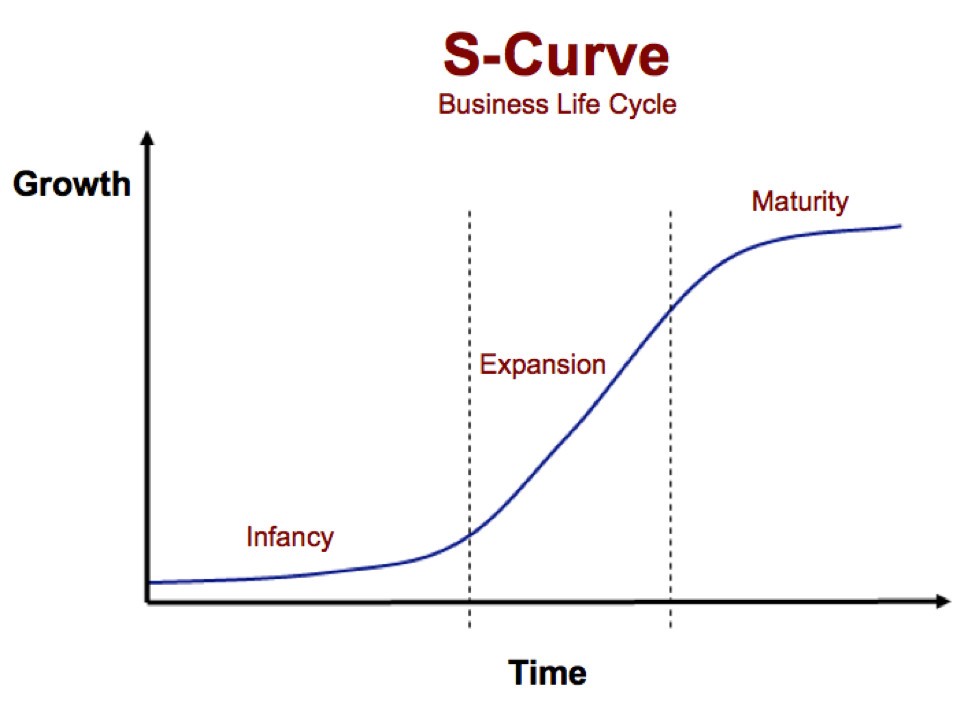
In a corporate lifecycle, a company experiences most growth during its expansion phase. That's where most returns are being created.

This is why high growth companies deliver huge returns.

source: Ravi Kumar
2/ The compounding of growth rates is often underestimated.

It can do wonders for your company.

Growing at 30% turns $1 to $13.79 by Y10.

Growing at 10% turns $1 to $2.59 by Y10.

The share price returns a company can generate based on this is significant.
3/ Here's an example: Crowdstrike $CRWD

It grew its ARR from $71 million in 1Q 2018 to $1,731 million in 4Q 2022.

The magic of compounding.
4/ Simple Back Test

I used my Capital IQ to find out what are the stocks that delivered more than 10x returns in the past 5 years and have at least a market cap of $600m USD.

There are 13 companies.

$APPS $XPEL $TSLA
4/ Simple Back Test (continued)

Apart from Ameresco and SolarEdge, others exhibited huge revenue growth.

This tells us future growth is an important ingredient for long term success.

This is echoed by Stanley Drunkmiller too.
5/ Growth stocks seem to be out of favour but have they truly underperformed?

Look at this picture.

Left: Year-til-Date
Right: 5 Yr Results
8/ Growth is the Long-Run Driver of Stock Performance

What we're experiencing now is most well-explained by this graph by Morgan Stanley.

In the short term, multiples are compressing due to interest rate hikes.

But...

In the long term, revenue growth drives returns.
That's a wrap!

If you enjoyed this thread:

1. Follow me @SlingshotCap for more of these
2. RT the tweet below to share this thread with your audience https://t.co/yRIDcwkPVJ

More from Valuation

June's research paper: Intangible Value ✨

Can value investing strategies be improved by adding intangible assets?
👾 The Asset-Light Economy
🔮 The Dark Matter of Finance
🏰 Intangible Moats
📉 The Disruption of Value
👨‍🎓 Fixing the "Value Factor"

(Not investment advice)

🧵

(0/10) Full paper here 📘

Blog
https://t.co/omtrn9kfvt


(1/10) The Asset-Light Economy 👾

“The four largest companies today by market value do not need any net tangible assets. They are not like AT&T, GM, or Exxon Mobil, requiring lots of capital to produce earnings. We have become an asset-light economy."

- Warren Buffett


(2/10) The End of Accounting 🧮

“The constant rise in the importance of intangibles in companies’ performance and value creation, yet suppressed by accounting and reporting practices, renders financial information increasingly irrelevant.”

- Baruch Lev and Feng Gu


(3/10) The Dark Matter of Finance 🔮

While intangible matter holds the financial universe together, it is not visible to the naked eye. Unstructured data contains info on intangibles but is large, noisy, and resistant to standard statistical analysis.

You May Also Like

A brief analysis and comparison of the CSS for Twitter's PWA vs Twitter's legacy desktop website. The difference is dramatic and I'll touch on some reasons why.

Legacy site *downloads* ~630 KB CSS per theme and writing direction.

6,769 rules
9,252 selectors
16.7k declarations
3,370 unique declarations
44 media queries
36 unique colors
50 unique background colors
46 unique font sizes
39 unique z-indices

https://t.co/qyl4Bt1i5x


PWA *incrementally generates* ~30 KB CSS that handles all themes and writing directions.

735 rules
740 selectors
757 declarations
730 unique declarations
0 media queries
11 unique colors
32 unique background colors
15 unique font sizes
7 unique z-indices

https://t.co/w7oNG5KUkJ


The legacy site's CSS is what happens when hundreds of people directly write CSS over many years. Specificity wars, redundancy, a house of cards that can't be fixed. The result is extremely inefficient and error-prone styling that punishes users and developers.

The PWA's CSS is generated on-demand by a JS framework that manages styles and outputs "atomic CSS". The framework can enforce strict constraints and perform optimisations, which is why the CSS is so much smaller and safer. Style conflicts and unbounded CSS growth are avoided.
This is NONSENSE. The people who take photos with their books on instagram are known to be voracious readers who graciously take time to review books and recommend them to their followers. Part of their medium is to take elaborate, beautiful photos of books. Die mad, Guardian.


THEY DO READ THEM, YOU JUDGY, RACOON-PICKED TRASH BIN


If you come for Bookstagram, i will fight you.

In appreciation, here are some of my favourite bookstagrams of my books: (photos by lit_nerd37, mybookacademy, bookswrotemystory, and scorpio_books)