Are private investors just a bunch of happy gamblers who should let the “real deal” aka professionals invest for them instead? Idk, maybe, maybe not. Peoples own choice, right? But I have an opinion about how media undervalue private investors.
THREAD: STOP UNDERVALUE THE PRIVATE INVESTORS
The misunderstanding of private investors - primarily known as amateur investors when talked about - done by media and professionals is too much.
Are you ready? Hope you will enjoy this one and bring your voice into the debate👇👇
Are private investors just a bunch of happy gamblers who should let the “real deal” aka professionals invest for them instead? Idk, maybe, maybe not. Peoples own choice, right? But I have an opinion about how media undervalue private investors.
There are many smart persons out there, which have a great skill to hold the same (or more ) knowledge and understanding than professionals.
Why? Because the world has developed so much and the information-level have changed💨
Earlier on you would not get access to accounting; it could be sent by Bloomberg terminal, send by post and even cost money. Now every accounting for every public company is available for free right after disclosure.
Professionals had exclusive access to the board, and even the founders, the professionals had access to industry experts and could connect the dots faster.
Now every interview with the company, blog post by an industry leader or a Q&A with founders is available realtime.
Professionals have a great network (and they really do), which earlier on was an edge. But now the private investors have a great network as well (thank you SoMe!). Look at Twitter, Reddit, Discord, Facebook groups... Crazy scale on crowdsourcing!
@chamath said it great here:
“r/wallstreetbets is now the largest hedge fund in the world.
Excepts it’s completely decentralized and entirely democratic.”
https://t.co/vgzpxrqTmz
r/wallstreetbets is now the largest hedge fund in the world.
— Chamath Palihapitiya (@chamath) January 30, 2021
Excepts it\u2019s completely decentralized and entirely democratic.
I think the HF, banks and PE-people still have a significant advantage in speed and execution (and network)!. But if both parties – private and Professionals – are longterm, I think the edge a lot smaller than many think.
They live with their math-models, they have never been “hustling” on a company, they have never disrupted anything themselves. They have never tried to make a campaign on SoMe, getting funding, setting up a company from the bottom or dealt with a PR-crisis, etc.
The above is more like an entrepreneur, but it not limited to that. A software developer has (hopefully) more knowledge about this sector than an HF-analyst, which measure the sector by “old” financial-reports.
And common for the above is that they probably have a greater network than everybody else (=outsiders) inside their sector. That is an edge.
It is a little bit funny how every professional think they can judge a sector or company better than private. Still, the private can definitely not do a better job at investing than the Professionals. Ironic, right?
I think the media and Professionals undervalued how competent people are out there, how willing people are to share their info and work together. And least: How much information there are available.
More from Trading
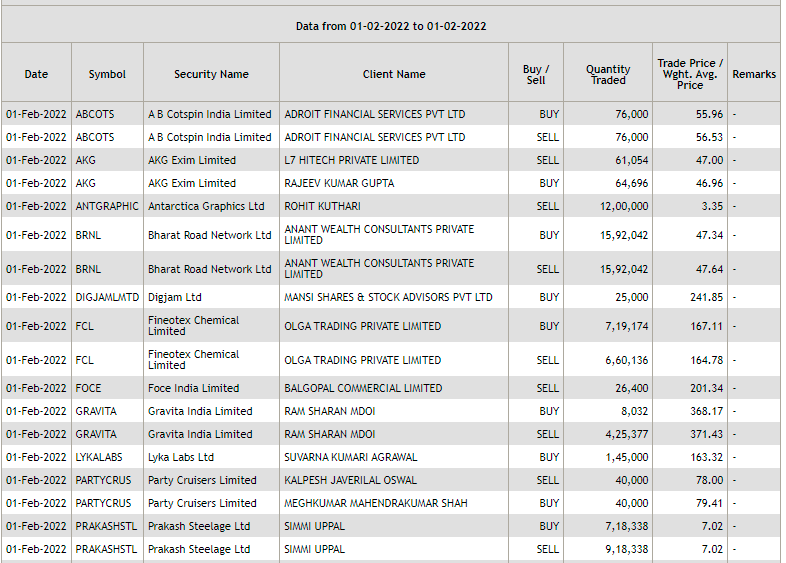
A 🧵on the basics of block and bulk deals.
Block and bulk deals are large purchases of stocks by investment banks, mutual funds, hedge funds, pension funds, FIIs, and promoters. Tracking block and bulk deals can help give you a sense of what these large players are thinking.
A single transaction where shares more than Rs 10 crores or the number of shares traded are more than 5 lakh is considered a block deal.
Block deals are carried out in separate trading windows. This trading window operates in two shifts of 15 minutes each:
Morning trading window from 8:45 AM to 9:00 AM.
Afternoon trading window from 2:05 PM to 2:20 PM
Block deals happen in different windows to reduce volatility and sudden price movements. Given that they are traded in a separate window, they do not show up on the volume charts.
Brokers facilitating the transaction are required to inform the exchange. You can track bulk and block deals on NSE & BSE:
https://t.co/pwTyzWTnUL
https://t.co/g9BbHiEag3
Block and bulk deals are large purchases of stocks by investment banks, mutual funds, hedge funds, pension funds, FIIs, and promoters. Tracking block and bulk deals can help give you a sense of what these large players are thinking.
A single transaction where shares more than Rs 10 crores or the number of shares traded are more than 5 lakh is considered a block deal.
Block deals are carried out in separate trading windows. This trading window operates in two shifts of 15 minutes each:
Morning trading window from 8:45 AM to 9:00 AM.
Afternoon trading window from 2:05 PM to 2:20 PM
Block deals happen in different windows to reduce volatility and sudden price movements. Given that they are traded in a separate window, they do not show up on the volume charts.
Brokers facilitating the transaction are required to inform the exchange. You can track bulk and block deals on NSE & BSE:
https://t.co/pwTyzWTnUL
https://t.co/g9BbHiEag3
You May Also Like
Recently, the @CNIL issued a decision regarding the GDPR compliance of an unknown French adtech company named "Vectaury". It may seem like small fry, but the decision has potential wide-ranging impacts for Google, the IAB framework, and today's adtech. It's thread time! 👇
It's all in French, but if you're up for it you can read:
• Their blog post (lacks the most interesting details): https://t.co/PHkDcOT1hy
• Their high-level legal decision: https://t.co/hwpiEvjodt
• The full notification: https://t.co/QQB7rfynha
I've read it so you needn't!
Vectaury was collecting geolocation data in order to create profiles (eg. people who often go to this or that type of shop) so as to power ad targeting. They operate through embedded SDKs and ad bidding, making them invisible to users.
The @CNIL notes that profiling based off of geolocation presents particular risks since it reveals people's movements and habits. As risky, the processing requires consent — this will be the heart of their assessment.
Interesting point: they justify the decision in part because of how many people COULD be targeted in this way (rather than how many have — though they note that too). Because it's on a phone, and many have phones, it is considered large-scale processing no matter what.
It's all in French, but if you're up for it you can read:
• Their blog post (lacks the most interesting details): https://t.co/PHkDcOT1hy
• Their high-level legal decision: https://t.co/hwpiEvjodt
• The full notification: https://t.co/QQB7rfynha
I've read it so you needn't!
Vectaury was collecting geolocation data in order to create profiles (eg. people who often go to this or that type of shop) so as to power ad targeting. They operate through embedded SDKs and ad bidding, making them invisible to users.
The @CNIL notes that profiling based off of geolocation presents particular risks since it reveals people's movements and habits. As risky, the processing requires consent — this will be the heart of their assessment.
Interesting point: they justify the decision in part because of how many people COULD be targeted in this way (rather than how many have — though they note that too). Because it's on a phone, and many have phones, it is considered large-scale processing no matter what.
1/Politics thread time.
To me, the most important aspect of the 2018 midterms wasn't even about partisan control, but about democracy and voting rights. That's the real battle.
2/The good news: It's now an issue that everyone's talking about, and that everyone cares about.
3/More good news: Florida's proposition to give felons voting rights won. But it didn't just win - it won with substantial support from Republican voters.
That suggests there is still SOME grassroots support for democracy that transcends
4/Yet more good news: Michigan made it easier to vote. Again, by plebiscite, showing broad support for voting rights as an
5/OK, now the bad news.
We seem to have accepted electoral dysfunction in Florida as a permanent thing. The 2000 election has never really
To me, the most important aspect of the 2018 midterms wasn't even about partisan control, but about democracy and voting rights. That's the real battle.
2/The good news: It's now an issue that everyone's talking about, and that everyone cares about.
3/More good news: Florida's proposition to give felons voting rights won. But it didn't just win - it won with substantial support from Republican voters.
That suggests there is still SOME grassroots support for democracy that transcends
4/Yet more good news: Michigan made it easier to vote. Again, by plebiscite, showing broad support for voting rights as an
5/OK, now the bad news.
We seem to have accepted electoral dysfunction in Florida as a permanent thing. The 2000 election has never really
Bad ballot design led to a lot of undervotes for Bill Nelson in Broward Co., possibly even enough to cost him his Senate seat. They do appear to be real undervotes, though, instead of tabulation errors. He doesn't really seem to have a path to victory. https://t.co/utUhY2KTaR
— Nate Silver (@NateSilver538) November 16, 2018