
I'd like to offer a few words about why Parler's "Russian IP" is nothing of note to me.
First, the IP belongs to ddos-guard, a CDN (Content Delivery Network). First, a CDN is a service gets content to your site visitors faster through methods which aren't important right now. /1
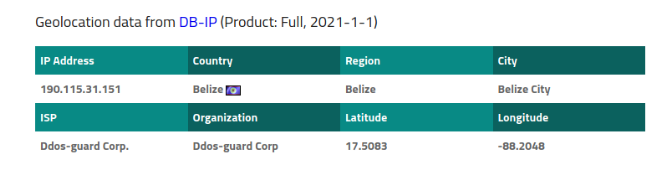
Basically, all we know is that Parler has not committed to using ddos-guard yet, in the sense that they...

My point is that the choice of CDN is the least interesting part about this. Focus on things like whether Rebeccah Mercer is still throwing money at Parler: https://t.co/BwcOUgU7Bh
More from Tech

These past few days I've been experimenting with something new that I want to use by myself.
Interestingly, this thread below has been written by that.
Let me show you how it looks like. 👇🏻
When you see localhost up there, you should know that it's truly an experiment! 😀
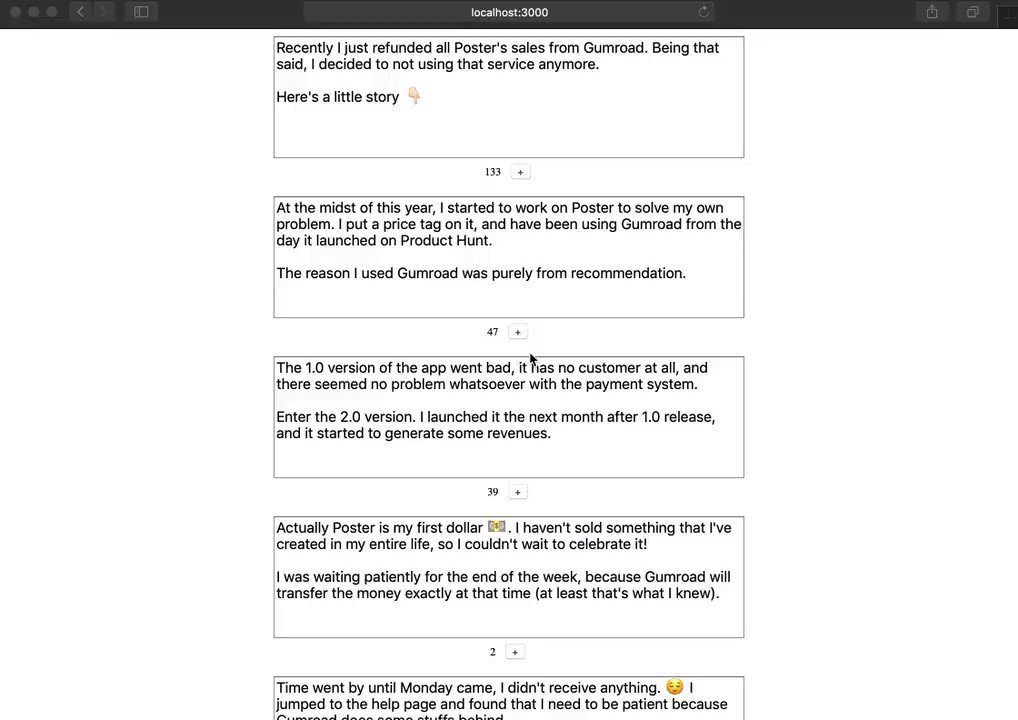
It's a dead-simple thread writer that will post a series of tweets a.k.a tweetstorm. ⚡️
I've been personally wanting it myself since few months ago, but neglected it intentionally to make sure it's something that I genuinely need.
So why is that important for me? 🙂
I've been a believer of a story. I tell stories all the time, whether it's in the real world or online like this. Our society has moved by that.
If you're interested by stories that move us, read Sapiens!
One of the stories that I've told was from the launch of Poster.
It's been launched multiple times this year, and Twitter has been my go-to place to tell the world about that.
Here comes my frustration.. 😤
Interestingly, this thread below has been written by that.
Let me show you how it looks like. 👇🏻
Recently I just refunded all Poster's sales from Gumroad. Being that said, I decided to not using that service anymore.
— Wilbert Liu \U0001f468\U0001f3fb\u200d\U0001f3a8 (@wilbertliu) November 19, 2018
Here's a little story \U0001f447\U0001f3fb
When you see localhost up there, you should know that it's truly an experiment! 😀
It's a dead-simple thread writer that will post a series of tweets a.k.a tweetstorm. ⚡️
I've been personally wanting it myself since few months ago, but neglected it intentionally to make sure it's something that I genuinely need.
So why is that important for me? 🙂
I've been a believer of a story. I tell stories all the time, whether it's in the real world or online like this. Our society has moved by that.
If you're interested by stories that move us, read Sapiens!
One of the stories that I've told was from the launch of Poster.
It's been launched multiple times this year, and Twitter has been my go-to place to tell the world about that.
Here comes my frustration.. 😤


"I really want to break into Product Management"
make products.
"If only someone would tell me how I can get a startup to notice me."
Make Products.
"I guess it's impossible and I'll never break into the industry."
MAKE PRODUCTS.
Courtesy of @edbrisson's wonderful thread on breaking into comics – https://t.co/TgNblNSCBj – here is why the same applies to Product Management, too.
There is no better way of learning the craft of product, or proving your potential to employers, than just doing it.
You do not need anybody's permission. We don't have diplomas, nor doctorates. We can barely agree on a single standard of what a Product Manager is supposed to do.
But – there is at least one blindingly obvious industry consensus – a Product Manager makes Products.
And they don't need to be kept at the exact right temperature, given endless resource, or carefully protected in order to do this.
They find their own way.
make products.
"If only someone would tell me how I can get a startup to notice me."
Make Products.
"I guess it's impossible and I'll never break into the industry."
MAKE PRODUCTS.
Courtesy of @edbrisson's wonderful thread on breaking into comics – https://t.co/TgNblNSCBj – here is why the same applies to Product Management, too.
"I really want to break into comics"
— Ed Brisson (@edbrisson) December 4, 2018
make comics.
"If only someone would tell me how I can get an editor to notice me."
Make Comics.
"I guess it's impossible and I'll never break into the industry."
MAKE COMICS.
There is no better way of learning the craft of product, or proving your potential to employers, than just doing it.
You do not need anybody's permission. We don't have diplomas, nor doctorates. We can barely agree on a single standard of what a Product Manager is supposed to do.
But – there is at least one blindingly obvious industry consensus – a Product Manager makes Products.
And they don't need to be kept at the exact right temperature, given endless resource, or carefully protected in order to do this.
They find their own way.


(1) Some haters of #Cardano are not only bag holders but also imperative developers.
If you are an imperative programmers you know that Plutus is not the most intuitive -> (https://t.co/m3fzq7rJYb)
It is, however, intuitive for people with IT financial background, e.g. banks
(2)
IELE + k framework will be a real game changer because there will be DSLs (Domain Specific Languages) in any programming language supported by K framework. The only issue is that we need to wait for all this
(3) Good news is that the moment we get IELE integrated into Cardano, we get some popular langs. To my knowledge we should get from day one: Solidity and Rust, maybe others as well?
List of langs: https://t.co/0uj1eBfrYj, some commits from many years ago..
@rv_inc ?
#Cardano
(a) Last but not least, marketing to people with Haskell, functional programming with experience and decision makers in banks is a tricky one, how do you market but not tell them you want to replace them. In the end one strategy is to pitch new markets, e.g. developing world
(b) As banks realize what is happening they maybe more inclined to join - not because they would like to but because they will have to - in such cases some development talent maybe re-routed to Plutus / Cardano / Algorand / Tezos
If you are an imperative programmers you know that Plutus is not the most intuitive -> (https://t.co/m3fzq7rJYb)
It is, however, intuitive for people with IT financial background, e.g. banks
(2)
IELE + k framework will be a real game changer because there will be DSLs (Domain Specific Languages) in any programming language supported by K framework. The only issue is that we need to wait for all this
(3) Good news is that the moment we get IELE integrated into Cardano, we get some popular langs. To my knowledge we should get from day one: Solidity and Rust, maybe others as well?
List of langs: https://t.co/0uj1eBfrYj, some commits from many years ago..
@rv_inc ?
#Cardano
(a) Last but not least, marketing to people with Haskell, functional programming with experience and decision makers in banks is a tricky one, how do you market but not tell them you want to replace them. In the end one strategy is to pitch new markets, e.g. developing world
(b) As banks realize what is happening they maybe more inclined to join - not because they would like to but because they will have to - in such cases some development talent maybe re-routed to Plutus / Cardano / Algorand / Tezos
You May Also Like







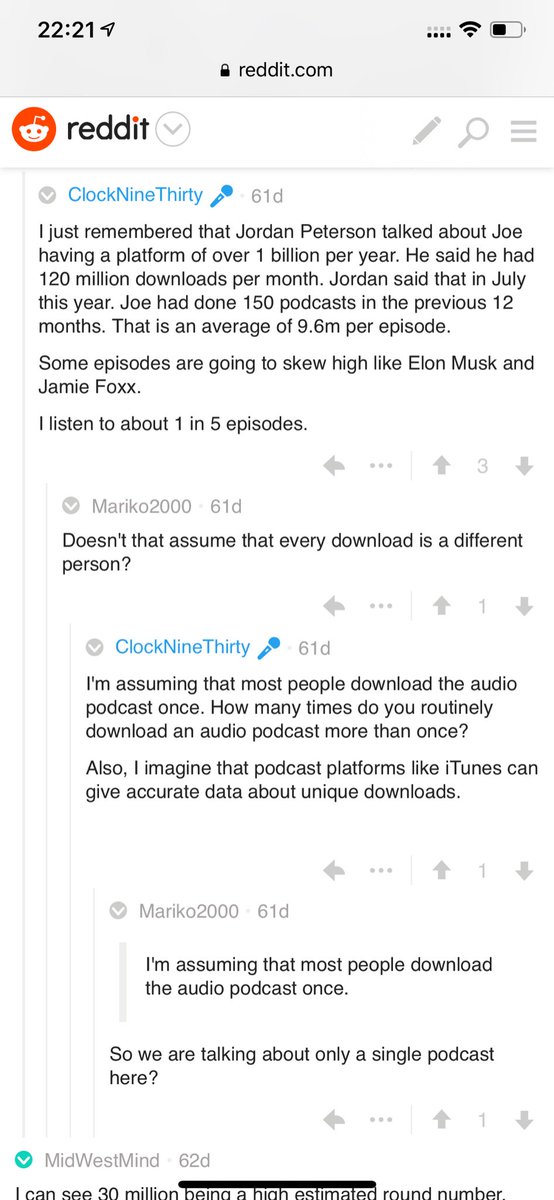
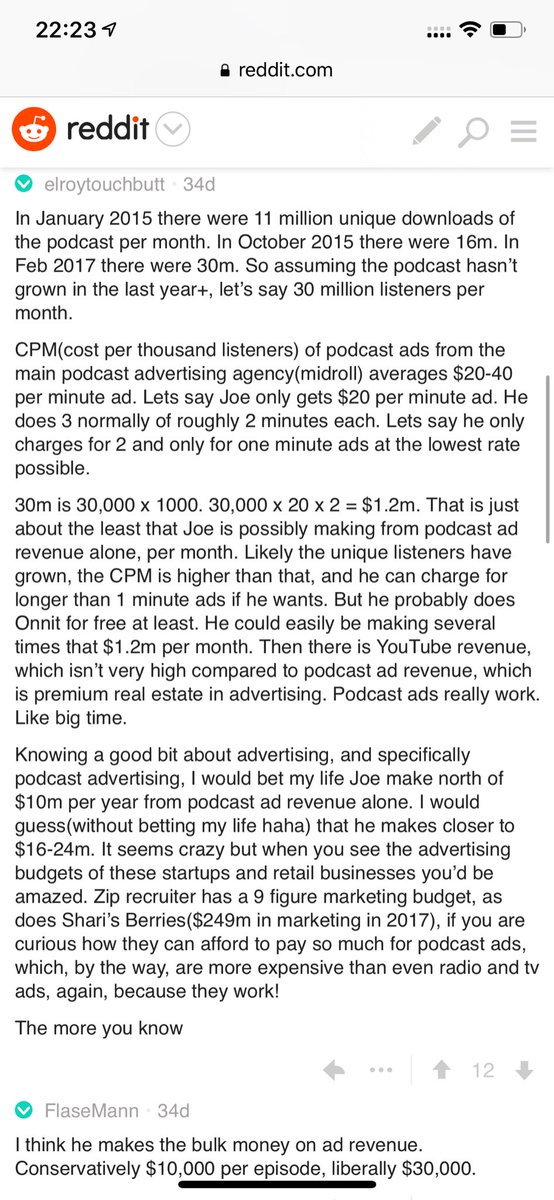
Joe Rogan's podcast is now is listened to 1.5+ billion times per year at around $50-100M/year revenue.
Independent and 100% owned by Joe, no networks, no middle men and a 100M+ people audience.
👏
https://t.co/RywAiBxA3s
Joe is the #1 / #2 podcast (depends per week) of all podcasts
120 million plays per month source https://t.co/k7L1LfDdcM
https://t.co/aGcYnVDpMu
Independent and 100% owned by Joe, no networks, no middle men and a 100M+ people audience.
👏
https://t.co/RywAiBxA3s
Joe is the #1 / #2 podcast (depends per week) of all podcasts
120 million plays per month source https://t.co/k7L1LfDdcM
https://t.co/aGcYnVDpMu
