
I wish everybody a Happy New Year 🎆. 2020 was a year like no other. The pandemic put normal life on pause. 🇲🇻tourism collapsed, thousands lost jobs and incomes, children missed schooling, some of us lost loved ones. Few of us will miss 2020. Thread (1/9)
https://t.co/Tdnkw5tLRb
More from Society


Sandbank Danger, A Thread

Controversy Has Been Caused By The Digging Of A Narrow Channel By A Resort On A Sandbank Near K. Hinmafushi.

Hinmafushi Council President Shan Ibrahim Stated To Sun That The Resort, Which Dug The Trench Creating A River On The Sandbank, Did Not Have Ownership Over The Sandbank.
Officials From The Island Of Hinmafushi Had Traveled To The Sandbank To Stop The Process Of Digging The Trench When They Became Aware Of It, Said Shan.
Officials Were Now Redepositing The Sand Removed From The Sandbank.
Controversy Has Been Caused By The Digging Of A Narrow Channel By A Resort On A Sandbank Near K. Hinmafushi.
Hinmafushi Council President Shan Ibrahim Stated To Sun That The Resort, Which Dug The Trench Creating A River On The Sandbank, Did Not Have Ownership Over The Sandbank.
Officials From The Island Of Hinmafushi Had Traveled To The Sandbank To Stop The Process Of Digging The Trench When They Became Aware Of It, Said Shan.
Officials Were Now Redepositing The Sand Removed From The Sandbank.
— Ahmed Aznil (@AhmedAznil) January 21, 2021


Patriotism is an interesting concept in that it’s excepted to mean something positive to all of us and certainly seen as a morally marketable trait that can fit into any definition you want for it.+
Tolstoy, found it both stupid and immoral. It is stupid because every patriot holds his own country to be the best, which obviously negates all other countries.+
It is immoral because it enjoins us to promote our country’s interests at the expense of all other countries, employing any means, including war. It is thus at odds with the most basic rule of morality, which tells us not to do to others what we would not want them to do to us+
My sincere belief is that patriotism of a personal nature, which does not impede on personal and physical liberties of any other, is not only welcome but perhaps somewhat needed.
But isn’t adherence to a more humane code of life much better than nationalistic patriotism?+
Göring said, “people can always be brought to the bidding of the leaders. That is easy. All you have to do is tell them they are being attacked, and denounce the peacemakers for lack of patriotism and exposing the country to danger. It works the same in any country.”+
\u0926\u0947\u0936 \u092e\u0947\u0902 \u092a\u0939\u0932\u0940 \u092c\u093e\u0930 \U0001f1ee\U0001f1f3
— AAP (@AamAadmiParty) March 12, 2021
\u0926\u0947\u0936\u092d\u0915\u094d\u0924\u093f \u0915\u0940 \u0938\u094d\u092a\u0947\u0936\u0932 \u0915\u094d\u0932\u093e\u0938 \u0932\u0917\u093e\u090f\u0917\u0940 @ArvindKejriwal \u0938\u0930\u0915\u093e\u0930\u0964
\u090f\u0915 \u092a\u093e\u0920\u094d\u092f\u0915\u094d\u0930\u092e \u092c\u0928\u093e\u092f\u093e \u091c\u093e\u090f\u0917\u093e, \u091c\u093f\u0938\u0938\u0947 \u092c\u091a\u094d\u091a\u094b\u0902 \u092e\u0947\u0902 \u0915\u0942\u091f \u0915\u0942\u091f \u0915\u0930 \u0926\u0947\u0936\u092d\u0915\u094d\u0924\u093f \u092d\u0930\u0940 \u091c\u093e\u090f\u0917\u0940\u0964 pic.twitter.com/iO6WMBh4YG
Tolstoy, found it both stupid and immoral. It is stupid because every patriot holds his own country to be the best, which obviously negates all other countries.+
It is immoral because it enjoins us to promote our country’s interests at the expense of all other countries, employing any means, including war. It is thus at odds with the most basic rule of morality, which tells us not to do to others what we would not want them to do to us+
My sincere belief is that patriotism of a personal nature, which does not impede on personal and physical liberties of any other, is not only welcome but perhaps somewhat needed.
But isn’t adherence to a more humane code of life much better than nationalistic patriotism?+
Göring said, “people can always be brought to the bidding of the leaders. That is easy. All you have to do is tell them they are being attacked, and denounce the peacemakers for lack of patriotism and exposing the country to danger. It works the same in any country.”+

You May Also Like

Keep dwelling on this:
Further Examination of the Motif near PRRA Reveals Close Structural Similarity to the SEB Superantigen as well as Sequence Similarities to Neurotoxins and a Viral SAg.
The insertion PRRA together with 7 sequentially preceding residues & succeeding R685 (conserved in β-CoVs) form a motif, Y674QTQTNSPRRAR685, homologous to those of neurotoxins from Ophiophagus (cobra) and Bungarus genera, as well as neurotoxin-like regions from three RABV strains
(20) (Fig. 2D). We further noticed that the same segment bears close similarity to the HIV-1 glycoprotein gp120 SAg motif F164 to V174.
https://t.co/EwwJOSa8RK

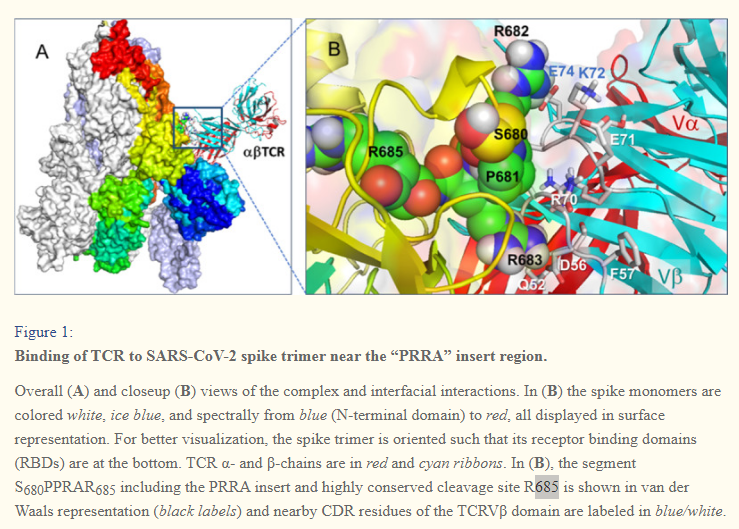
In (B), the segment S680PPRAR685 including the PRRA insert and highly conserved cleavage site *R685* is shown in van der Waals representation (black labels) and nearby CDR residues of the TCRVβ domain are labeled in blue/white
https://t.co/BsY8BAIzDa
Sequence Identity %
https://t.co/BsY8BAIzDa
Y674 - QTQTNSPRRA - R685
Similar to neurotoxins from Ophiophagus (cobra) & Bungarus genera & neurotoxin-like regions from three RABV strains
T678 - NSPRRA- R685
Superantigenic core, consistently aligned against bacterial or viral SAgs

Further Examination of the Motif near PRRA Reveals Close Structural Similarity to the SEB Superantigen as well as Sequence Similarities to Neurotoxins and a Viral SAg.
The insertion PRRA together with 7 sequentially preceding residues & succeeding R685 (conserved in β-CoVs) form a motif, Y674QTQTNSPRRAR685, homologous to those of neurotoxins from Ophiophagus (cobra) and Bungarus genera, as well as neurotoxin-like regions from three RABV strains
(20) (Fig. 2D). We further noticed that the same segment bears close similarity to the HIV-1 glycoprotein gp120 SAg motif F164 to V174.
https://t.co/EwwJOSa8RK
In (B), the segment S680PPRAR685 including the PRRA insert and highly conserved cleavage site *R685* is shown in van der Waals representation (black labels) and nearby CDR residues of the TCRVβ domain are labeled in blue/white
https://t.co/BsY8BAIzDa
Sequence Identity %
https://t.co/BsY8BAIzDa
Y674 - QTQTNSPRRA - R685
Similar to neurotoxins from Ophiophagus (cobra) & Bungarus genera & neurotoxin-like regions from three RABV strains
T678 - NSPRRA- R685
Superantigenic core, consistently aligned against bacterial or viral SAgs





I just finished Eric Adler's The Battle of the Classics, and wanted to say something about Joel Christiansen's review linked below. I am not sure what motivates the review (I speculate a bit below), but it gives a very misleading impression of the book. 1/x
The meat of the criticism is that the history Adler gives is insufficiently critical. Adler describes a few figures who had a great influence on how the modern US university was formed. It's certainly critical: it focuses on the social Darwinism of these figures. 2/x
Other insinuations and suggestions in the review seem wildly off the mark, distorted, or inappropriate-- for example, that the book is clickbaity (it is scholarly) or conservative (hardly) or connected to the events at the Capitol (give me a break). 3/x
The core question: in what sense is classics inherently racist? Classics is old. On Adler's account, it begins in ancient Rome and is revived in the Renaissance. Slavery (Christiansen's primary concern) is also very old. Let's say classics is an education for slaveowners. 4/x
It's worth remembering that literacy itself is elite throughout most of this history. Literacy is, then, also the education of slaveowners. We can honor oral and musical traditions without denying that literacy is, generally, good. 5/x
As someone\u2019s who\u2019s read the book, this review strikes me as tremendously unfair. It mostly faults Adler for not writing the book the reviewer wishes he had! https://t.co/pqpt5Ziivj
— Teresa M. Bejan (@tmbejan) January 12, 2021
The meat of the criticism is that the history Adler gives is insufficiently critical. Adler describes a few figures who had a great influence on how the modern US university was formed. It's certainly critical: it focuses on the social Darwinism of these figures. 2/x
Other insinuations and suggestions in the review seem wildly off the mark, distorted, or inappropriate-- for example, that the book is clickbaity (it is scholarly) or conservative (hardly) or connected to the events at the Capitol (give me a break). 3/x
The core question: in what sense is classics inherently racist? Classics is old. On Adler's account, it begins in ancient Rome and is revived in the Renaissance. Slavery (Christiansen's primary concern) is also very old. Let's say classics is an education for slaveowners. 4/x
It's worth remembering that literacy itself is elite throughout most of this history. Literacy is, then, also the education of slaveowners. We can honor oral and musical traditions without denying that literacy is, generally, good. 5/x