The World Rugby Transgender guideline is now out, and fully available here: https://t.co/RUZ7QrlodQ You\u2019ll also find a document called FAQs which tries to answer some common questions. We firmly believe it is the right thing in an emotive issue, for many reasons.
— Ross Tucker (@Scienceofsport) October 9, 2020
Since it is a lovely peaceful Saturday morning, I clearly have to rectify that. Therefore: the World Rugby Transgender Policy and Nye Bevan.
Thread.

"This is my truth, tell me yours."
I know that sounds impossible. The truth is the truth is the truth, right? There can only be one truth, not truths, right?
Wrong. Here's why.
"Lived experience" is this form of truth. It is your individual truth. It is entirely true for you because it is your experience of what happened.
Two such means are other truths: legal and scientific.
In the Common Law world, the key word here is "reasonable". Decisions must be reasonable; "beyond reasonable doubt"; "reasonably foreseeable".
It does have the advantage that lawyers are used to being blamed. For centuries, we have been the Millwall of professions: nobody likes us, we don't care.
As noted, going by "reasonable" doesn't mean people will be happy. When a subjective truth isn't preferred, people feel hurt. There is no way around that to make policy.
It was: "This is my truth, tell me yours."
More from Society





Brief thread to debunk the repeated claims we hear about transmission not happening 'within school walls', infection in school children being 'a reflection of infection from the community', and 'primary school children less likely to get infected and contribute to transmission'.
I've heard a lot of scientists claim these three - including most recently the chief advisor to the CDC, where the claim that most transmission doesn't happen within the walls of schools. There is strong evidence to rebut this claim. Let's look at
Let's look at the trends of infection in different age groups in England first- as reported by the ONS. Being a random survey of infection in the community, this doesn't suffer from the biases of symptom-based testing, particularly important in children who are often asymptomatic
A few things to note:
1. The infection rates among primary & secondary school children closely follow school openings, closures & levels of attendance. E.g. We see a dip in infections following Oct half-term, followed by a rise after school reopening.
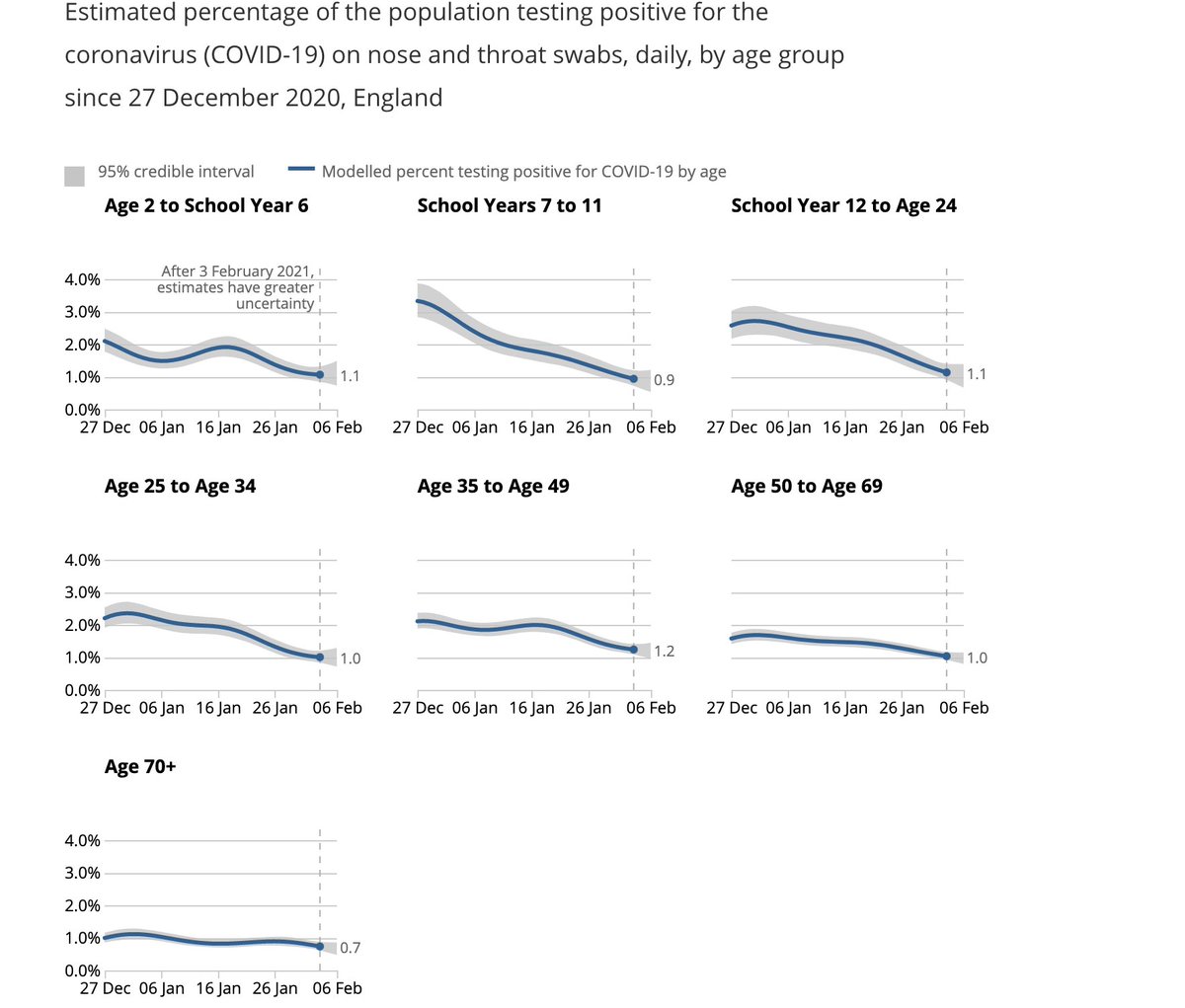
We see steep drops in both primary & secondary school groups after end of term (18th December), but these drops plateau out in primary school children, where attendance has been >20% after re-opening in January (by contrast with 2ndary schools where this is ~5%).
I've heard a lot of scientists claim these three - including most recently the chief advisor to the CDC, where the claim that most transmission doesn't happen within the walls of schools. There is strong evidence to rebut this claim. Let's look at
The science shows us that most disease transmission does not happen in the walls of the school, but it comes in from the community. So, CDC is advocating to get our K-5 students back in school at least in a hybrid mode with universal mask wearing and 6 ft of distancing. https://t.co/dfvJ2nl2s4
— Rochelle Walensky, MD, MPH (@CDCDirector) February 14, 2021
Let's look at the trends of infection in different age groups in England first- as reported by the ONS. Being a random survey of infection in the community, this doesn't suffer from the biases of symptom-based testing, particularly important in children who are often asymptomatic
A few things to note:
1. The infection rates among primary & secondary school children closely follow school openings, closures & levels of attendance. E.g. We see a dip in infections following Oct half-term, followed by a rise after school reopening.
We see steep drops in both primary & secondary school groups after end of term (18th December), but these drops plateau out in primary school children, where attendance has been >20% after re-opening in January (by contrast with 2ndary schools where this is ~5%).