https://t.co/DF40S9biYF
Unfortunately the observed ORF8 inactivation or the nsp6 SGF deletion are both indicative of T cell depletion, yet the deletion of HV and Y suggest functional B cell immunity—specifically the HV deletion is not observed in the patient nor the ORF8

Which happened to be a requirement for human infection fitness,
https://t.co/Ytdb1hkZdU
Also suggest a mouse host (which hosts non-Heparan sulfate binding MHV A59 and other non-cell passaged MHV strains) being likely.
Notice that for this other case the same kind of deletion—multiple AAs in the S position 144 and no deletion at S position 69-70, and a single deletion in the nsp1 removing a single Methionine residue, was found. This indicate functional B and T cell
More from Science






#DDDD $LBPS $LOAC
A thread on the potential near term catalysts behind why I have increased my position in 4d Pharma @4dpharmaplc (LON: #DDDD):

1) NASDAQ listing. This is the most obvious.
The idea behind this is that the huge pool of capital and institutional interest in the NASDAQ will enable a higher per-share valuation for #DDDD than was achievable in the UK.
Comparators to @4dpharmaplc #DDDD (market capitalisation £150m) on the NASDAQ and their market capitalisation:
Seres Therapeutics: $2.33bn = £1.72bn (has had a successful phase 3 C. difficile trial); from my previous research (below) the chance of #DDDD achieving this at least once is at least
Kaleido Biosciences: $347m = £256m. 4 products under consideration, compared to #DDDD's potential 16. When you view @4dpharmaplc's 1000+ patents and AI-driven MicroRx platform (not to mention their end-to-end manufacturing capability), 4d's undervaluation is clear.
A thread on the potential near term catalysts behind why I have increased my position in 4d Pharma @4dpharmaplc (LON: #DDDD):
1) NASDAQ listing. This is the most obvious.
The idea behind this is that the huge pool of capital and institutional interest in the NASDAQ will enable a higher per-share valuation for #DDDD than was achievable in the UK.
Comparators to @4dpharmaplc #DDDD (market capitalisation £150m) on the NASDAQ and their market capitalisation:
Seres Therapeutics: $2.33bn = £1.72bn (has had a successful phase 3 C. difficile trial); from my previous research (below) the chance of #DDDD achieving this at least once is at least
While looking at speculative pharmaceutical stocks I am reminded of why I am averse to these risky picks.#DDDD was compelling enough, though, to break this rule. The 10+ treatments under trial, industry-leading IP portfolio, and comparable undervaluation are inescapable.
— Shrey Srivastava (@BlogShrey) December 16, 2020
Kaleido Biosciences: $347m = £256m. 4 products under consideration, compared to #DDDD's potential 16. When you view @4dpharmaplc's 1000+ patents and AI-driven MicroRx platform (not to mention their end-to-end manufacturing capability), 4d's undervaluation is clear.


It was great to talk about reproducible workflows for @riotscienceclub @riotscience_wlv. You can watch the recording below, but if you don't want to listen to me talk for 40 minutes, I thought I would summarise my talk in a thread:
My inspiration was making open science accessible. I wanted to outline the mistakes I've made along the way so people would feel empowered to give it a go. Increased accountability is seen as a barrier to adopting open science practices as an ECR
It also comes across as all or nothing. You are either fully open science or your research won't get anywhere. However, that can be quite intimidating, so I wanted to emphasise this incremental approach to adapting your workflow
There are two sides to why you should work towards reproducibility. The first is communal. It's going to help the field if you or someone else can reproduce your whole pipeline.

There is also the selfish element of it's just going to help you do your work. If you can't remember what your work means after a lunch break, you're not going to remember months or years down the line
Thank you again @JamesEBartlett for a fantastic talk (with a really nice personal touch) on reproducible workflows!
— RIOT Science Club Wolverhampton (@riotscience_wlv) February 16, 2021
Thanks especially for the co-leads @IMLahart for co-hosting and @DrManiBhogal for nabbing James!
Slides: https://t.co/CNqxzOhch1
Video: https://t.co/YjHEHuRJlz
My inspiration was making open science accessible. I wanted to outline the mistakes I've made along the way so people would feel empowered to give it a go. Increased accountability is seen as a barrier to adopting open science practices as an ECR
It also comes across as all or nothing. You are either fully open science or your research won't get anywhere. However, that can be quite intimidating, so I wanted to emphasise this incremental approach to adapting your workflow
There are two sides to why you should work towards reproducibility. The first is communal. It's going to help the field if you or someone else can reproduce your whole pipeline.
There is also the selfish element of it's just going to help you do your work. If you can't remember what your work means after a lunch break, you're not going to remember months or years down the line
Why are lunch breaks important for #code?
— Dr Rebecca Hirst (@HirstRj) February 11, 2021
If you can't remember what your variable names refer to after lunch, you sure as hell won't remember in 3 months.

You May Also Like











@EricTopol @NBA @StephenKissler @yhgrad B.1.1.7 reveals clearly that SARS-CoV-2 is reverting to its original pre-outbreak condition, i.e. adapted to transgenic hACE2 mice (either Baric's BALB/c ones or others used at WIV labs during chimeric bat coronavirus experiments aimed at developing a pan betacoronavirus vaccine)
@NBA @StephenKissler @yhgrad 1. From Day 1, SARS-COV-2 was very well adapted to humans .....and transgenic hACE2 Mice
@NBA @StephenKissler @yhgrad 2. High Probability of serial passaging in Transgenic Mice expressing hACE2 in genesis of SARS-COV-2
@NBA @StephenKissler @yhgrad B.1.1.7 has an unusually large number of genetic changes, ... found to date in mouse-adapted SARS-CoV2 and is also seen in ferret infections.
https://t.co/9Z4oJmkcKj

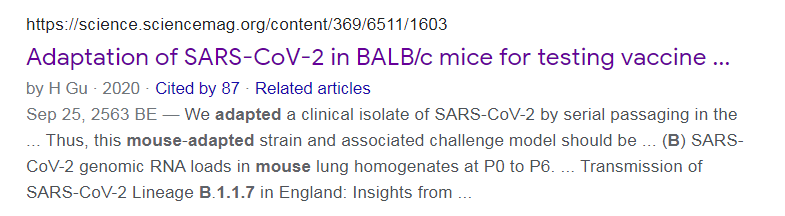
@NBA @StephenKissler @yhgrad We adapted a clinical isolate of SARS-CoV-2 by serial passaging in the ... Thus, this mouse-adapted strain and associated challenge model should be ... (B) SARS-CoV-2 genomic RNA loads in mouse lung homogenates at P0 to P6.
https://t.co/I90OOCJg7o
@NBA @StephenKissler @yhgrad 1. From Day 1, SARS-COV-2 was very well adapted to humans .....and transgenic hACE2 Mice
1. From Day 1, SARS-COV-2 was very well adapted to humans .....and transgenic hACE2 Mice
— Billy Bostickson \U0001f3f4\U0001f441&\U0001f441 \U0001f193 (@BillyBostickson) January 30, 2021
"we generated a mouse model expressing hACE2 by using CRISPR/Cas9 knockin technology. In comparison with wild-type C57BL/6 mice, both young & aged hACE2 mice sustained high viral loads... pic.twitter.com/j94XtSkscj
@NBA @StephenKissler @yhgrad 2. High Probability of serial passaging in Transgenic Mice expressing hACE2 in genesis of SARS-COV-2
1. High Probability of serial passaging in Transgenic Mice expressing hACE2 in genesis of SARS-COV-2!
— Billy Bostickson \U0001f3f4\U0001f441&\U0001f441 \U0001f193 (@BillyBostickson) January 2, 2021
2 papers:
Human\u2013viral molecular mimicryhttps://t.co/irfH0Zgrve
Molecular Mimicryhttps://t.co/yLQoUtfS6s https://t.co/lsCv2iMEQz
@NBA @StephenKissler @yhgrad B.1.1.7 has an unusually large number of genetic changes, ... found to date in mouse-adapted SARS-CoV2 and is also seen in ferret infections.
https://t.co/9Z4oJmkcKj
@NBA @StephenKissler @yhgrad We adapted a clinical isolate of SARS-CoV-2 by serial passaging in the ... Thus, this mouse-adapted strain and associated challenge model should be ... (B) SARS-CoV-2 genomic RNA loads in mouse lung homogenates at P0 to P6.
https://t.co/I90OOCJg7o