Inspired by @michellearning I will be sharing 10 robotics papers that I really enjoyed reading (made me think and raised my heart rate) when I was a grad student. One paper per day. Starting tonight, ending on xmas day. Here we go: 👇🤖 1/n

Note: this is not necessarily an exhaustive list of the best or most influential papers in robotics, nor is it a list of my current favorite papers. These are papers that I found compelling and I still enjoy re-reading from time to time. The order is random. 2/n
[Paper #1] LQR-Trees by Russ Tedrake https://t.co/nYDaHYJryk. I love this paper. It's about feedback control and motion planning with probabilistic guarantees. Given a desired goal state, sample an initial state and find a nominal trajectory from the initial state to the goal 3/n
using LQR control (linear dynamics, quadratic cost). So far, so good. Then it gets interesting: it sets out to explicitly compute the region of stability of the computed controller without doing sampling. It underestimates this region by trying to compute a Lyapunov function 4/n
that will certify stability in the region. It only considers Lyapunov functions that are polynomials of deg N and optimizes for a positive function using sums-of-squares programming. So, now you have a nominal trajectory to the goal and a region of stability around it. 5/n
Repeat this process backwards by setting the new goal to be in the computed region of stability, and you have a region of stability that grows over time and (a) covers space, (b) can lead to complex global behaviors from simple linear controllers that are locally valid, 6/n
and (c) is one way to address compositionality in control. So, does all of this work in practice? Yes, with a few asterisks: the major bottleneck is solving the sum-of-squares program that computes the region of stability. It has been shown to be practical for low-dim systems 7/n
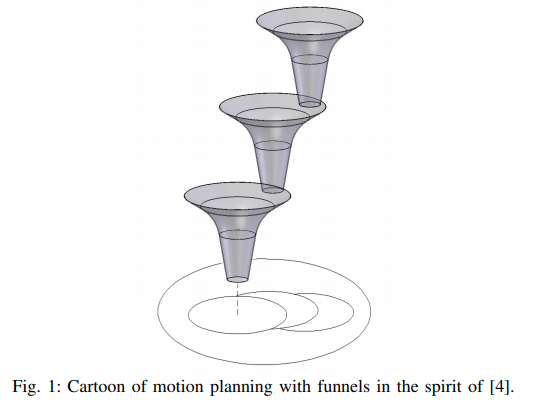
This paper, published in ~2010, was influenced by Pablo Parrilo's PhD thesis on semidef programming (2000), as well as older ideas about funnels from Matt Mason https://t.co/4MxHCJQy7l (1985) Rob Burridge, Alfred Rizzi, and Dan Koditschek https://t.co/LjNnY0ItD3 (1999) 8/n
Some of the limitations of the LQR Trees paper were addressed by @Majumdar_Ani in his PhD thesis https://t.co/m5jcbmZ3x5 I encourage you to read it and check out his other papers https://t.co/vso7qQchGp 9/n

You May Also Like

1/12

RT-PCR corona (test) scam

Symptomatic people are tested for one and only one respiratory virus. This means that other acute respiratory infections are reclassified as


2/12

It is tested exquisitely with a hypersensitive non-specific RT-PCR test / Ct >35 (>30 is nonsense, >35 is madness), without considering Ct and clinical context. This means that more acute respiratory infections are reclassified as


3/12

The Drosten RT-PCR test is fabricated in a way that each country and laboratory perform it differently at too high Ct and that the high rate of false positives increases massively due to cross-reaction with other (corona) viruses in the "flu


4/12

Even asymptomatic, previously called healthy, people are tested (en masse) in this way, although there is no epidemiologically relevant asymptomatic transmission. This means that even healthy people are declared as COVID


5/12

Deaths within 28 days after a positive RT-PCR test from whatever cause are designated as deaths WITH COVID. This means that other causes of death are reclassified as
Still wondering about this 🤔


save as q