Why It's Good To Push Politicians To Do The Right Thing (Even When They Probably Won't)
"You don't push politicians to do the right thing because you think they will, you do it to show everyone else that they
https://t.co/Lrxznn7kbh
Why They're Denying You Healthcare And Financial Support During A Pandemic
— Caitlin Johnstone \u23f3 (@caitoz) December 20, 2020
"If wealth were more evenly distributed in the most powerful nation on earth, there'd be no ruling class to ensure the domination of the globe-spanning empire."https://t.co/0o5YjLLgQS
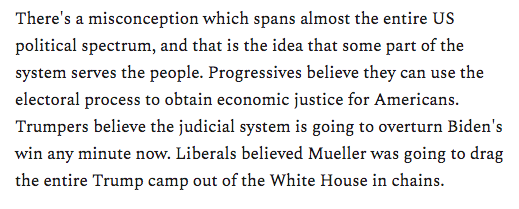
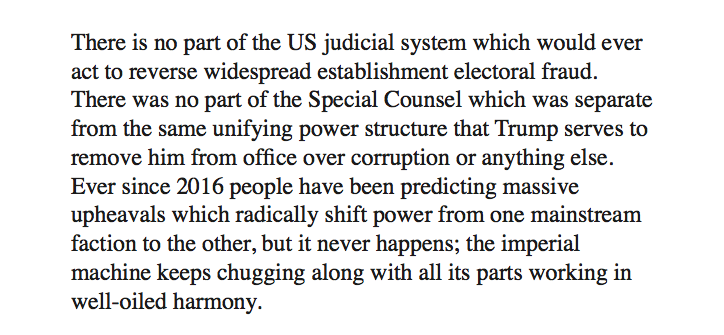
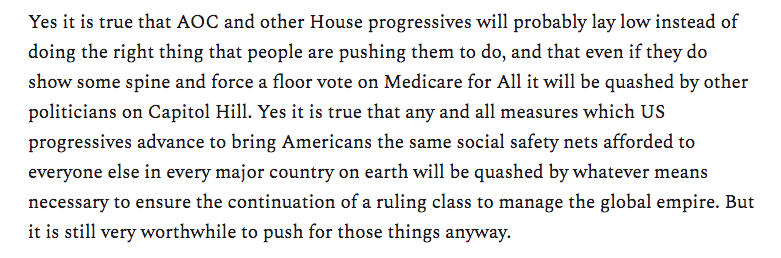

This is why so much of the battle is happening on the front of propaganda, censorship, and press freedoms.
More from Caitlin Johnstone ⏳
The Two Faces Of The US Empire
"The empire needs both faces. Without the murder face, it could not exist as an empire. Without the grinning face, the public would never consent to the murder
The Biden inauguration event is going to be a star-studded celebration spanning an unprecedented five days, a giddy orgy of excitement at a murderous oligarchic empire having a new face behind the front desk after promising wealthy donors that nothing will fundamentally change.

This comes at a time when Americans are now reporting that they trust corporations more than they trust their own government or
when pundits are gleefully proclaiming in The New York Times that “CEOs have become the fourth branch of government” as they pressure the entire political system to smoothly install
when the leading contender for the Department of Justice's Antitrust Division is an Obama holdover who went from the administration to working for both Amazon and
"The empire needs both faces. Without the murder face, it could not exist as an empire. Without the grinning face, the public would never consent to the murder
The Biden inauguration event is going to be a star-studded celebration spanning an unprecedented five days, a giddy orgy of excitement at a murderous oligarchic empire having a new face behind the front desk after promising wealthy donors that nothing will fundamentally change.
This comes at a time when Americans are now reporting that they trust corporations more than they trust their own government or
when pundits are gleefully proclaiming in The New York Times that “CEOs have become the fourth branch of government” as they pressure the entire political system to smoothly install
\u201cCEOs have become the fourth branch of government,\u201d said Jonathan Greenblatt, chief executive of the Anti-Defamation League. \u201cThey\u2019re trying to hold the country together.\u201d https://t.co/V8x34qbhlh
— Rania Khalek (@RaniaKhalek) January 15, 2021
when the leading contender for the Department of Justice's Antitrust Division is an Obama holdover who went from the administration to working for both Amazon and
The Prospect and The Intercept have learned that Renata Hesse, a former Obama Justice Department official who then went on to work for Google and Amazon, is a leading contender to head up the DoJ Antitrust Division.
— David Dayen (@ddayen) January 15, 2021
Yet Another Major Escalation In Establishment Internet Censorship
"YouTube, whose corporate owner Google is arguably the most powerful company on earth, is now deleting user videos which claim the US election was
YouTube's official statement on its decision to do this is very revealing, not so much for what it says as for what it does not
At no point does the video publishing platform attempt to argue that it is removing these videos because they jeopardize anyone's health or safety, as it did when it began deleting videos deemed to be spreading misinformation about Covid-19.
"YouTube, whose corporate owner Google is arguably the most powerful company on earth, is now deleting user videos which claim the US election was
YouTube's official statement on its decision to do this is very revealing, not so much for what it says as for what it does not
2/ Yesterday was the safe harbor deadline. Now that enough states certified their Presidential election results, we\u2019ll remove any content published today (or anytime after) that alleges widespread fraud or errors changed the 2020 U.S. Presidential election outcome.
— YouTubeInsider (@YouTubeInsider) December 9, 2020
At no point does the video publishing platform attempt to argue that it is removing these videos because they jeopardize anyone's health or safety, as it did when it began deleting videos deemed to be spreading misinformation about Covid-19.
The Washington Post Can't Stop Babbling About Russians 'Hacking Our Minds'
"The dawn of political insight comes when you realize that propaganda is not just something that is done by other nations to other
The Washington Post has published another article warning its readers that the Russians are "hacking our minds", this one authored by CNN's Fareed
The article about "the Russian model" of propaganda where "people get convinced when they hear the same message many times from a variety of sources, no matter how biased."
Which is funny, since WaPo has been repeating this same ridiculous
Just two months ago the Washington Post editorial board published an article which opens with the line "Russia and other adversaries may not need to hack the election if they can hack something else: our minds."
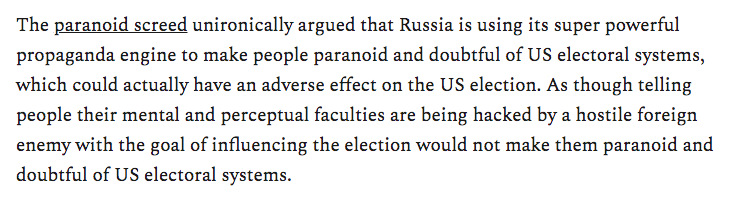
Zakaria's piece builds on this already established theme by parroting the still completely evidence-free claim that Russia was responsible for the far-reaching cyber intrusion into the IT company
"The dawn of political insight comes when you realize that propaganda is not just something that is done by other nations to other
The Washington Post has published another article warning its readers that the Russians are "hacking our minds", this one authored by CNN's Fareed
The problem is not just that Russia has hacked America\u2019s computer systems. It seems to have hacked our minds.
— Fareed Zakaria (@FareedZakaria) December 18, 2020
My latest column: https://t.co/iVFK7u2F4o
The article about "the Russian model" of propaganda where "people get convinced when they hear the same message many times from a variety of sources, no matter how biased."
Which is funny, since WaPo has been repeating this same ridiculous
"Russia and other adversaries may not need to hack the election if they can hack something else: our minds."
— Caitlin Johnstone \u23f3 (@caitoz) October 4, 2020
From The Washington Post. Democracy Dies in Darkness. pic.twitter.com/RkURiogRUc
Just two months ago the Washington Post editorial board published an article which opens with the line "Russia and other adversaries may not need to hack the election if they can hack something else: our minds."
Zakaria's piece builds on this already established theme by parroting the still completely evidence-free claim that Russia was responsible for the far-reaching cyber intrusion into the IT company
So We're Already At The 'Chinese Super Soldiers' Part Of The Propaganda Campaign
"Truth, as they say, is the first casualty in war. With its emphasis on global narrative control in lieu of conventional military tactics, this is doubly true of cold
"What we know is that the nation’s top intelligence official says that the US has evidence that China is conducting biological experiments on its soldiers to enhance their capabilities," said CIA asset and reporter Ken Dilanian on a recent MSNBC
"Picture super strong commandos who can operate on three hours' sleep, or a sniper who can see twice as far as a normal person."
~ CIA stooge Dilanian
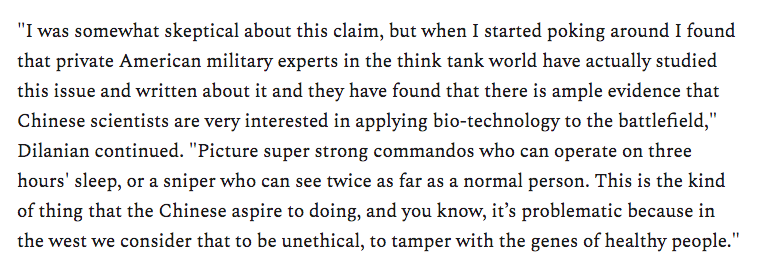
Dilanian was referring to a claim made in a freakish screed of cold war smut recently published in the Wall Street Journal by US Director of National Intelligence John Ratcliffe titled "China Is National Security Threat No. 1".
https://t.co/zdsuhRw2YR

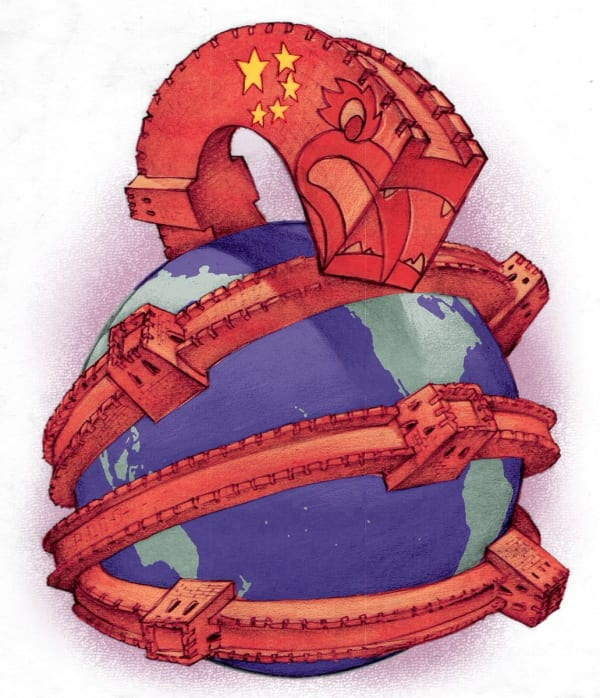
The piece includes an illustration of a red serpent shaped like the Great Wall squeezing the world in its coils, much like the globe-strangling tentacled beasts traditionally used in propaganda to drum up fears of communists and Jews taking over the world.
"Truth, as they say, is the first casualty in war. With its emphasis on global narrative control in lieu of conventional military tactics, this is doubly true of cold
"What we know is that the nation’s top intelligence official says that the US has evidence that China is conducting biological experiments on its soldiers to enhance their capabilities," said CIA asset and reporter Ken Dilanian on a recent MSNBC
"Picture super strong commandos who can operate on three hours' sleep, or a sniper who can see twice as far as a normal person."
~ CIA stooge Dilanian
Dilanian was referring to a claim made in a freakish screed of cold war smut recently published in the Wall Street Journal by US Director of National Intelligence John Ratcliffe titled "China Is National Security Threat No. 1".
https://t.co/zdsuhRw2YR
The piece includes an illustration of a red serpent shaped like the Great Wall squeezing the world in its coils, much like the globe-strangling tentacled beasts traditionally used in propaganda to drum up fears of communists and Jews taking over the world.
More from Politics


We’ve been getting calls and outreach from Queens residents all day about this.
The community’s response? Outrage.
Amazon is a billion-dollar company. The idea that it will receive hundreds of millions of dollars in tax breaks at a time when our subway is crumbling and our communities need MORE investment, not less, is extremely concerning to residents here.
When we talk about bringing jobs to the community, we need to dig deep:
- Has the company promised to hire in the existing community?
- What’s the quality of jobs + how many are promised? Are these jobs low-wage or high wage? Are there benefits? Can people collectively bargain?
Displacement is not community development. Investing in luxury condos is not the same thing as investing in people and families.
Shuffling working class people out of a community does not improve their quality of life.
We need to focus on good healthcare, living wages, affordable rent. Corporations that offer none of those things should be met w/ skepticism.
It’s possible to establish economic partnerships w/ real opportunities for working families, instead of a race-to-the-bottom competition.
The community’s response? Outrage.
Amazon will divide its second headquarters evenly between New York's Long Island City and Arlington County's Crystal City neighborhoods. Other cities may also receive major sites. https://t.co/c1lKmeQinX
— The Wall Street Journal (@WSJ) November 13, 2018
Amazon is a billion-dollar company. The idea that it will receive hundreds of millions of dollars in tax breaks at a time when our subway is crumbling and our communities need MORE investment, not less, is extremely concerning to residents here.
When we talk about bringing jobs to the community, we need to dig deep:
- Has the company promised to hire in the existing community?
- What’s the quality of jobs + how many are promised? Are these jobs low-wage or high wage? Are there benefits? Can people collectively bargain?
Displacement is not community development. Investing in luxury condos is not the same thing as investing in people and families.
Shuffling working class people out of a community does not improve their quality of life.
We need to focus on good healthcare, living wages, affordable rent. Corporations that offer none of those things should be met w/ skepticism.
It’s possible to establish economic partnerships w/ real opportunities for working families, instead of a race-to-the-bottom competition.

I think a plausible explanation is that whatever Corbyn says or does, his critics will denounce - no matter how much hypocrisy it necessitates.
Corbyn opposes the exploitation of foreign sweatshop-workers - Labour MPs complain he's like Nigel
He speaks up in defence of migrants - Labour MPs whinge that he's not listening to the public's very real concerns about immigration:
He's wrong to prioritise Labour Party members over the public:
He's wrong to prioritise the public over Labour Party
One of the oddest features of the Labour tax row is how raising allowances, which the media allowed the LDs to describe as progressive (in spite of evidence to contrary) through the coalition years, is now seen by everyone as very right wing
— Tom Clark (@prospect_clark) November 2, 2018
Corbyn opposes the exploitation of foreign sweatshop-workers - Labour MPs complain he's like Nigel
He speaks up in defence of migrants - Labour MPs whinge that he's not listening to the public's very real concerns about immigration:
He's wrong to prioritise Labour Party members over the public:
He's wrong to prioritise the public over Labour Party