
Raslila is a divine play, a form of dance without any CARNAL DESIRES.For this very reason,
The most miraculous place of the world..
Nidhivan (Nidhi means Pleasure & Van means Garden) , is a forest in Vrindavan where Lord Krishna spent his childhood. It's a same place where Swami Haridas ji manifested the deity of Shri Bankey Bihari ji.
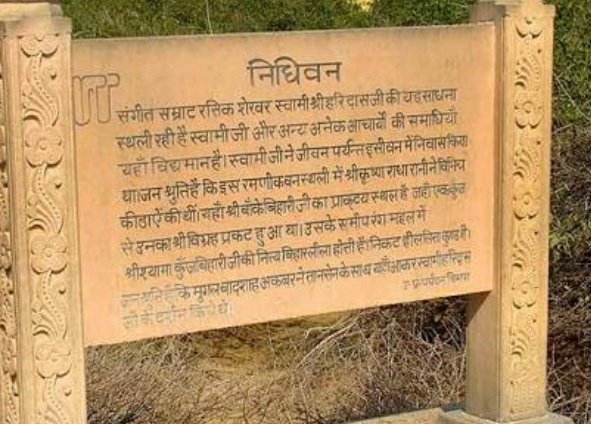
Raslila is a divine play, a form of dance without any CARNAL DESIRES.For this very reason,
Krishna performs Raslila in Nidhivan with Srimati Radharani & 16108 Gopis who r present there in d form of trees..
The Gopis r none other than sages in their previous births who had done rigorous tapasya &
It is said that only such pure Souls hear d sound of Krishna's divine flute during d play..

Rang Mahal in Nidhivan: Its a small temple inside Nidhivan. Just before the temple closes ,

Many historians & scientists who hv attempted to unlock d mystery of Nidhivan hv cm fully satisfied that Lord resides in this place.
Samadhi of Swamy Haridas:The garden also houses d samadhi of d great singer & devotee Shri Haridas. RadheKrishna appeared before him in Nidhivan..
Thread
— S@B$ (@Enigma2916) December 11, 2020
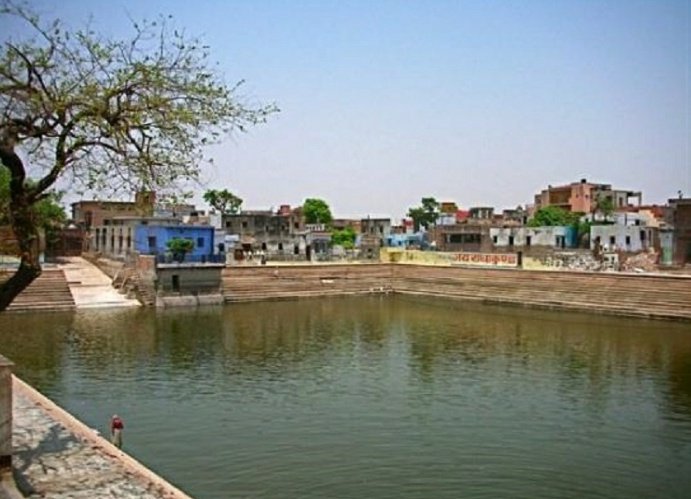
Radha Kund and Shyama Kund, the two most spiritually surcharged ,r located a village called Arita about 3 miles north-east of\xa0Govardhan& fourteen miles from Mathura & Vrindavan.These 2 pond ponds r right nxt to each other.
Radha Kund (Left)
Shyam Kund (Right) pic.twitter.com/BqPb52zNWj
More from Politics

1/Politics thread time.
To me, the most important aspect of the 2018 midterms wasn't even about partisan control, but about democracy and voting rights. That's the real battle.
2/The good news: It's now an issue that everyone's talking about, and that everyone cares about.
3/More good news: Florida's proposition to give felons voting rights won. But it didn't just win - it won with substantial support from Republican voters.
That suggests there is still SOME grassroots support for democracy that transcends
4/Yet more good news: Michigan made it easier to vote. Again, by plebiscite, showing broad support for voting rights as an
5/OK, now the bad news.
We seem to have accepted electoral dysfunction in Florida as a permanent thing. The 2000 election has never really
To me, the most important aspect of the 2018 midterms wasn't even about partisan control, but about democracy and voting rights. That's the real battle.
2/The good news: It's now an issue that everyone's talking about, and that everyone cares about.
3/More good news: Florida's proposition to give felons voting rights won. But it didn't just win - it won with substantial support from Republican voters.
That suggests there is still SOME grassroots support for democracy that transcends
4/Yet more good news: Michigan made it easier to vote. Again, by plebiscite, showing broad support for voting rights as an
5/OK, now the bad news.
We seem to have accepted electoral dysfunction in Florida as a permanent thing. The 2000 election has never really
Bad ballot design led to a lot of undervotes for Bill Nelson in Broward Co., possibly even enough to cost him his Senate seat. They do appear to be real undervotes, though, instead of tabulation errors. He doesn't really seem to have a path to victory. https://t.co/utUhY2KTaR
— Nate Silver (@NateSilver538) November 16, 2018

So let's see a show of hands: how many of you even knew Huber was digging into the Clinton Foundation? While he was assisting Horowitz in his digging into the FISC/Steele Dossier/Fusion GPS/Perkins Coie/DNC/Hillary campaign stuff?
I'm sure Huber is coming to DC *only* to discuss Clinton Foundation things with Meadows and his committee.
He for certain, like, won't be huddling with Horowitz or that new guy, Whitaker while he's in town. That would NEVER HAPPEN. [wink wink wink!] 😉
I just spent a year and a half telling you they will SHOW YOU what they are REALLY DOING when they are READY.
Not before.
No matter how much whining is done about it.
I'm exhausted but it's worth it.
Now you know why they're f**king TERRIFIED of Whitaker, the closer tapped by Trump to come in late for the hysterical fireworks that will ensue soon.
Look who's suddenly fund raising for his legal defen- er, I mean, ha ha - his reelection campaign!
Breaking News: House GOP to hold investigative hearing into DOJ\u2019s handling of Clinton Foundation probe. Top prosecutor to be summoned. https://t.co/HogyXHHcvo
— John Solomon (@jsolomonReports) November 21, 2018
I'm sure Huber is coming to DC *only* to discuss Clinton Foundation things with Meadows and his committee.
He for certain, like, won't be huddling with Horowitz or that new guy, Whitaker while he's in town. That would NEVER HAPPEN. [wink wink wink!] 😉
I just spent a year and a half telling you they will SHOW YOU what they are REALLY DOING when they are READY.
Not before.
No matter how much whining is done about it.
I'm exhausted but it's worth it.
Now you know why they're f**king TERRIFIED of Whitaker, the closer tapped by Trump to come in late for the hysterical fireworks that will ensue soon.
Look who's suddenly fund raising for his legal defen- er, I mean, ha ha - his reelection campaign!
President Trump just attacked Adam on Twitter with his most profane insult yet. Will you chip in $5 to send Trump a message and show him you stand with Adam?
— Adam Schiff (@AdamSchiff) November 19, 2018


This is partly what makes it impossible to have a constructive conversation nowadays. The stubborn refusal to accept that opposition to Trumpism and GOP nationalism is about more than simply holding different beliefs about things in and of itself. 👇
It's fine for people to hold different beliefs. But that doesn't mean all beliefs deserve equal treatment or tolerance and it doesn't mean intolerance of some beliefs makes a person intolerant of every belief which they don't share.
So if I said I don't think Trumpism deserves to be tolerated because it's just a fresh 21st century coat of cheap paint on a failed, dangerous 20th century ideology (fascism) that doesn't mean I'm intolerant of all beliefs with which I disagree. You'd think this would be obvious.
Another important facet. People who support fascist movements tend to give what they think are valid reasons for supporting them. That doesn't mean anyone is obliged to tolerate fascism or accept their proffered excuse.
Say you joined a neighborhood group that sets up community gardens and does roadside beautification projects. All good, right? Say one day you're having a meeting and you notice the President and exec board of this group are saying some bizarre things about certain neighbors.
No, but you can\u2019t keep labeling half of the country Nazis just because their beliefs are different than yours. Trump has fucked this whole country up in a matter of a few years. No one can even have a constructive conversation without someone getting triggered
— Joshua Savoy (@JoshuaSavoy2) February 11, 2021
It's fine for people to hold different beliefs. But that doesn't mean all beliefs deserve equal treatment or tolerance and it doesn't mean intolerance of some beliefs makes a person intolerant of every belief which they don't share.
So if I said I don't think Trumpism deserves to be tolerated because it's just a fresh 21st century coat of cheap paint on a failed, dangerous 20th century ideology (fascism) that doesn't mean I'm intolerant of all beliefs with which I disagree. You'd think this would be obvious.
Another important facet. People who support fascist movements tend to give what they think are valid reasons for supporting them. That doesn't mean anyone is obliged to tolerate fascism or accept their proffered excuse.
Just because some of the politicians act that way doesn\u2019t mean the whole party are Nazis. Some Republicans just vote that way because of abortion. You can\u2019t keep calling all of them Nazis and expect them to just start listening to your points.
— Joshua Savoy (@JoshuaSavoy2) February 11, 2021
Say you joined a neighborhood group that sets up community gardens and does roadside beautification projects. All good, right? Say one day you're having a meeting and you notice the President and exec board of this group are saying some bizarre things about certain neighbors.
You May Also Like


The entire discussion around Facebook’s disclosures of what happened in 2016 is very frustrating. No exec stopped any investigations, but there were a lot of heated discussions about what to publish and when.
In the spring and summer of 2016, as reported by the Times, activity we traced to GRU was reported to the FBI. This was the standard model of interaction companies used for nation-state attacks against likely US targeted.
In the Spring of 2017, after a deep dive into the Fake News phenomena, the security team wanted to publish an update that covered what we had learned. At this point, we didn’t have any advertising content or the big IRA cluster, but we did know about the GRU model.
This report when through dozens of edits as different equities were represented. I did not have any meetings with Sheryl on the paper, but I can’t speak to whether she was in the loop with my higher-ups.
In the end, the difficult question of attribution was settled by us pointing to the DNI report instead of saying Russia or GRU directly. In my pre-briefs with members of Congress, I made it clear that we believed this action was GRU.
The story doesn\u2019t say you were told not to... it says you did so without approval and they tried to obfuscate what you found. Is that true?
— Sarah Frier (@sarahfrier) November 15, 2018
In the spring and summer of 2016, as reported by the Times, activity we traced to GRU was reported to the FBI. This was the standard model of interaction companies used for nation-state attacks against likely US targeted.
In the Spring of 2017, after a deep dive into the Fake News phenomena, the security team wanted to publish an update that covered what we had learned. At this point, we didn’t have any advertising content or the big IRA cluster, but we did know about the GRU model.
This report when through dozens of edits as different equities were represented. I did not have any meetings with Sheryl on the paper, but I can’t speak to whether she was in the loop with my higher-ups.
In the end, the difficult question of attribution was settled by us pointing to the DNI report instead of saying Russia or GRU directly. In my pre-briefs with members of Congress, I made it clear that we believed this action was GRU.


