OK. India's External Affairs Minister @DrSJaishankar is about to speak to @mfullilove at @LowyInstitute and I'm going to live tweet. Please mute if you don't care about India's foreign policy (you should though you numpties, it's stupendously interesting) 1/

Jaishankar was previously the head of MEA (comparable to @dfat Secretary) before becoming Minister. Fullilove asks which job is more satisfying. Jaishankar doesn't quite answer but says the ministerial role gave him a "broader" view of both domestic and international politics 2/
Now to Jaishankar's new book "The India Way." He says the core ideas he's exploring in the book are "multi-polarity and re-balancing." A "new architecture" is being built as power shifts. But countries are now far more interdependent. This creates "constrained competition" 3/
Jaishankar also says a new "more expanded" view of national security is emerging, which includes things like "health, food, trade, data and energy" 4/
The Minister says he also "indirectly" broaches the argument over US decline in his book. He says he's "not a great believer" in US declinism, but adds that as relative power shifts "it creates an argument for a different relationship between the West and India" 5/
India has been battered by #COVID19 . Jaishankar recognises the scale of the challenge. He says the pandemic "took us completely by surprise." And he acknowledges that in some ways India was "completely unprepared" to deal with the crisis 6/
But he is cautiously optimistic about India's recovery. He says daily cases are down to one third of what they were at the peak. And he also believes the economy is on a path to recovery and growth 7/
Fullilove asks about Jaishankar's views on Xi Jinping and China in 2020. Jaishankar says these days "you have a very much more nationalistic China, and that is expressed down the line in a variety of ways. Often in policies as well." 8/
Now to India's conflict with China and the border standoff in Ladakh. Jaishankar says Chinese incursions are at the heart of the problem- "they have brought tens of thousands of soldiers to the LAC" (Line of Actual Control) 9/
Frank stuff here. Jaishankar says in these circumstances it is "not entirely surprising that something went horribly wrong" with clashes and combat deaths on the border. He says the conflict has "completely changed national sentiment (towards China) in India" 10/
Jaishankar: "peace on border is the basis for the (India China) relationship to progress." He says it's "not realistic" to separate the conflict from other elements of bilateral ties: "frankly the relationship has been significantly damaged" 11/
Jaishankar is downright gushing about how the India-Australia relationship has grown. Recites cliches about cricket, but more important: "if there's one relationship I take satisfaction in it is the Australia-India relationship." He calls it "a partnership waiting to happen" 12/
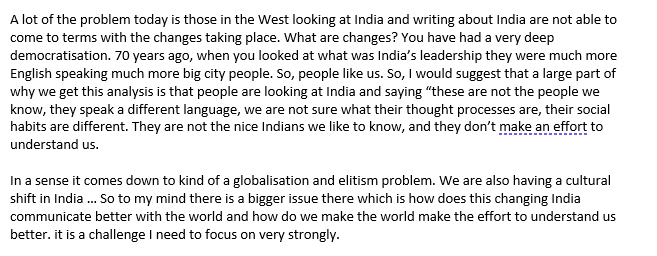
Now Fullilove asks about democracy in India. He quotes an Economist piece which argued civil liberties and the rule of law are being degraded under Modi. He asks "are you concerned by perceptions in the West that India is moving in an illiberal direction" 13/
Jaishankar is quite dismissive. He argues some Western liberals are uncomfortable with contemporary India simply because they have not grappled with the way it has democratised. Its political leaders are no long English-speaking elites with familiar attitudes 14/
The full answer here really is quite interesting, so I'm reproducing it below 15/
Now Jaishankar is asked if Australia and India will ever sign a formal trade or defence pact. Jaishankar acknowledges the long running FTA negotiations (editor: don't hold your breath) and emphasises defence cooperation. But adds he doesn't know how formal those links will be 16/
The conversation ends with another somewhat painful cricket analogy (I LOVE CRICKET BUT WHY DO WE ALWAYS RESORT TO CRICKET CLICHES WHEN WE TALK ABOUT AUSTRALIA-INDIA TIES ARGGHHH) but overall it was both illuminating and interesting 17/

More from Politics

THREAD

1)
@SidneyPowell1 reflects on #Iran’s meddling in the U.S. in a recent tweet to U.S. President Donald Trump.

This thread focuses on Iran’s dangerous influence in the U.S., especially through its DC-based lobby group


2)
Why is this important?

@DNI_Ratcliffe "told CBS News that there was foreign election interference by China, #Iran & Russia in November of this year [2020]."

All Americans should be informed about how Iran & its lobby group NIAC are meddling in the


3)
#Iran has been increasingly aiming to interfere in U.S. elections specifically through NIAC.

DNI John Ratcliffe had previously shed light on this vital


4)
NIAC is a lobby group in the U.S. pushing Iran’s talking points.

Listen to this Iranian regime insider explain that NIAC was established by @JZarif, the foreign minister of


5)
@tparsi is the official founder of NIAC in the U.S.

Listen to how Trita Parsi parrots Zarif’s talking
This idea - that elections should translate into policy - is not wrong at all. But political science can help explain why it's not working this way. There are three main explanations: 1. mandates are constructed, not automatic, 2. party asymmetry, 3. partisan conpetition 1/


First, party/policy mandates from elections are far from self-executing in our system. Work on mandates from Dahl to Ellis and Kirk on the history of the mandate to mine on its role in post-Nixon politics, to Peterson Grossback and Stimson all emphasize that this link is... 2/

Created deliberately and isn't always persuasive. Others have to convinced that the election meant a particular thing for it to work in a legislative context. I theorized in the immediate period of after the 2020 election that this was part of why Repubs signed on to ...3/

Trump's demonstrably false fraud nonsense - it derailed an emerging mandate news cycle. Winners of elections get what they get - institutional control - but can't expect much beyond that unless the perception of an election mandate takes hold. And it didn't. 4/

Let's turn to the legislation element of this. There's just an asymmetry in terms of passing a relief bill. Republicans are presumably less motivated to get some kind of deal passed. Democrats are more likely to want to do *something.* 5/

You May Also Like