
⬇️⬇️⬇️ The "Math" of Fear
As it is Thursday, I have a post for you today in anticipation of Gov. DeWine's new Maps of Fear which he has tried to phase in. I have previously discussed both the new red and blue maps and their issues -
The first is a hyper-simplistic (and unrealistic) but illustrative example of the calculations that the new blue map goes through to arrive at its numbers.
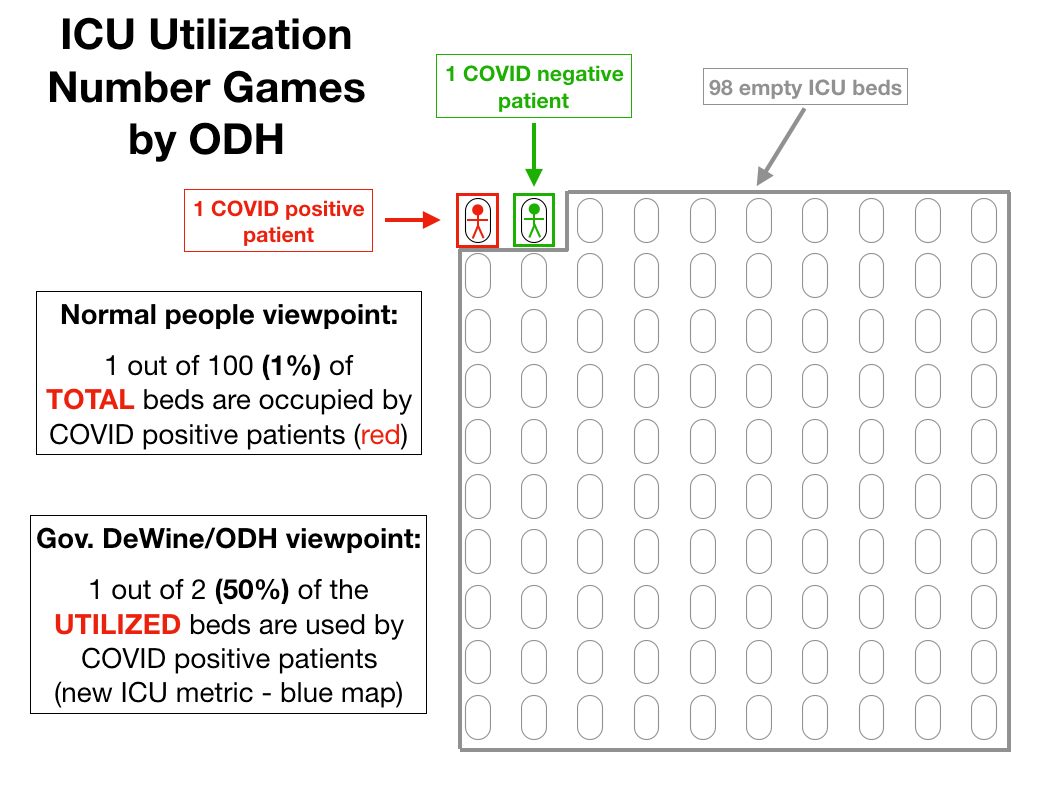
But that's not how Gov. DeWine would present this situation to us. Instead of looking at the total available beds, they look only at the beds in use.
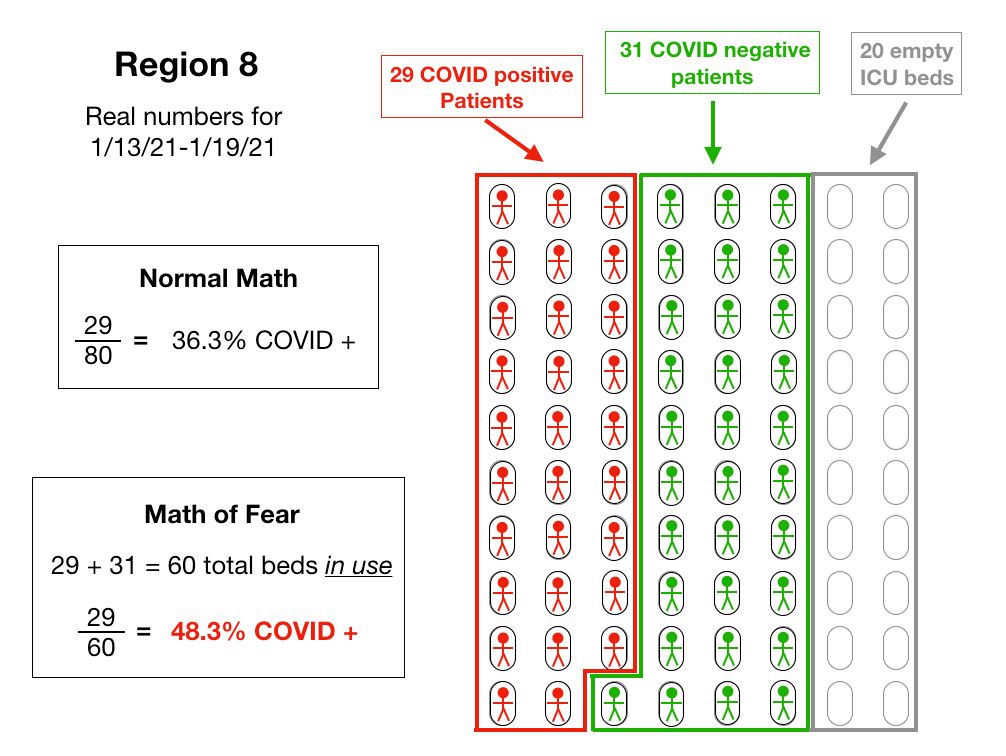
By manipulating the numbers, they have increased the real percentage by a third.
More from Maths

Loops and their multiplication groups
A thread in 15 parts
(0/15)
Recall that a quasigroup (Q,*) is a set Q with a binary operation * such that for each a,b in Q, the equations a*x=b and y*a=b have unique solutions x,y. Groups are quasigroups and this property is usually one of the first things proved in elementary group theory.
(1/15)
Note that we don't assume associativity of *!
A loop is a quasigroup with an identity element. The story of why they are called loops is an interesting one and may even be true, but I will save it for another day. I am going to focus on loops in this thread.
(2/15)
Natural examples of nonassociative loops:
- The nonzero octonions under multiplication
- The sphere S^7 under octonion multiplication
- I have discussed other examples
For each x in a loop Q, define the left & right translations L_x, R_x : Q->Q by L_x(y)=xy and R_x(y)=yx. These mappings are permutations of Q. The composition L_x L_y of two left translations is not necessarily a left translation because Q is not necessarily associative.
(4/15)
A thread in 15 parts
(0/15)
Recall that a quasigroup (Q,*) is a set Q with a binary operation * such that for each a,b in Q, the equations a*x=b and y*a=b have unique solutions x,y. Groups are quasigroups and this property is usually one of the first things proved in elementary group theory.
(1/15)
Note that we don't assume associativity of *!
A loop is a quasigroup with an identity element. The story of why they are called loops is an interesting one and may even be true, but I will save it for another day. I am going to focus on loops in this thread.
(2/15)
Natural examples of nonassociative loops:
- The nonzero octonions under multiplication
- The sphere S^7 under octonion multiplication
- I have discussed other examples
Rethinking Vector Addition
— Michael Kinyon (@ProfKinyon) December 1, 2020
or
How I Learned to Stop Worrying and Love Nonassociativity
A thread in 29 tweets
(0/28)
For each x in a loop Q, define the left & right translations L_x, R_x : Q->Q by L_x(y)=xy and R_x(y)=yx. These mappings are permutations of Q. The composition L_x L_y of two left translations is not necessarily a left translation because Q is not necessarily associative.
(4/15)


You May Also Like

Master Thread of all my threads!
Hello!! 👋
• I have curated some of the best tweets from the best traders we know of.
• Making one master thread and will keep posting all my threads under this.
• Go through this for super learning/value totally free of cost! 😃
1. 7 FREE OPTION TRADING COURSES FOR
2. THE ABSOLUTE BEST 15 SCANNERS EXPERTS ARE USING
Got these scanners from the following accounts:
1. @Pathik_Trader
2. @sanjufunda
3. @sanstocktrader
4. @SouravSenguptaI
5. @Rishikesh_ADX
3. 12 TRADING SETUPS which experts are using.
These setups I found from the following 4 accounts:
1. @Pathik_Trader
2. @sourabhsiso19
3. @ITRADE191
4.
4. Curated tweets on HOW TO SELL STRADDLES.
Everything covered in this thread.
1. Management
2. How to initiate
3. When to exit straddles
4. Examples
5. Videos on
Hello!! 👋
• I have curated some of the best tweets from the best traders we know of.
• Making one master thread and will keep posting all my threads under this.
• Go through this for super learning/value totally free of cost! 😃
1. 7 FREE OPTION TRADING COURSES FOR
A THREAD:
— Aditya Todmal (@AdityaTodmal) November 28, 2020
7 FREE OPTION TRADING COURSES FOR BEGINNERS.
Been getting lot of dm's from people telling me they want to learn option trading and need some recommendations.
Here I'm listing the resources every beginner should go through to shorten their learning curve.
(1/10)
2. THE ABSOLUTE BEST 15 SCANNERS EXPERTS ARE USING
Got these scanners from the following accounts:
1. @Pathik_Trader
2. @sanjufunda
3. @sanstocktrader
4. @SouravSenguptaI
5. @Rishikesh_ADX
The absolute best 15 scanners which experts are using.
— Aditya Todmal (@AdityaTodmal) January 29, 2021
Got these scanners from the following accounts:
1. @Pathik_Trader
2. @sanjufunda
3. @sanstocktrader
4. @SouravSenguptaI
5. @Rishikesh_ADX
Share for the benefit of everyone.
3. 12 TRADING SETUPS which experts are using.
These setups I found from the following 4 accounts:
1. @Pathik_Trader
2. @sourabhsiso19
3. @ITRADE191
4.
12 TRADING SETUPS which experts are using.
— Aditya Todmal (@AdityaTodmal) February 7, 2021
These setups I found from the following 4 accounts:
1. @Pathik_Trader
2. @sourabhsiso19
3. @ITRADE191
4. @DillikiBiili
Share for the benefit of everyone.
4. Curated tweets on HOW TO SELL STRADDLES.
Everything covered in this thread.
1. Management
2. How to initiate
3. When to exit straddles
4. Examples
5. Videos on
Curated tweets on How to Sell Straddles
— Aditya Todmal (@AdityaTodmal) February 21, 2021
Everything covered in this thread.
1. Management
2. How to initiate
3. When to exit straddles
4. Examples
5. Videos on Straddles
Share if you find this knowledgeable for the benefit of others.









I think a plausible explanation is that whatever Corbyn says or does, his critics will denounce - no matter how much hypocrisy it necessitates.
Corbyn opposes the exploitation of foreign sweatshop-workers - Labour MPs complain he's like Nigel
He speaks up in defence of migrants - Labour MPs whinge that he's not listening to the public's very real concerns about immigration:
He's wrong to prioritise Labour Party members over the public:
He's wrong to prioritise the public over Labour Party
One of the oddest features of the Labour tax row is how raising allowances, which the media allowed the LDs to describe as progressive (in spite of evidence to contrary) through the coalition years, is now seen by everyone as very right wing
— Tom Clark (@prospect_clark) November 2, 2018
Corbyn opposes the exploitation of foreign sweatshop-workers - Labour MPs complain he's like Nigel
He speaks up in defence of migrants - Labour MPs whinge that he's not listening to the public's very real concerns about immigration:
He's wrong to prioritise Labour Party members over the public:
He's wrong to prioritise the public over Labour Party