Based on my many years experience, I’ve developed 24 laws of ad tech product management. These are “laws”, meaning they are always true, everywhere. Thread...
7. There\u2019s nothing more important to your customers than macros.
— Ari Paparo (@aripap) February 16, 2021
More from Marketing

Can't run FB ads on your own profile?
No problem.
Here's how you use a virtual browser to run ads safely on someone else's FB account.
** Thread **
In order for this to work, you need to have permission from someone to use their FB profile.
Whether that's a friend/family of yours or some random guy/gal you pay.
Because you'll need the login information to their FB profile.
Just a heads up.
A virtual browser is the best solution I've found for this.
A remote access tool like Splashtop is an alternative option but the user has to have their computer on if you want to access it.
This can create a bunch of headaches which is why I prefer to use a virtual browser.
It allows you to access the user's computer alongside them so you're able to log on whenever you like no matter if the user is using their computer or not.
I'm sure there are a bunch of options for virtual browsers but I use Multilogin ==> https://t.co/RF6s0Mto8f
99% of you will be fine with the Solo package which is around $100 a month.
Small price to pay, if this is the only option you have to run ads.
No problem.
Here's how you use a virtual browser to run ads safely on someone else's FB account.
** Thread **
In order for this to work, you need to have permission from someone to use their FB profile.
Whether that's a friend/family of yours or some random guy/gal you pay.
Because you'll need the login information to their FB profile.
Just a heads up.
A virtual browser is the best solution I've found for this.
A remote access tool like Splashtop is an alternative option but the user has to have their computer on if you want to access it.
This can create a bunch of headaches which is why I prefer to use a virtual browser.
It allows you to access the user's computer alongside them so you're able to log on whenever you like no matter if the user is using their computer or not.
I'm sure there are a bunch of options for virtual browsers but I use Multilogin ==> https://t.co/RF6s0Mto8f
99% of you will be fine with the Solo package which is around $100 a month.
Small price to pay, if this is the only option you have to run ads.


Hey #EconTwitter: For the first time in 20 years, I am not spending my first week of January at the @ASSAMeeting. It's a weird feeling; I've always enjoyed showing off new books, connecting with friends, and talking with economists about new ideas 1/25
As with so much else, #ASSA2021 will be a new (hopefully one-off) experience; and even though I'm not standing by a booth in a sub-basement of the Hyatt Regency Chicago, I'd like to introduce you to some recent and forthcoming books in #economics from @yalepress 2/25
First up is CAUSAL INFERENCE: THE MIXTAPE by @causalinf. The short description is that this is a toolkit for economists and other social scientists to untangle cause and effect, but this book is so much more than that 3/25

It is a labor of love by @causalinf; a guide through one of the most important ideas in economics; and an indispensable "second book" for any econometrics course. It is also the only book you'll ever see that has been endorsed by both @JustinWolfers and @officialyoungmc 4/25
If you've used the online version of the Mixtape in the past, this edition is wholly revised and expanded, with coding for both R and Stata. An HTML version will be accessible at https://t.co/QSvOJb0HSG. You'll want the physical book as well; they are complementary goods 5/25
As with so much else, #ASSA2021 will be a new (hopefully one-off) experience; and even though I'm not standing by a booth in a sub-basement of the Hyatt Regency Chicago, I'd like to introduce you to some recent and forthcoming books in #economics from @yalepress 2/25
First up is CAUSAL INFERENCE: THE MIXTAPE by @causalinf. The short description is that this is a toolkit for economists and other social scientists to untangle cause and effect, but this book is so much more than that 3/25
It is a labor of love by @causalinf; a guide through one of the most important ideas in economics; and an indispensable "second book" for any econometrics course. It is also the only book you'll ever see that has been endorsed by both @JustinWolfers and @officialyoungmc 4/25
If you've used the online version of the Mixtape in the past, this edition is wholly revised and expanded, with coding for both R and Stata. An HTML version will be accessible at https://t.co/QSvOJb0HSG. You'll want the physical book as well; they are complementary goods 5/25

You May Also Like


1/OK, data mystery time.
This New York Times feature shows China with a Gini Index of less than 30, which would make it more equal than Canada, France, or the Netherlands. https://t.co/g3Sv6DZTDE
That's weird. Income inequality in China is legendary.
Let's check this number.
2/The New York Times cites the World Bank's recent report, "Fair Progress? Economic Mobility across Generations Around the World".
The report is available here:
3/The World Bank report has a graph in which it appears to show the same value for China's Gini - under 0.3.
The graph cites the World Development Indicators as its source for the income inequality data.
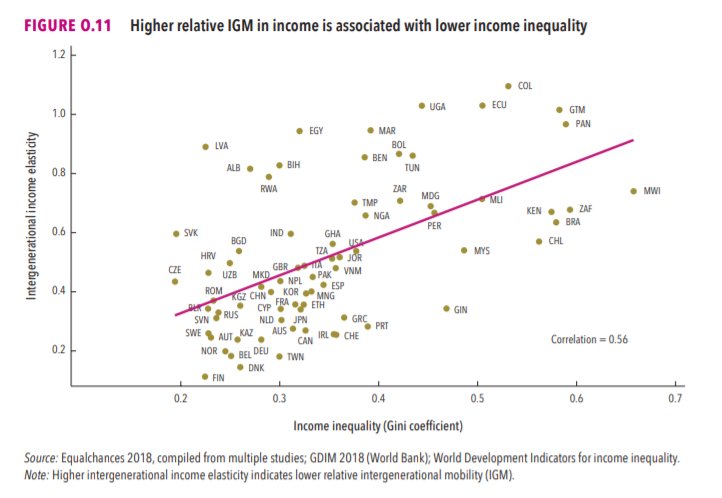
4/The World Development Indicators are available at the World Bank's website.
Here's the Gini index: https://t.co/MvylQzpX6A
It looks as if the latest estimate for China's Gini is 42.2.
That estimate is from 2012.
5/A Gini of 42.2 would put China in the same neighborhood as the U.S., whose Gini was estimated at 41 in 2013.
I can't find the <30 number anywhere. The only other estimate in the tables for China is from 2008, when it was estimated at 42.8.
This New York Times feature shows China with a Gini Index of less than 30, which would make it more equal than Canada, France, or the Netherlands. https://t.co/g3Sv6DZTDE
That's weird. Income inequality in China is legendary.
Let's check this number.
2/The New York Times cites the World Bank's recent report, "Fair Progress? Economic Mobility across Generations Around the World".
The report is available here:
3/The World Bank report has a graph in which it appears to show the same value for China's Gini - under 0.3.
The graph cites the World Development Indicators as its source for the income inequality data.
4/The World Development Indicators are available at the World Bank's website.
Here's the Gini index: https://t.co/MvylQzpX6A
It looks as if the latest estimate for China's Gini is 42.2.
That estimate is from 2012.
5/A Gini of 42.2 would put China in the same neighborhood as the U.S., whose Gini was estimated at 41 in 2013.
I can't find the <30 number anywhere. The only other estimate in the tables for China is from 2008, when it was estimated at 42.8.