
Lawyers - does Tanzin v. Tanvir set precedent for suing federal health officials for violating our rights?
SCOTUS has unanimously ruled that federal agents can be sued when they violate your rights. Now do qualified immunity. https://t.co/Gec47ZMEg0 via @reason
More from Dannielle (Dossy) Blumenthal PhD


Please remember this whistleblower's statements. The true objective here is an attack on Iran, which would presumably lead to draconian measures at home, and justify martial law. Look past the temporary events and see the scheme. Who truly controls
What is the real relationship between Kerry and Zarif? Does Iran truly control its own
Why did Obama have to mislead the American people in order to do a deal with Iran?
Jan 25 2018
CONFIRMED.
https://t.co/Y8k4D0ja4w📁
Why did HUSSEIN travel ahead of POTUS?
"Trump would not be in office for long, suggesting he could be out in a year."
Re-read crumbs.
Future unlocks past.
Q
Note - the Q item is quoted.


More from Law





Some WESC submissions that are worth a read....(my thread of bookmarks)
Judge Paula Grey is president of the Gender Recognition Panel
She doesn't make any recommendations, but she sets out how the process currently works
Which chimes with my analysis of the GRP User Panel and statistics https://t.co/XixEz7lNJv
She is also co-author if the Equal Treatment Bench Book and writes about how the judges are trained by Gendered Intelligence
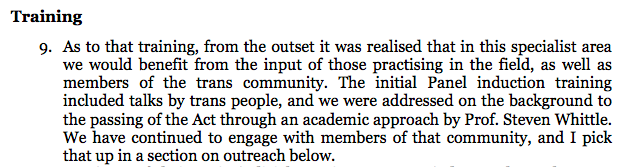
There is the government's own response
https://t.co/bOn9XecAkz
On single sex spaces they say the law is clear that service providers are able to restrict access to spaces on the basis of biological sex where there is clear justification.

The response from @womensaid is significant.
Their members want trans survivors to get support they need but not by undermining their ability to serve women with female staff & female only services
They highlight lack of clarity
https://t.co/p7096sZcos
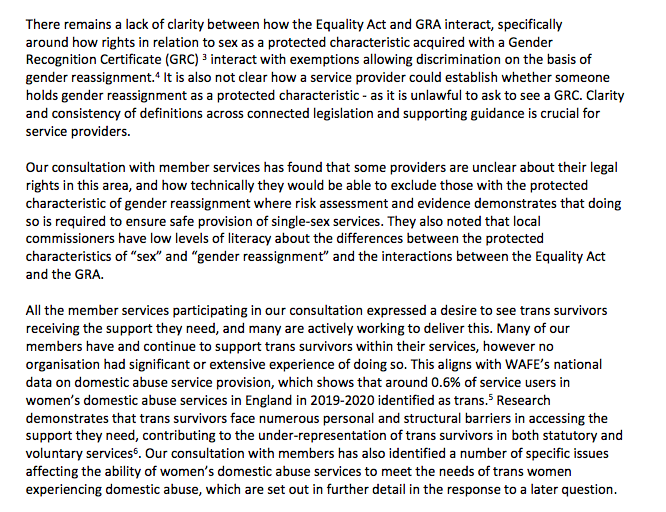
This was their position in 2015
They have moved on alot - they have been consulting with members since last year, and have had the courage to say what their members told them, not what Stonewall wanted to
Judge Paula Grey is president of the Gender Recognition Panel
She doesn't make any recommendations, but she sets out how the process currently works
Which chimes with my analysis of the GRP User Panel and statistics https://t.co/XixEz7lNJv
She is also co-author if the Equal Treatment Bench Book and writes about how the judges are trained by Gendered Intelligence
There is the government's own response
https://t.co/bOn9XecAkz
On single sex spaces they say the law is clear that service providers are able to restrict access to spaces on the basis of biological sex where there is clear justification.
The response from @womensaid is significant.
Their members want trans survivors to get support they need but not by undermining their ability to serve women with female staff & female only services
They highlight lack of clarity
https://t.co/p7096sZcos
This was their position in 2015
They have moved on alot - they have been consulting with members since last year, and have had the courage to say what their members told them, not what Stonewall wanted to

You May Also Like


1/“What would need to be true for you to….X”
Why is this the most powerful question you can ask when attempting to reach an agreement with another human being or organization?
A thread, co-written by @deanmbrody:
2/ First, “X” could be lots of things. Examples: What would need to be true for you to
- “Feel it's in our best interest for me to be CMO"
- “Feel that we’re in a good place as a company”
- “Feel that we’re on the same page”
- “Feel that we both got what we wanted from this deal
3/ Normally, we aren’t that direct. Example from startup/VC land:
Founders leave VC meetings thinking that every VC will invest, but they rarely do.
Worse over, the founders don’t know what they need to do in order to be fundable.
4/ So why should you ask the magic Q?
To get clarity.
You want to know where you stand, and what it takes to get what you want in a way that also gets them what they want.
It also holds them (mentally) accountable once the thing they need becomes true.
5/ Staying in the context of soliciting investors, the question is “what would need to be true for you to want to invest (or partner with us on this journey, etc)?”
Multiple responses to this question are likely to deliver a positive result.
Why is this the most powerful question you can ask when attempting to reach an agreement with another human being or organization?
A thread, co-written by @deanmbrody:
Next level tactic when closing a sale, candidate, or investment:
— Erik Torenberg (@eriktorenberg) February 27, 2018
Ask: \u201cWhat needs to be true for you to be all in?\u201d
You'll usually get an explicit answer that you might not get otherwise. It also holds them accountable once the thing they need becomes true.
2/ First, “X” could be lots of things. Examples: What would need to be true for you to
- “Feel it's in our best interest for me to be CMO"
- “Feel that we’re in a good place as a company”
- “Feel that we’re on the same page”
- “Feel that we both got what we wanted from this deal
3/ Normally, we aren’t that direct. Example from startup/VC land:
Founders leave VC meetings thinking that every VC will invest, but they rarely do.
Worse over, the founders don’t know what they need to do in order to be fundable.
4/ So why should you ask the magic Q?
To get clarity.
You want to know where you stand, and what it takes to get what you want in a way that also gets them what they want.
It also holds them (mentally) accountable once the thing they need becomes true.
5/ Staying in the context of soliciting investors, the question is “what would need to be true for you to want to invest (or partner with us on this journey, etc)?”
Multiple responses to this question are likely to deliver a positive result.