This thread will debunk "the judges didn't look at evidence" nonsense that has been going around.

Over and over again, judges have gone out of their way to listen to the evidence and dismantle it, enjoy the carnage!

1/

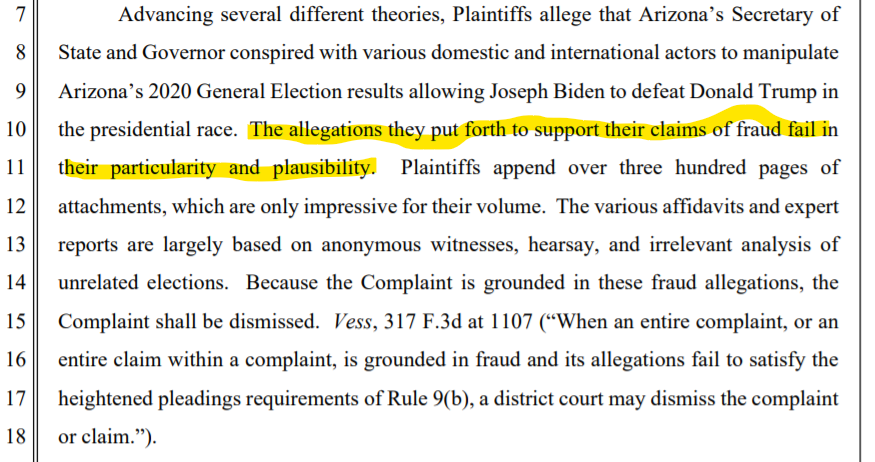
Bowyer v. Ducey (Sidney Powell's case in Arizona)

"Plaintiffs have not moved the
needle for their fraud theory from conceivable to plausible"

This is a great opinion to start with. The Judge completely dismantles the nonsense brought before her.

2/

https://t.co/F2vllUhM2G
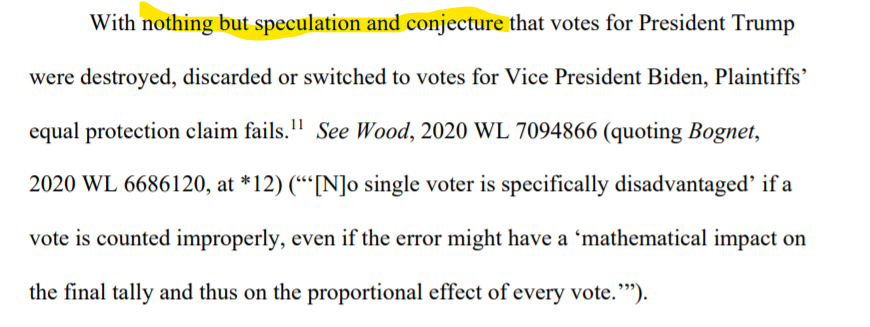
King vs. Whitmer (Michigan, Sidney Powell case)

"Nothing but speculation and conjecture"

This is a good one to show people who think affidavits are good evidence. Notice how the affidavits don't actually say they saw fraud happen in Detroit.

3/

https://t.co/NZAtqivWkL
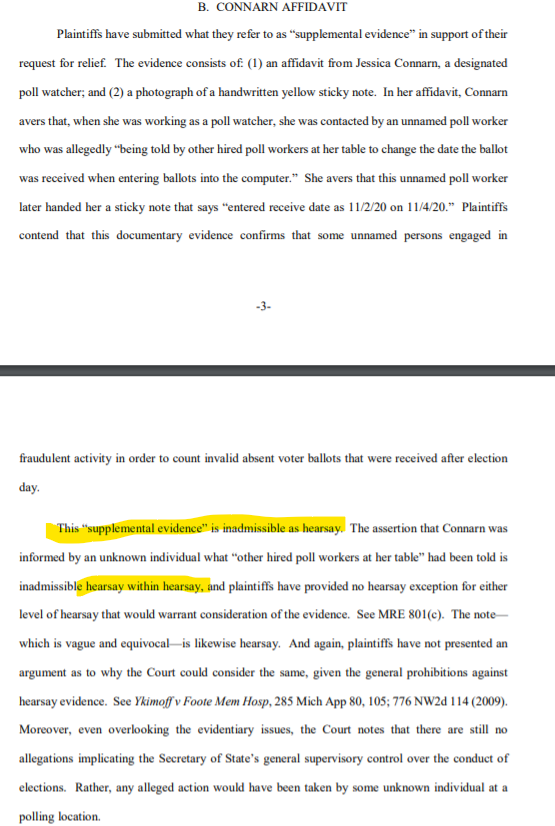
Trump v. Benson (Michigan)

"hearsay within hearsay"

Another good one to show people who think affidavits are absolute proof.

4/

https://t.co/17GeGhImHF
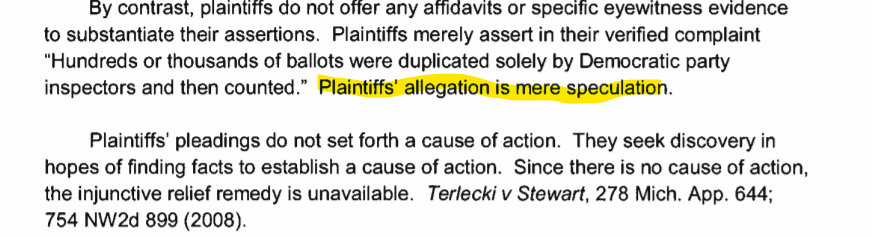
Stoddard v. City Election Commission (Michigan)

"mere speculation"

/5

https://t.co/ekqYEqiIL9
Law v. Whitmer (Nevada case backed by the Trump Campaign)

Literally the last four pages just show the utter lack of evidence of fraud of any kind. No point in highlighting everything!

/6
Constantio v. Detroit

This is another good one showing that the people being accused of fraud sign affidavits too. And they are far more trustworthy than rumors and innuendo. If the accusers had just shown up to training!

/7

https://t.co/Ci4ESGIN45
Arizona Republican Party v. Fontes

"A theory for which no evidence exists"

"the real issue" was not fraud, but "the outcome of the election"

Damn.

/8
https://t.co/5aTdtXbcrv
Ward v. Jackson (Arizona)

"the challenge fails to present any evidence of misconduct [or] illegal votes”

/9
https://t.co/w16Cmnga9G
I will definently add to this thread as I come across new cases. Please feel free to suggest them!

Also, I will probably do a thread that goes over the courts finding that the States did NOT break their own election laws, so let me know if you will find that useful!

More from Law

How to avoid (successful) accusations of defamation on Twitter. A few thoughts from someone who is NOT a libel lawyer, but does say very critical things about named individuals. 1/

1. Facts are different from opinions. But stating an opinion can imply a fact.
https://t.co/1PkiI4olib


2. When I tweet I aim to be sure A. I show the *facts* I am basing my *opinion* on. B. I have good reason to believe the *facts* are true. C. My opinion is reasonable based on the facts.

Here I am calling Arron Banks a racist (opinion). Pointing out this is because he called for mosques to be demolished (fact). 4/


I can prove this fact - and others - about what Banks has said. And I can justify why in my opinion that shows he’s a racist. 5/

You May Also Like

Following @BAUDEGS I have experienced hateful and propagandist tweets time after time. I have been shocked that an academic community would be so reckless with their publications. So I did some research.
The question is:
Is this an official account for Bahcesehir Uni (Bau)?


Bahcesehir Uni, BAU has an official website
https://t.co/ztzX6uj34V which links to their social media, leading to their Twitter account @Bahcesehir

BAU’s official Twitter account


BAU has many departments, which all have separate accounts. Nowhere among them did I find @BAUDEGS
@BAUOrganization @ApplyBAU @adayBAU @BAUAlumniCenter @bahcesehirfbe @baufens @CyprusBau @bauiisbf @bauglobal @bahcesehirebe @BAUintBatumi @BAUiletisim @BAUSaglik @bauebf @TIPBAU

Nowhere among them was @BAUDEGS to find
1/“What would need to be true for you to….X”

Why is this the most powerful question you can ask when attempting to reach an agreement with another human being or organization?

A thread, co-written by @deanmbrody:


2/ First, “X” could be lots of things. Examples: What would need to be true for you to

- “Feel it's in our best interest for me to be CMO"
- “Feel that we’re in a good place as a company”
- “Feel that we’re on the same page”
- “Feel that we both got what we wanted from this deal

3/ Normally, we aren’t that direct. Example from startup/VC land:

Founders leave VC meetings thinking that every VC will invest, but they rarely do.

Worse over, the founders don’t know what they need to do in order to be fundable.

4/ So why should you ask the magic Q?

To get clarity.

You want to know where you stand, and what it takes to get what you want in a way that also gets them what they want.

It also holds them (mentally) accountable once the thing they need becomes true.

5/ Staying in the context of soliciting investors, the question is “what would need to be true for you to want to invest (or partner with us on this journey, etc)?”

Multiple responses to this question are likely to deliver a positive result.