Thus bypassing all restrictions , tariff, tax, human rights, climate change legislation - everything
A Warning:
The 'Freeports' in at least 10 locations in Britain will evolve into Charter Cities with their own laws. They will NOT be legally bound to ANY of the trade agreements between the UK and EU or any other country. They will be used to bypass all International scrutiny
Thus bypassing all restrictions , tariff, tax, human rights, climate change legislation - everything
More from Law

This issue was repeatedly highlighted bu Judge Totenberg:
Dominion’s system “does not produce a voter-verifiable paper ballot or a paper ballot marked with the voter’s choices in a format readable by the voter because the votes are tabulated solely from the unreadable QR code.”
Judge also found that Dominion's QR codes are NOT encrypted:
“Evidence plainly contradicts any contention that the QR codes or digital signatures are encrypted,”
This was “ultimately conceded by Mr. Cobb and expressly acknowledged later by Dr. Coomer during his testimony.”
Judge Totenberg said there was “demonstrable evidence” that the implementation of Dominion’s systems by Georgia placed voters at an “imminent risk of deprivation of their fundamental right to cast an effective vote,” which she defined as a “vote that is accurately counted.”
Judge Totenberg found that Dominion Systems inherently could not be audited.
She noted that auditors are severely limited and “can only determine whether the BMD printout was tabulated accurately, not whether the election outcome is correct.“
Totenberg stated in her ruling that a BMD printout “is not trustworthy” and the application of an Risk-Limiting audit (RLA) to an election that used BMD printouts “does not yield a true risk-limiting audit.”
Georgia used RLAs to claim no fraud...
Dominion’s system “does not produce a voter-verifiable paper ballot or a paper ballot marked with the voter’s choices in a format readable by the voter because the votes are tabulated solely from the unreadable QR code.”
Witness explaining that on electronic ballots (QR code ballots), it's impossible to determine voter intent. The machine decides the intent, whereas, with paper ballots, a human can double-check the ballot. https://t.co/kkhamio2Je
— The Election Wizard (@Wizard_Predicts) December 30, 2020
Judge also found that Dominion's QR codes are NOT encrypted:
“Evidence plainly contradicts any contention that the QR codes or digital signatures are encrypted,”
This was “ultimately conceded by Mr. Cobb and expressly acknowledged later by Dr. Coomer during his testimony.”
Judge Totenberg said there was “demonstrable evidence” that the implementation of Dominion’s systems by Georgia placed voters at an “imminent risk of deprivation of their fundamental right to cast an effective vote,” which she defined as a “vote that is accurately counted.”
Judge Totenberg found that Dominion Systems inherently could not be audited.
She noted that auditors are severely limited and “can only determine whether the BMD printout was tabulated accurately, not whether the election outcome is correct.“
Totenberg stated in her ruling that a BMD printout “is not trustworthy” and the application of an Risk-Limiting audit (RLA) to an election that used BMD printouts “does not yield a true risk-limiting audit.”
Georgia used RLAs to claim no fraud...


We need to talk about the 'expert' witness statement evidence led by Ms Bell in her successful case before the Tavistock. THREAD
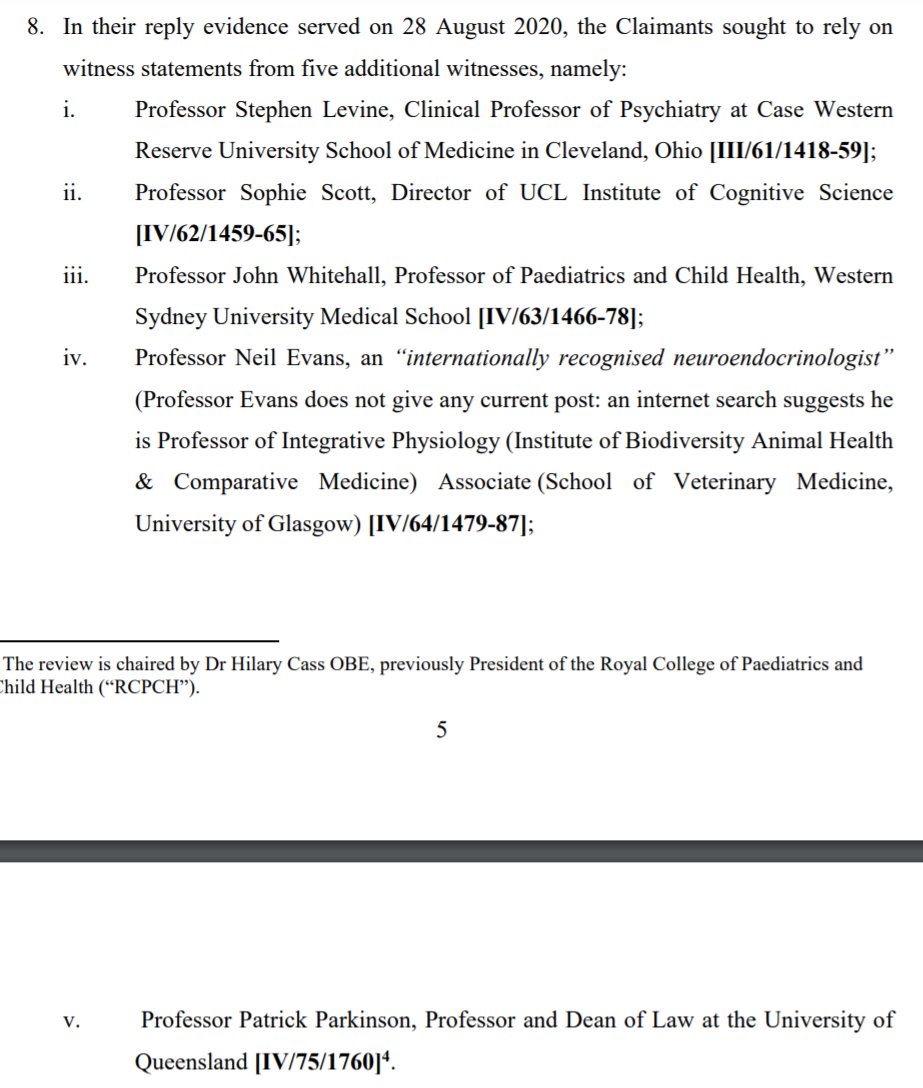
You can see who gave evidence in her support from these extracts from the Tavistock's Skeleton Argument.
Helpful for you to bear in mind that her solicitor was a man called Paul Conrathe, who has a long association with the religious right in the US (I have talked about him a number of times but this is as good a starting point as any).
I am not going to address here other criticisms that might be made of the form in which that evidence was given or the timing of its service before the court. I am just going to address, in alphabetical order, the individuals whose evidence Mr Conrathe led on Ms Bell's behalf.
The first witness, alphabetically, was Associate Professor of Sociology at the University of Oxford, Michael Biggs.
Mr Biggs was exposed for posting transphobic statements online under a fake twitter handle: @MrHenryWimbush according to this report.
You can see who gave evidence in her support from these extracts from the Tavistock's Skeleton Argument.
Helpful for you to bear in mind that her solicitor was a man called Paul Conrathe, who has a long association with the religious right in the US (I have talked about him a number of times but this is as good a starting point as any).
In this thread, I noted the lawyer acting against the Tavistock, Paul Conrathe, is using very similar arguments (those under 18 cannot consent at all; or cannot lawfully consent without x conditions) as he has run/is running in a number of cases challenging abortion rights. https://t.co/gJk4c9bUED
— Jo Maugham (@JolyonMaugham) June 21, 2020
I am not going to address here other criticisms that might be made of the form in which that evidence was given or the timing of its service before the court. I am just going to address, in alphabetical order, the individuals whose evidence Mr Conrathe led on Ms Bell's behalf.
The first witness, alphabetically, was Associate Professor of Sociology at the University of Oxford, Michael Biggs.
Mr Biggs was exposed for posting transphobic statements online under a fake twitter handle: @MrHenryWimbush according to this report.