"At least we don't behead people, be happy"....
Thread on beheadings by H!ndus
(1/n) https://t.co/jr72XYZHTq

Radical Hindutva Extremists
— Dhruv Rathee \U0001f1ee\U0001f1f3 (@dhruv_rathee) January 3, 2021
= Radical Islamic Extremists - Beheading + Mob Lynching
+ "At least we don't behead people, be happy"


More from India


In his letters describing the India Mission, Carey has given us an insight into how the society functioned then, of how the minds of the people worked and what methods the missionaries used to approach and brainwash the common people.
It is entirely possible that,Carey in his arrogance of being the white man and hence more civilized,his inability to under the Hindu scriptures and his natural disdain for the learned community coupled with his inherent hatred for the idolaters may have exaggerated the incidents.
In fact, considering the venom with which he has spoken about Hinduism and it's practices, it's likely that he has exaggerated these incidents. But it cannot be denied that these incidents did happen even if they may not have been on scale at which Carey has described.
One of his journal entry mentions a debate which happened in a temple in front of around 200 people. Carey describes having debated with two learned men and goes on to say when both learned men failed to answer his questions, he went on to preach the gospel to the assembled crowd
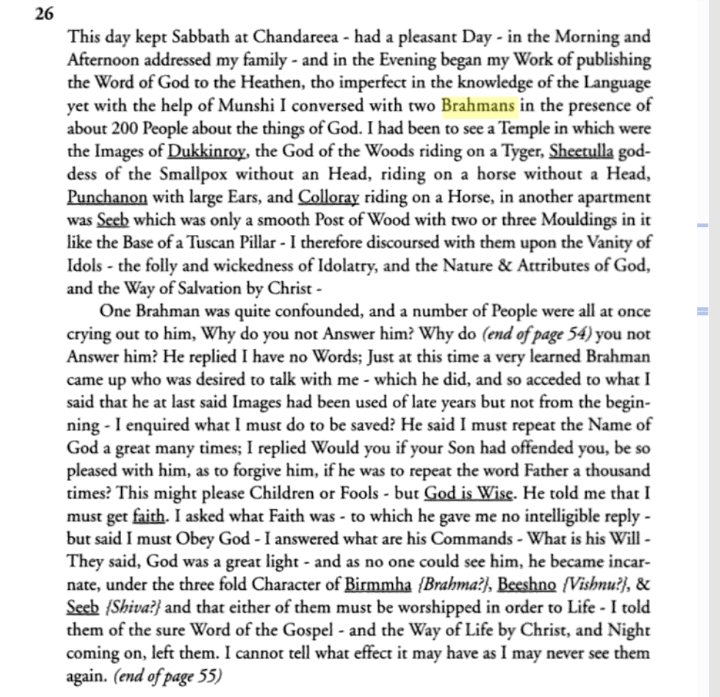
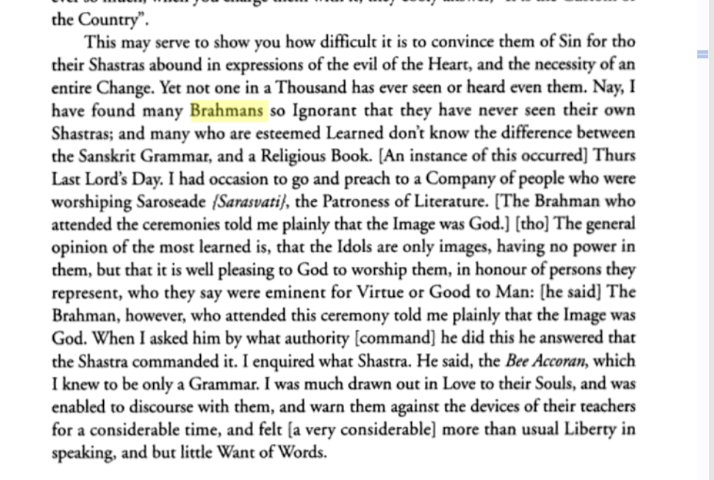
In a letter dated 30th June,1795 he goes on to gleefully narate how Hindus were unaware of their own scriptures and how an supposed expert named a grammar book when he was questioned as which scripture said that the Murti is God.
William Carey landed on the Indian soil in the year 1793. He spent the remaining years of his life in India. He was a British missionary, a translator and a social reformer who is best known for having the practice of Sati abolished in India. https://t.co/kRiPwgjwcP pic.twitter.com/JqO3A7cCsX
— Tanvangi (@Tanvangi17) December 18, 2020
It is entirely possible that,Carey in his arrogance of being the white man and hence more civilized,his inability to under the Hindu scriptures and his natural disdain for the learned community coupled with his inherent hatred for the idolaters may have exaggerated the incidents.
In fact, considering the venom with which he has spoken about Hinduism and it's practices, it's likely that he has exaggerated these incidents. But it cannot be denied that these incidents did happen even if they may not have been on scale at which Carey has described.
One of his journal entry mentions a debate which happened in a temple in front of around 200 people. Carey describes having debated with two learned men and goes on to say when both learned men failed to answer his questions, he went on to preach the gospel to the assembled crowd
In a letter dated 30th June,1795 he goes on to gleefully narate how Hindus were unaware of their own scriptures and how an supposed expert named a grammar book when he was questioned as which scripture said that the Murti is God.


Hindutva does not belong to Modi nor his party, it belongs to the people as a unifying, decolonial ideology similar to pan-Africanism or Yugoslavism.
His own brand of "positive secularism" is even milder - deepening special rights and welfare schemes for religious minorities.
After the disbanding of the Hindu Mahasabha and Jana Sangh, Hindutva as a political ideology does not even exist, except as a bogeyman in the minds of the Anglophone elite.
Even the BJP gave up Hindutva for civic nationalism, Gandhian socialism, and positive secularism in 1980s.
Under Modi, there has been compete policy continuity on minority rights and welfare from the Congress era, with little to no "Hindutva agenda" coming to see the light of day.
The most radical policy they can dream of is religion-neutral laws and equal rights for equal citizens.
Hindutva was essential in forming a national consciousness, but was abandoned with time. The modern BJP refuses to self-identify as a Hindutva movement, adopting moderates like Sardar Patel, Deendayal Upadhyay, and JP Narayan as their icons, rather than Savarkar or the Mahasabha.
When they say Hindu Rashtra, all they mean is an "Indic polity".
When British India was partitioned into a Muslim homeland and a Dharmic homeland, one state became a 'Ghazi' garrison state, and one the successor state to the Indic
His own brand of "positive secularism" is even milder - deepening special rights and welfare schemes for religious minorities.
I'm not entirely comfortable with Modi's "Hindutva".
— Onye Nkuzi (@cchukudebelu) February 2, 2021
I know many of my Indian followers will come at me, angrily - but let me just say this out.
I'm not sure it is a great model for democracy in a diverse, multi-cultural developing nation.
After the disbanding of the Hindu Mahasabha and Jana Sangh, Hindutva as a political ideology does not even exist, except as a bogeyman in the minds of the Anglophone elite.
Even the BJP gave up Hindutva for civic nationalism, Gandhian socialism, and positive secularism in 1980s.
Under Modi, there has been compete policy continuity on minority rights and welfare from the Congress era, with little to no "Hindutva agenda" coming to see the light of day.
The most radical policy they can dream of is religion-neutral laws and equal rights for equal citizens.
Hindutva was essential in forming a national consciousness, but was abandoned with time. The modern BJP refuses to self-identify as a Hindutva movement, adopting moderates like Sardar Patel, Deendayal Upadhyay, and JP Narayan as their icons, rather than Savarkar or the Mahasabha.
When they say Hindu Rashtra, all they mean is an "Indic polity".
When British India was partitioned into a Muslim homeland and a Dharmic homeland, one state became a 'Ghazi' garrison state, and one the successor state to the Indic