#Thread on farm Act and all its controversies.
Let us start with the controversies-
Is this act unconstitutional as it is being preached by many political parties?
There are two ways in which a law can be declared unconstitutional: substantive and procedural.

a. Substantive grounds are where the law itself is unconstitutional, which means the law is against the fundamental rights. Farm act is not about the fundamental rights.
b. Procedural grounds are where the way in which a law is enforced is unconstitutional.
Now, this give us two points where this law can be challenged-

I. If this act against the Federalism structure of India.

Federalism in India refers to relations between the Centre and the States of the Union of India.
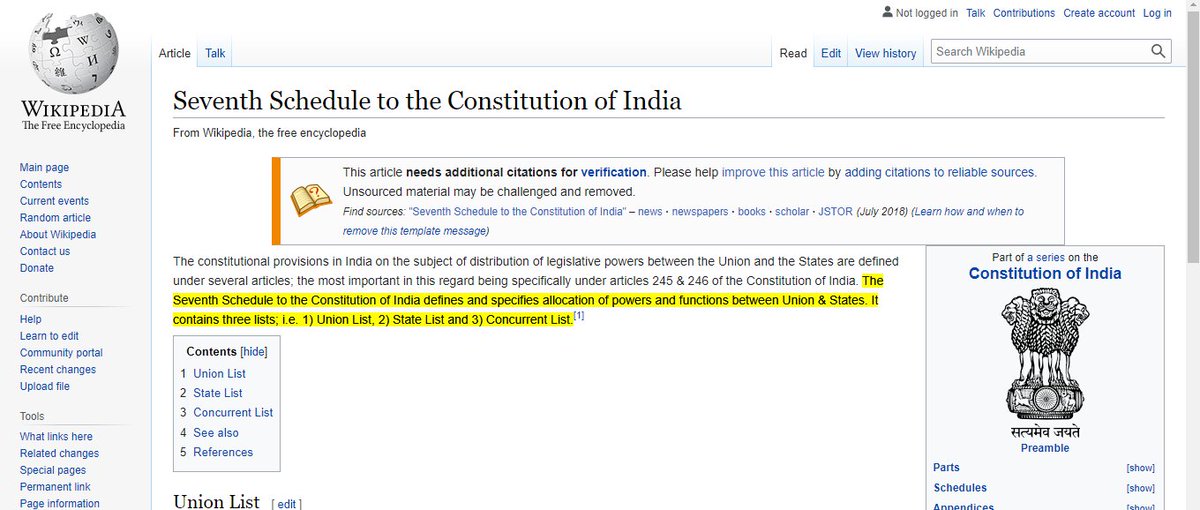
In simple words, there are few sections where only state govt. can make law (state list) & there are few sections where only Centre can make law (union list). However, there are few section where both can make law (concurrent list), refers to the 7th schedule of our constitution.
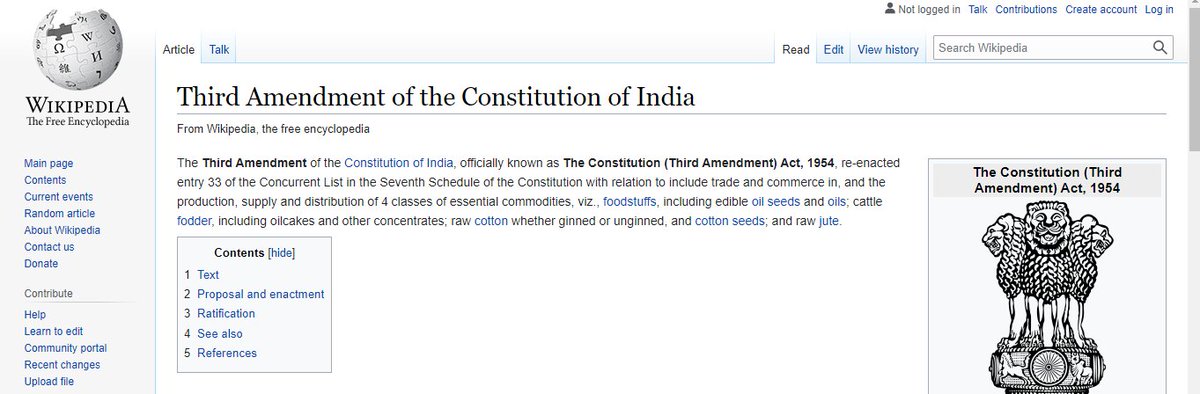
Before 1954, only state govt. had powers to make law related to agriculture. But, in 1954, Nehru chacha did an amendment which gave powers to centre too to make agriculture related law, refers to the entry on 33 of concurrent list.
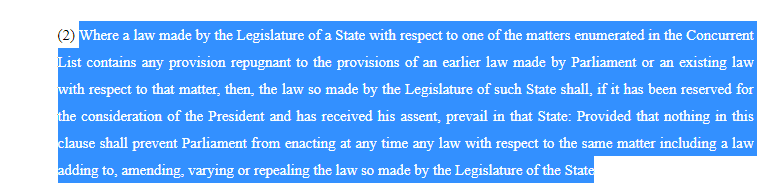
Also, in case of a conflict b/w state and centre govt. regarding any law made under concurrent list, the law made by Parliament dominates, (Article 254/1).
I can bet that supreme court will not even waste a second to deny the challenge based on this point.
ii. If it is against the draft procedure of the Act.
Before discussing this, lets know something about ordinance. Legally, an ordinance is the equivalent of an Act; but is not passed by the legislature initially. It is a temporary law till its expiry or till it is repealed or
till it is approved by the legislature (after which it becomes an Act). Article 123 provides power to centre to make ordinance. An ordinance will expire after 6 weeks once both houses of the Parliament are in session.
It is compulsory for a session of Parliament to be held within six months (as per Article 85). Therefore, the maximum validity of an ordinance is 6 months and 6 weeks.
Farm ordinance was introduced on 5th june 2020 and first session of parliament was held b/w 14-sept to 1st oct.
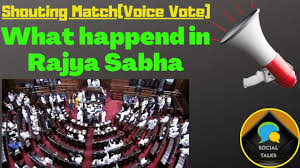
hence it was necessary for the govt. to pass it. In loksabha this ordinance was passed easily and on 20th sept. this ordinance was presented in rajyasabha and was passed on the basis of voice vote, which was the biggest controversy.
Why voice vote?
For individual voting, all member requires to sit at their allotted seats which was not possible due to covid 19 situation and social distancing was mandatory.

Can the process of passing bill, decided by the speaker be challenged in any court?
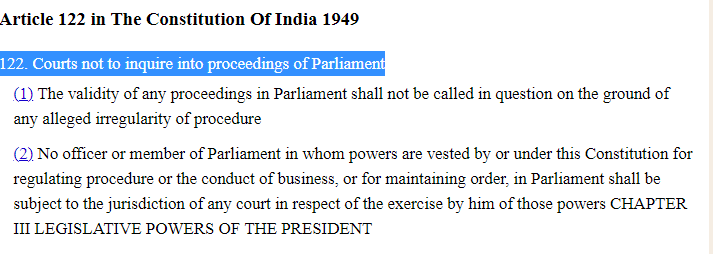
No, referring to the article 122 which states that, Courts will not inquire into proceedings of Parliament.
Hence, one can question on the morality of the procedure but, there is nothing wrong with this act legally.
Okay, let’s just suppose that the bill had got rejected in the rajyasabha, then this bill would have gone to the joint session and needed to be pass from there.

Loksabha has 543 members and rajyasabha has rajyasabha 242 members. Total members are 785.
So, to pass the bill in the joint session one require to have 393 votes. NDA has 353 members in loksabha only. Hence nothing could have stopped farm bill to become an act.
However, congress is now talking to use Article 254/2 to override the act, which states-
Though states could come out with their own Bills to some extent to override the statutes of passed by the Parliament, none of those Bills would be effective unless the President accords his consent to such Bills.
But why there was a need of ordinance and so much hurry?

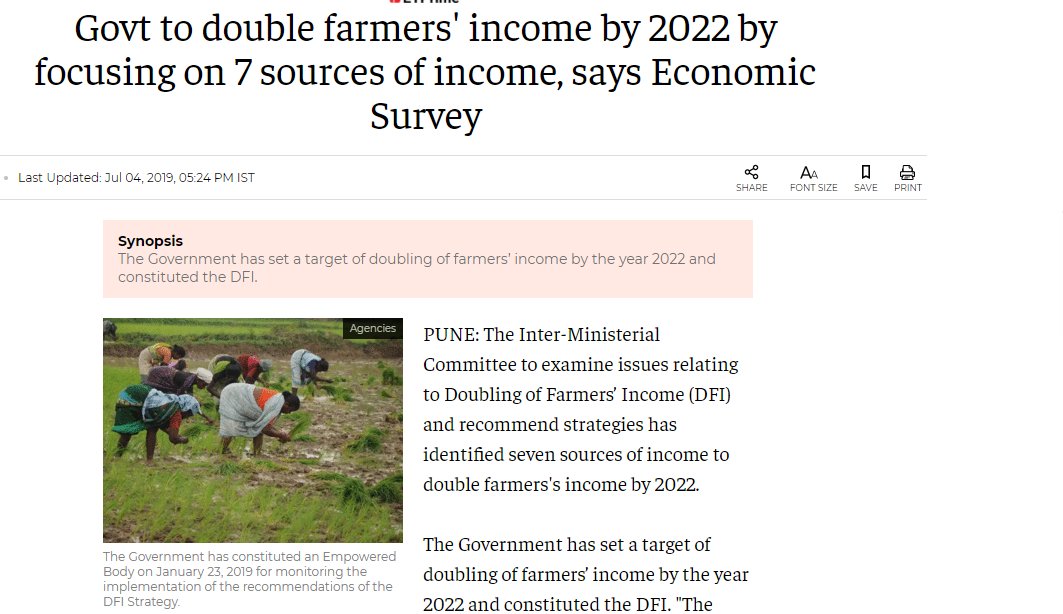
Modi govt. had promised to double the wedges of farmers till 2022 and for that major reforms are required.

If we see the acts, they are actually a very major reforms in the agriculture sector.
Govt. knew that any such reform will create major instability in opposition anyways.

What is the guarantee of the success of farm Act?

Well, Bihar did such reforms in 2006 and according to an article of "the print" itself-
"In the last five years, India’s agricultural growth has been 2 per cent while that of Bihar has been 7 per cent. Bihar is an example that agriculture does well when reforms are carried out," said by @ShekharGupta

link of full article-
https://t.co/TGwKdg9Zr7

More from हठयोगी

#Thread on speed of light in terms of vedic measurement.

Galileo Galilee was among the first to try to measure the speed of light in the early 17th century. Today we know that the exact speed of light is defined as 29,97,92,458 metres per second (approximately 186000 mi/s).


But, when it comes to Indian prospect, there are many references about the speed of light much before the 17th century.
The speed of light is not directly from the Rigveda Samhita but It is given by a great Indian scholor Sāyaṇācārya, popularly known as Sayana.


Sayana was a sanskrit scholar under king Bukka Raya I and Harihara II of Vijaynagar empire in 14th century. His commentary on vedas are very famous and was translated from Sanskrit to English by Max Müller, himself.


RigVeda verse 1.50.4-
तरणिविश्वदर्शवो ज्योतिष्कृदसि सूर्य । विश्वमा भासि रोचनम् ।।
Swift and all beautiful art thou, O Surya, maker of the light, Illuming all the radiant realm.

As it talks about maker of light. Commentary of Sayana in this verse is as:


तथा च स्मर्यत योजनानां सहस्रम् द्वे द्वे शते द्वे च योजने । एकेन निमिषार्धेन क्रममाण नमोऽस्तु ते ॥
It is remembered, [O Sun] bow to you, you who traverse 2,202 yojanas in half a nimesha.
Here it is talking about speed of Sun.
#Thread on kundalini- The hidden treasure!

In Hinduism, there are few topics which can fascinate even an atheist. Kundalini is one of them.

Kundalini is the latent Shakti sleeping near the Muladhara region (bottom of the spinal cords).

Siva Samhita, chapter 5 (pic 2)


Two fingers above the rectum and two fingers below the linga , four fingers in width is a space like a bulbous root.

Between this space is the yoni having its face towards the back.That space is called the root;there dwells the Goddess Kundalini.


It surrounds all the nadis and has three coils and a half;and catching its tail in its own mouth,it rests in the hole of the Sushumna(nadi).

Significance-

Chandogya Upanishad 8.6.6 and Katha Upanishad  2.16 says:

यदा सर्वे प्रभिद्यन्ते हृदयस्येह ग्रन्थयः ।
अथ मर्त्योऽमृतो भवत्येतावद्ध्यनुशासनम् ॥

शतं चैका च हृदयस्य नाड्य-
    स्तासां मूर्धानमभिनिःसृतैका ।
तयोर्ध्वमायन्नमृतत्वमेति
    विष्वङ्ङन्या उत्क्रमणे भवन्ति ॥

When all the knots of Hridaya Granthi are cut down, mortal becomes an immortal & attains Brahman there. There are 101 Nadis which emerge from heart, one Nadi goes out piercing the head. Going up through that, one attains immortality; the others serve for departing in diiff. ways.

More from India

You May Also Like

"I lied about my basic beliefs in order to keep a prestigious job. Now that it will be zero-cost to me, I have a few things to say."


We know that elite institutions like the one Flier was in (partial) charge of rely on irrelevant status markers like private school education, whiteness, legacy, and ability to charm an old white guy at an interview.

Harvard's discriminatory policies are becoming increasingly well known, across the political spectrum (see, e.g., the recent lawsuit on discrimination against East Asian applications.)

It's refreshing to hear a senior administrator admits to personally opposing policies that attempt to remedy these basic flaws. These are flaws that harm his institution's ability to do cutting-edge research and to serve the public.

Harvard is being eclipsed by institutions that have different ideas about how to run a 21st Century institution. Stanford, for one; the UC system; the "public Ivys".
Recently, the @CNIL issued a decision regarding the GDPR compliance of an unknown French adtech company named "Vectaury". It may seem like small fry, but the decision has potential wide-ranging impacts for Google, the IAB framework, and today's adtech. It's thread time! 👇

It's all in French, but if you're up for it you can read:
• Their blog post (lacks the most interesting details):
https://t.co/PHkDcOT1hy
• Their high-level legal decision: https://t.co/hwpiEvjodt
• The full notification: https://t.co/QQB7rfynha

I've read it so you needn't!

Vectaury was collecting geolocation data in order to create profiles (eg. people who often go to this or that type of shop) so as to power ad targeting. They operate through embedded SDKs and ad bidding, making them invisible to users.

The @CNIL notes that profiling based off of geolocation presents particular risks since it reveals people's movements and habits. As risky, the processing requires consent — this will be the heart of their assessment.

Interesting point: they justify the decision in part because of how many people COULD be targeted in this way (rather than how many have — though they note that too). Because it's on a phone, and many have phones, it is considered large-scale processing no matter what.