
The 12 Life Learnings of Carlos Gracie Sr.
(And my thoughts)
//THREAD//

While physical strength is a great supplementation, the power of the mind is essential to any great achievement.
However, it is equally important to speak of these things to yourself.
Perfect your health,
Pursue your happiness,
Think of your prosperity.
Positivity is a benefit that repays itself.
Good things happen to optimists.
Don’t only dream bigger, actually take the action to achieve bigger.
Remember that your long-term goals are achieved through continual short-term discipline.
Envy is a poison that kills slowly and painfully.
Don’t fall victim to the victim mentality.
Keep the pleasant attitude though, even in exhaustion.
When anger comes, use it productively before it turns into blind wrath.
When fear rears its head, POWER THROUGH.
Be pleasant while you fight your battles, it will separate you from the pack.
More from History



Joshua Hawley, Missouri's Junior Senator, is an autocrat in waiting.
His arrogance and ambition prohibit any allegiance to morality or character.
Thus far, his plan to seize the presidency has fallen into place.
An explanation in photographs.
🧵
Joshua grew up in the next town over from mine, in Lexington, Missouri. A a teenager he wrote a column for the local paper, where he perfected his political condescension.
2/
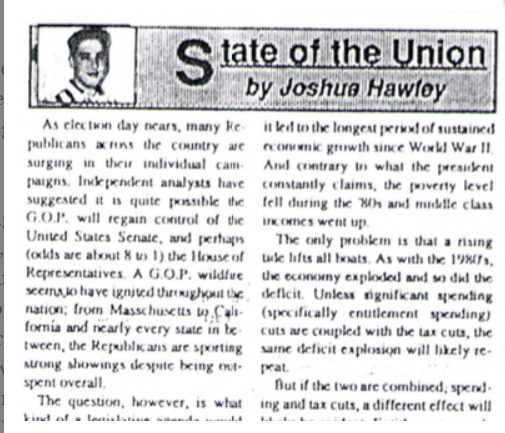
By the time he reached high-school, however, he attended an elite private high-school 60 miles away in Kansas City.
This is a piece of his history he works to erase as he builds up his counterfeit image as a rural farm boy from a small town who grew up farming.
3/

After graduating from Rockhurst High School, he attended Stanford University where he wrote for the Stanford Review--a libertarian publication founded by Peter Thiel..
4/
(Full Link: https://t.co/zixs1HazLk)
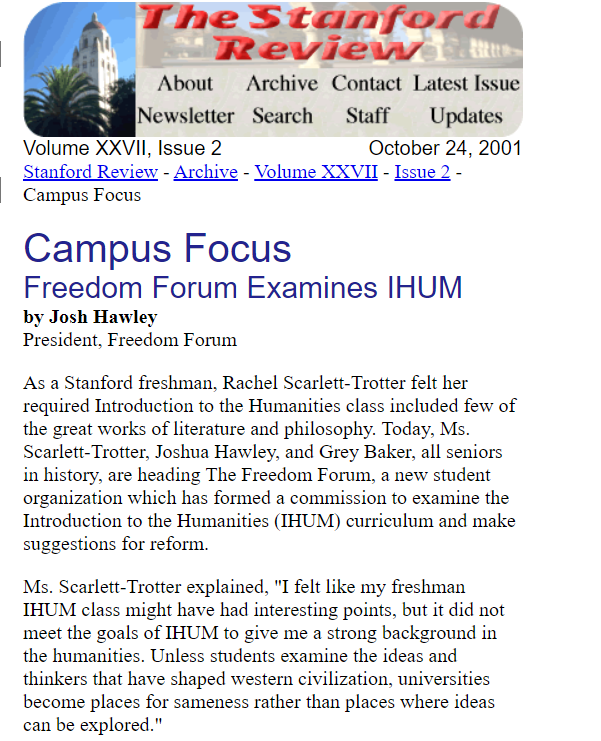
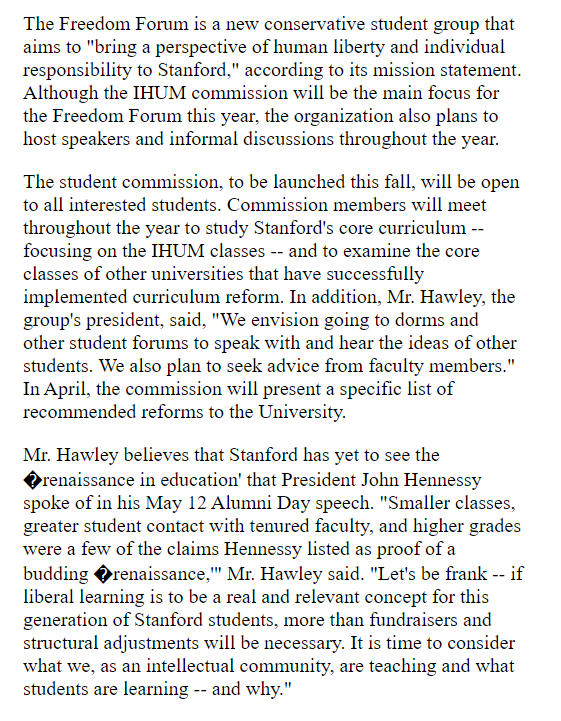
Hawley's writing during his early 20s reveals that he wished for the curriculum at Stanford and other "liberal institutions" to change and to incorporate more conservative moral values.
This led him to create the "Freedom Forum."
5/
His arrogance and ambition prohibit any allegiance to morality or character.
Thus far, his plan to seize the presidency has fallen into place.
An explanation in photographs.
🧵
Joshua grew up in the next town over from mine, in Lexington, Missouri. A a teenager he wrote a column for the local paper, where he perfected his political condescension.
2/
By the time he reached high-school, however, he attended an elite private high-school 60 miles away in Kansas City.
This is a piece of his history he works to erase as he builds up his counterfeit image as a rural farm boy from a small town who grew up farming.
3/
After graduating from Rockhurst High School, he attended Stanford University where he wrote for the Stanford Review--a libertarian publication founded by Peter Thiel..
4/
(Full Link: https://t.co/zixs1HazLk)
Hawley's writing during his early 20s reveals that he wished for the curriculum at Stanford and other "liberal institutions" to change and to incorporate more conservative moral values.
This led him to create the "Freedom Forum."
5/


You May Also Like


I just finished Eric Adler's The Battle of the Classics, and wanted to say something about Joel Christiansen's review linked below. I am not sure what motivates the review (I speculate a bit below), but it gives a very misleading impression of the book. 1/x
The meat of the criticism is that the history Adler gives is insufficiently critical. Adler describes a few figures who had a great influence on how the modern US university was formed. It's certainly critical: it focuses on the social Darwinism of these figures. 2/x
Other insinuations and suggestions in the review seem wildly off the mark, distorted, or inappropriate-- for example, that the book is clickbaity (it is scholarly) or conservative (hardly) or connected to the events at the Capitol (give me a break). 3/x
The core question: in what sense is classics inherently racist? Classics is old. On Adler's account, it begins in ancient Rome and is revived in the Renaissance. Slavery (Christiansen's primary concern) is also very old. Let's say classics is an education for slaveowners. 4/x
It's worth remembering that literacy itself is elite throughout most of this history. Literacy is, then, also the education of slaveowners. We can honor oral and musical traditions without denying that literacy is, generally, good. 5/x
As someone\u2019s who\u2019s read the book, this review strikes me as tremendously unfair. It mostly faults Adler for not writing the book the reviewer wishes he had! https://t.co/pqpt5Ziivj
— Teresa M. Bejan (@tmbejan) January 12, 2021
The meat of the criticism is that the history Adler gives is insufficiently critical. Adler describes a few figures who had a great influence on how the modern US university was formed. It's certainly critical: it focuses on the social Darwinism of these figures. 2/x
Other insinuations and suggestions in the review seem wildly off the mark, distorted, or inappropriate-- for example, that the book is clickbaity (it is scholarly) or conservative (hardly) or connected to the events at the Capitol (give me a break). 3/x
The core question: in what sense is classics inherently racist? Classics is old. On Adler's account, it begins in ancient Rome and is revived in the Renaissance. Slavery (Christiansen's primary concern) is also very old. Let's say classics is an education for slaveowners. 4/x
It's worth remembering that literacy itself is elite throughout most of this history. Literacy is, then, also the education of slaveowners. We can honor oral and musical traditions without denying that literacy is, generally, good. 5/x
