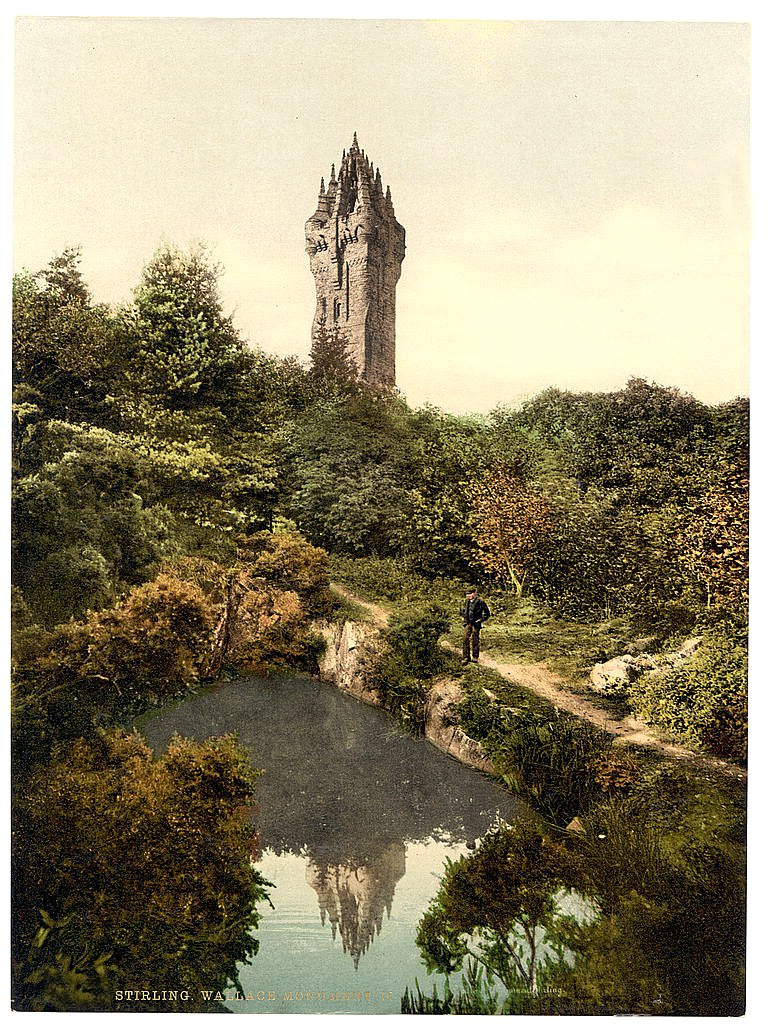
opponent to English domination, the Wallace Monument, erected by public subscription and built from 1861 to 1869, was designed to stress the qualities that Scotland had brought to the Union of the Parliaments in 1707. Most Scottish newspapers published full descriptions of the
grandiose ceremony that took place on June, 24th 1861 to mark the laying of the foundation stone of the monument.
Glasgow Herald, June 25, 1861.
Mr Sheriff GLASSFORD said—
Sir Archibald Alison, ladies and fellow-countrymen, I have the honour to propose that we avail
ourselves of this opportunity to record a vote of thanks to the subscribers to the Wallace National Monument. They are very numerous—they are composed of every class from the highest to the lowest—they belong to every town and village of Scotland—they are scattered far and
wide through all our colonies, from the frozen north to the burning south. Widely as they are diffused, one electric spark has united them all. To them no country is so dear as Scotland—no virtue more inherent than patriotism—no patriot through all ages more worthy of regard
than Wallace. With his name, as with a talisman, the general heart has been stirred. Some have come forward with their hundreds, and some with whatever might they could afford, but all with an eager desire to be allowed to throw a stone on the magnificent cairn which
Scotland’s gratitude is about to erect on this romantic hill. We live in heroic times–not in times, thank God! when we are called upon to struggle for our national independence, but in times when we are obliged to show a bold front in the face of Europe, Asia, and the world—in
times when we have occasion to send forth the best and oldest of our warriors to many a well-fought field—in times when the martial spirit of our youth, long repressed, but never extinguished, has burst out spontaneously with a bright and pure flame which shall be seen
burning from afar—
I look upon this monument but as a reflex of the spirit of the age. I see our Volunteers there, upon the hill side, and in the valleys beneath, glittering in rank and file; is it wonderful that they should rejoice to behold on this fair eminence that which
will be not only a noble record of patriotism, even greater than their own, but a visible testimony that Scotland through all generations, and irrespective of the flight of centuries, preserves the memory green of those who fought and fell, who lived and died for her, who
preserved her liberties untarnished, who gave her a glorious past, who made her what she is? If there be those, as I have heard there are, who affect to sneer at the sentiment which has inspired, and the energy which has gone forward to the execution of a work like this, I
for one do not envy the sneerers. I doubt whether such cold cynicism will make them happier men, or more respected by their fellow-countrymen. […] Shall I, in this presence, ask whether any progress of civilisation, any change of time and circumstance, has made it necessary
for us to blot out the grand heroic annals of our native land? Would England, would Ireland do so? True, we are not now separate, but united kingdoms. True, we have all reaped great gain from that good and holy alliance. May it be indissoluble! But because a gallant bridegroom
leads a fair bride to the altar, does it therefore follow that all reminiscences of the early days of each are to cease—all looking back upon their childhood’s home—all grateful recollection of the lessons which then were taught, and the characters which then were formed? No!
The very ancestral feuds which may at one time have divided the families make the union the sweeter now. Blood is stronger than water; and, if either individual or national character be worth a farthing, it is not to be annihilated by any union—the multitudinous seas will not
wash it out. As well might we be told that we should cease to take delight in the great features of our national scenery, as that we should cease to cultivate the recollection of the great incidents of our national history. We are all proud of the name of Briton; it is a name
common to both Englishmen and Scotchmen; but the Englishman would not be the man he is if he could ever forget the glories of old England before she could claim a foot of land to the north of the Tweed; and the Scotchman would be but a base descendant of those who bled with
Wallace and conquered with Bruce if he did not thrill with an emotion at their names which no Englishman can ever know. Scotland and England now stand side by side, shoulder to shoulder […] But we were rocked in different cradles—we were nursed by different mothers […] So
let it ever be! and let no man grudge us this monument. The living pulse of Scotland beats in it. It is reared in no boastful spirit, but in that of reverence and love for the great and the noble of all time. In its architecture it is national, massive, and appropriate; it
stands upon a site which it will not desecrate but consecrate; to thousands upon thousands the royal diadem which is to grace the summit will speak, when we are all away, of the unconquered son of an unconquerable country! It is because I cherish this belief, and am not ashamed
to avow it, that I have the greatest satisfaction in being permitted to move a vote of thanks to the subscribers. (Loud cheers.)