A thread on some links between art and literature...
All available in an editable booklet >> https://t.co/QQQ5j31ekw #TeamEnglish

Sethos I Before Horus, by Unknown Artist (c.1280 BCE)

Sethos I was the father of Ramesses II (also known as Ozymandias). In the wallpainting, Sethos is receiving pharaonic regalia to emphasise his power and military success.

Link: Ozymandias, by Percy Bysshe Shelley
Mona Lisa, by Leonardo da Vinci (1503)

The smile of Mona Lisa, also known as a Lisa Gherardini, is playful and ambiguous – almost like she is hiding a secret.

Link: My Last Duchess, by Robert Browning
Landscape with the Fall of Icarus, by Pieter Bruegel the Elder (1558)

An illustration of the dangers of pride and ambition. From soaring so high, Icarus is barely noticeable after his fall and life simply carries on around him.

Link: Jekyll and Hyde, by Robert Louis Stevenson
Experiment with a Bird in an Air Pump, by Joseph Wright of Derby (1768)

A wild-eyed scientist, onlookers who seem both intrigued and horrified, and a strong contrast between darkness and light.

Link: Jekyll and Hyde, by Robert Louis Stevenson
Wanderer Above the Sea of Fog, by Caspar David Friedrich (1818)

A melancholy figure stands alone amidst a sweepingly dynamic, powerful landscape.

Link: The Prelude, by William Wordsworth
Anatomical Pieces, by Théodore Géricault (1818-20)

A brutal, unglamorous and disturbing picture of body parts that seem to have been carelessly discarded and thrown into a pile.

Link: Frankenstein, by Mary Shelley
Norwegian Mountain Landscape, by Johan Cristian Dahl (1819)

The rocks in Johan Dahl’s Norwegian Mountain Landscape first appear to be gentle and inviting, but on a second glance seem much more dramatic and threatening.

Link: The Prelude, by William Wordsworth
The City, by August Strindberg (1903)

The sea is darkly turbulent and the grey sky is full of menace. The city of the Stockholm, brightly lit in the distance, is made to seem very small by comparison.

Link: Storm on the Island, by Seamus Heaney
Metropolis, by George Grosz (1916-17)

A blood red, claustrophobic cityscape in which ghostly figures seem to climb, trample and scramble away from imminent danger.

Link: London, by William Blake
Invasion Pattern, Normandy, by Eric Aldwinckle (1945)

A strangely calm image that, at least initially, doesn’t seem to depict a battle scene. The distance of the viewer’s perspective evokes a fleeting sense of contemplation and control.

Link: Kamikaze, by Beatrice Garland
Izzy Orts, by Edward Burra (1955)

The vacant, troubled stare of the sailor in the foreground contrasts with the celebratory scene behind him. He seems completely out of place and isolated whilst life goes on around him.

Link: Remains, by Simon Armitage
Painting 150, by Manolo Millares (1961)

A dark, abstract image evocative of a primitive human body in the throes of both construction and deconstruction.

Links: Jekyll and Hyde, by Robert Louis Stevenson
War, by Marc Chagall (1964-66)

An overcrowded cart leaves a burning city as people twist in anguish and despair. A white lamb is clearly visible, placed next to a shadowy image of Jesus to represent the sacrifice of innocent people.

Link: War Photographer, by Carol Ann Duffy
View of Madrid from Torres Blancas, by Edward Burra (1976-82)

The soft morning light helps to transform what would ordinarily be a mundane, ugly cityscape into something altogether more beautiful and majestic.

Link: The Emigrée, by Carol Rumens

More from History

Folks who don't know history just tweet whatever they want.

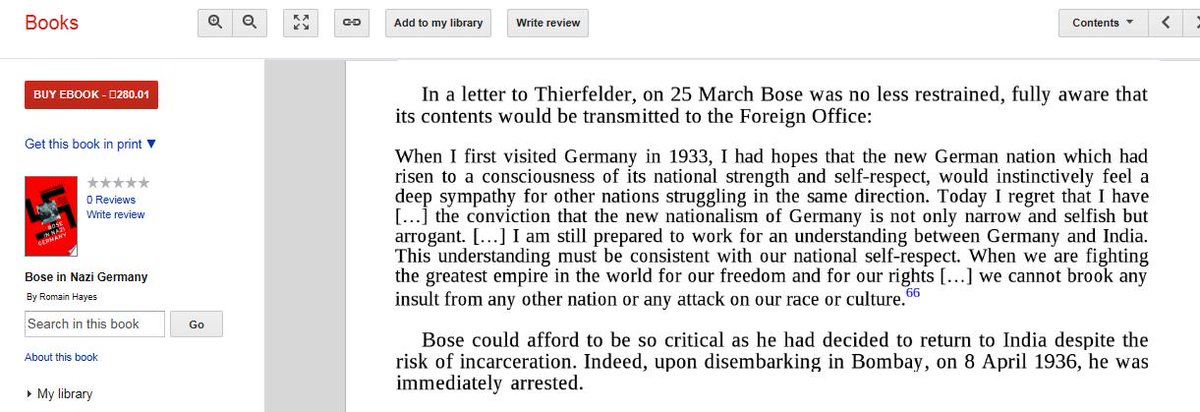
On Feb 1935, Bose attacked the Nazis as he was angry as Indians were described as Sub-Humans in Mein Kampf. The British arrested Bose in April 1936, because he insulted the Nazis.

#Thread


The West at this point had a soft spot for the Nazis. France, Great Britain, Netherlands, Poland all gave the Nazi Salute during the 1936 Olympics in Berlin.

Even during the Spanish Civil War (1936 - 1939), the Western powers observed neutrality as the Fascists rose in Spain.


In 1937, Hitler told British Foreign Secretary Lord Halifax that one of his fav movies was ‘The Lives of a Bengal Lancer’. Why?

‘The Lives of a Bengal Lancer’ depicted a handful of "superior race" Brits holding sway over an entire Indian subcontinent (Sub-Humans).

"Shoot Gandhi. If necessary, shoot more Congress Leaders (Nehru & Bose)."

- Hitler to Lord Halifax, Britain's Foreign Secretary

This statement by Hitler in 1937 angered many pro-Leftist leaders of the INC including Bose.

Bose reached London in Jan 1938, and he met many leaders of the British Labour Party including Attlee.

1938 & 1939 were two huge years for the Indian National Congress. As i always say, the 10-year phase from 1938 - 1948 shaped modern India and it began in 1938 Haripura session.

You May Also Like