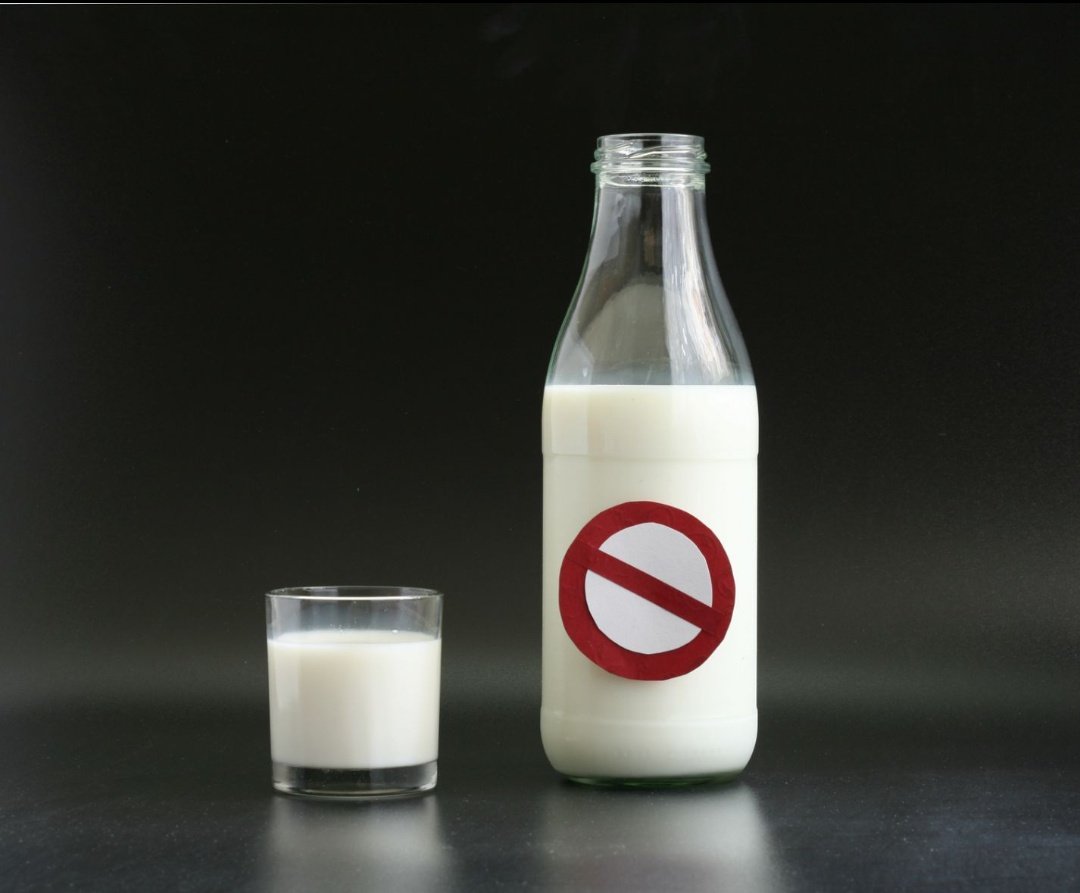
There are some of us that don't have the pleasure of being able to consume milk products like we wish because when we do, it is accompanied by diarrhea, abdominal pains and bloating.

Sorry my dear friend, you're lactose intolerant. Let's talk about lactose intolerance today.

Lactose intolerance is a common disorder and is due to the inability to digest lactose into its constituents, glucose and galactose, secondary to low levels of lactase enzyme in the digestive tract.

So when you consume milk, it contains lactose. This lactose must be broken down.
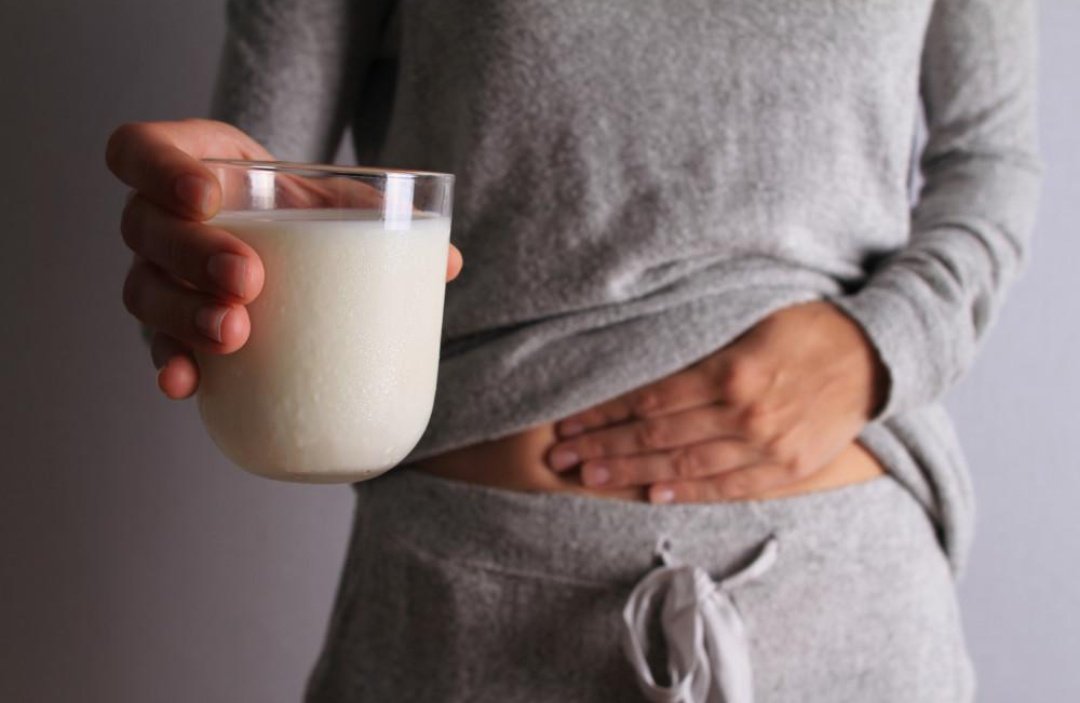
Lactose in it's original form is a disaccharide, but for it to be absorbed by your small intestine, an enzyme called Lactase is required to break it down (hydrolysis) into a monosaccharide. In those with Lactose Intolerance, Lactase is absent. So Lactose remains a disaccharide.
The osmotic load or weight of this undigested lactose disaccharide causes secretion of lots of fluid and electrolytes into your digestive system, and that's where wahala starts. This leads to enlargement (dilation) of the small intestine that induces quick movement of the...
undigested lactose into the large intestine. Now when this lactose gets to the large intestine, it becomes fermented by bactaeria and this yields short chain fatty acids and gas. The combined effects of increased water in the feces, movement of the poorly digested lactose, gas...
..leads to the wide range of symptoms people with Lactose Intolerance begin to experience.

Is interesting to note too that according to International Statistics, about 70-75% of the Worlds Population is Lactose Intolerant to some degree.
Lactose intolerance may be right from birth (congenital lactose intolerance) or developed from childhood (Primary lactose intolerance), or can even occur due to an episode of an acute illness like Gastroenteritis (Secondary Lactose Intolerance).

So what do you do?
Well, for lactose intolerant folks, be careful of milk and diary products. You can also choose to consume plant based milk like Soya (they're better tolerated). If you can find prehydrolyed milk, this works for you too.

Probiotics containing Lactobacillus helps too
If you really want to consume milk products and you can't help it, Lactase enzyme is available in drug preparation. When you meet a Doctor, you'd be given a prescription for this so you can be on the right dosage.

So are you Lactose Intolerant, share your experience. Cheers

End
I run live podcasts where we discuss exciting health and Lifestyle topics and play games. Tomorrow will be game night. Care to join me? 😍😍😍

https://t.co/lbgMhDlda6
Okay guys. I have heard you.

Tomorrow on Game Night I'm going to share more practical tips about how to deal with Lactose Intolerance.. Ensure you join me tomorrow evening by 9pm. We'll be taking donations for Charity, with all proceeds heading to the @aproko_doctor 's 100k Fund
A dairy hack for people with Lactose Intolerance

https://t.co/UmHwudHGFG

More from Health

You gotta think about this one carefully!

Imagine you go to the doctor and get tested for a rare disease (only 1 in 10,000 people get it.)

The test is 99% effective in detecting both sick and healthy people.

Your test comes back positive.

Are you really sick? Explain below 👇

The most complete answer from every reply so far is from Dr. Lena. Thanks for taking the time and going through


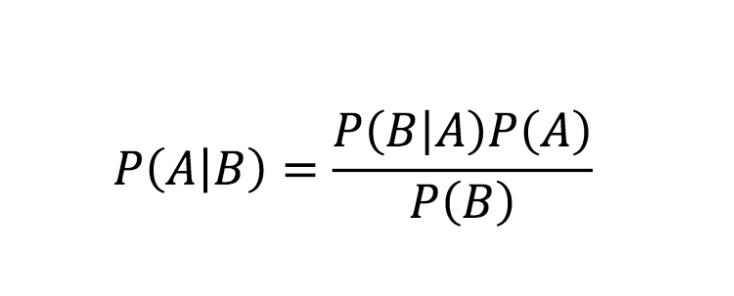
You can get the answer using Bayes' theorem, but let's try to come up with it in a different —maybe more intuitive— way.

👇


Here is what we know:

- Out of 10,000 people, 1 is sick
- Out of 100 sick people, 99 test positive
- Out of 100 healthy people, 99 test negative

Assuming 1 million people take the test (including you):

- 100 of them are sick
- 999,900 of them are healthy

👇

Let's now test both groups, starting with the 100 people sick:

▫️ 99 of them will be diagnosed (correctly) as sick (99%)

▫️ 1 of them is going to be diagnosed (incorrectly) as healthy (1%)

👇

You May Also Like

1/ Here’s a list of conversational frameworks I’ve picked up that have been helpful.

Please add your own.

2/ The Magic Question: "What would need to be true for you


3/ On evaluating where someone’s head is at regarding a topic they are being wishy-washy about or delaying.

“Gun to the head—what would you decide now?”

“Fast forward 6 months after your sabbatical--how would you decide: what criteria is most important to you?”

4/ Other Q’s re: decisions:

“Putting aside a list of pros/cons, what’s the *one* reason you’re doing this?” “Why is that the most important reason?”

“What’s end-game here?”

“What does success look like in a world where you pick that path?”

5/ When listening, after empathizing, and wanting to help them make their own decisions without imposing your world view:

“What would the best version of yourself do”?
https://t.co/6cRR2B3jBE
Viruses and other pathogens are often studied as stand-alone entities, despite that, in nature, they mostly live in multispecies associations called biofilms—both externally and within the host.

https://t.co/FBfXhUrH5d


Microorganisms in biofilms are enclosed by an extracellular matrix that confers protection and improves survival. Previous studies have shown that viruses can secondarily colonize preexisting biofilms, and viral biofilms have also been described.


...we raise the perspective that CoVs can persistently infect bats due to their association with biofilm structures. This phenomenon potentially provides an optimal environment for nonpathogenic & well-adapted viruses to interact with the host, as well as for viral recombination.


Biofilms can also enhance virion viability in extracellular environments, such as on fomites and in aquatic sediments, allowing viral persistence and dissemination.