1/15
Why can cefepime cause neurological toxicity?

And why is renal failure the main risk factor for this complication?

The answer requires us to learn about cefepime's structure and why it unexpectedly binds to a certain CNS receptor.

#MedTwitter #Tweetorial

2/
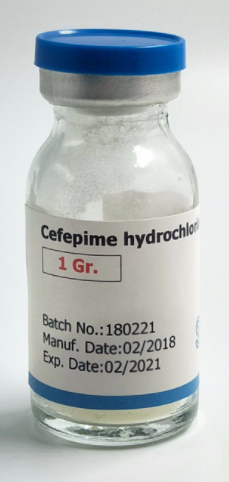
Let's establish a few facts about cefepime:

🔺4th generation cephalosporin antibiotic
🔺Excretion = exclusively in the urine (mostly as unchanged drug)
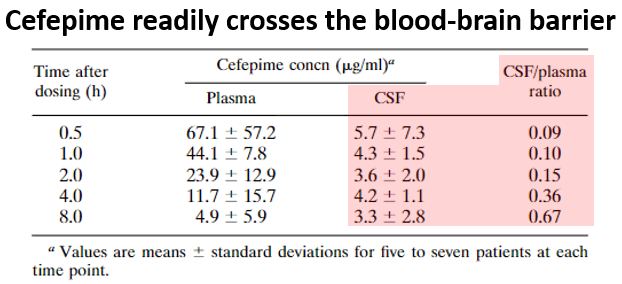
🔺Readily crosses the blood-brain barrier (so it easily accesses the brain)

https://t.co/rjYG1BfGPR
3/
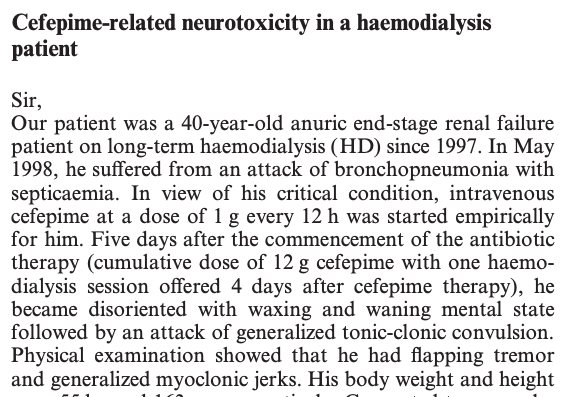
The first report of cefepime neurotoxicity was in 1999.

A patient w/ renal failure received high doses of cefepime and then developed encephalopathy, tremors, myoclonic jerks, and tonic-clonic seizures.

✅All symptoms resolved after hemodialysis.

https://t.co/u7JLVitQpp
4/
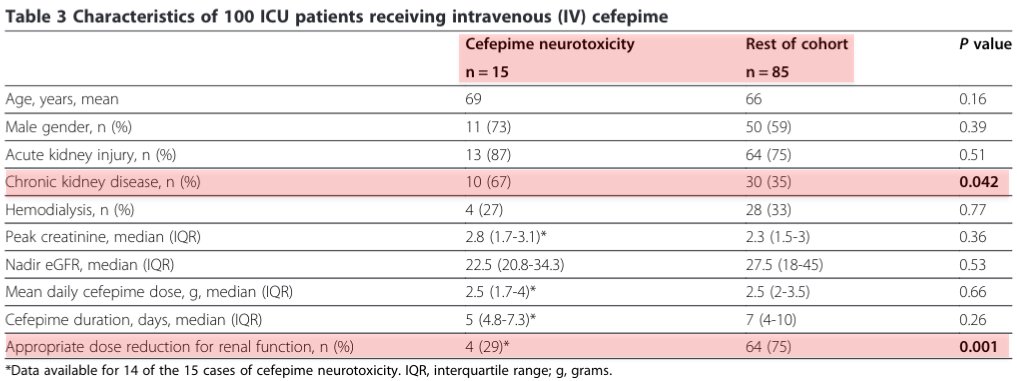
Cefepime neurotoxicity is surprisingly common, occurring in up to 15% of treated critically ill patients (w/ symptoms varying from encephalopathy to seizures).

💡The main risk factors = renal failure and lack of dose adjustment for renal function.

https://t.co/nxbnzSq8AR
5/
What about cefepime induces neurotoxicity?

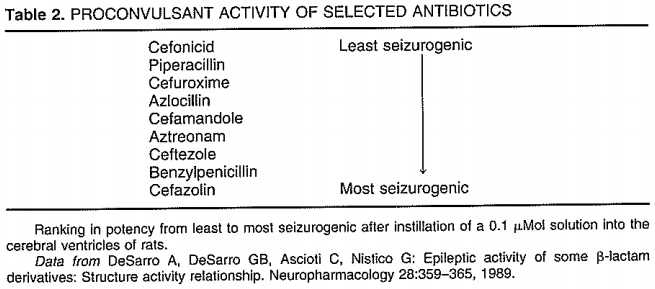
One clue is that it's not the only antibiotic that causes neurotoxicity, particularly seizures.

This actually is a class effect w/ other beta-lactam antibiotics (including penicillins and carbapenems).

https://t.co/Lf4BhON9IY
6/
Recall that beta-lactam antibiotics all share a common structural feature: a beta-lactam ring.

https://t.co/iWXweuG4Ct
7/
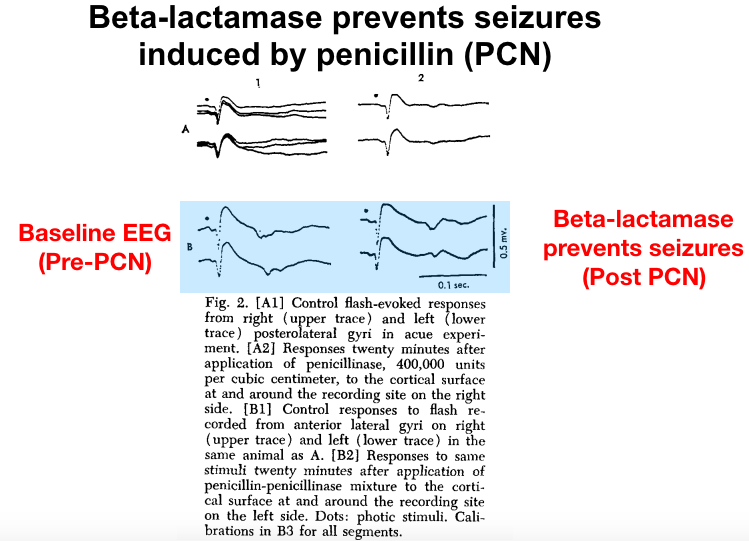
A 1971 study in cats implicated beta-lactam rings as the source of neurotoxicity.

High doses of penicillin were used to induce seizures.

🔑But pre-incubation w/ the enzyme beta-lactamase (disrupts the beta-lactam ring) blocked all seizure activity.

https://t.co/M3lDiXm88N
8/
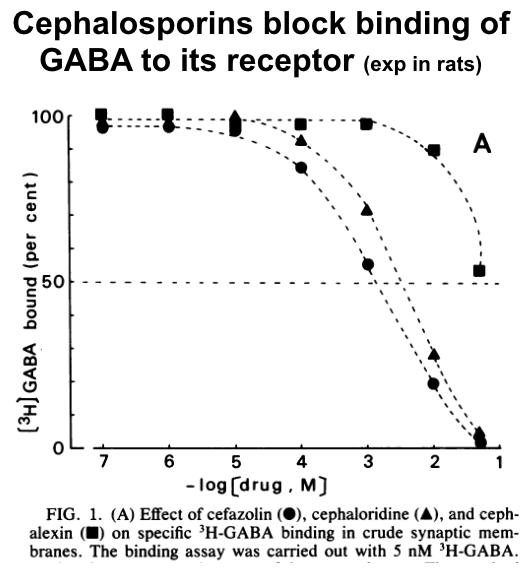
So why can beta-lactam antibiotics like cefepime cause neurotoxicity?

It turns that they block the binding of the inhibitory neurotransmitter gamma aminobutyric acid (GABA) to its receptor.     

🔑Cephalosporins block GABA particularly effectively.

https://t.co/Eo0OlTduOE
9/
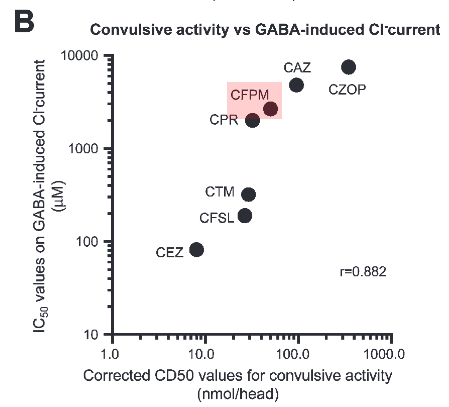
The GABA receptor has two subtypes (A and B), and the A subtype functions as a ligand-gated Cl⁻ ion channel.

Cefepime binds to the GABA-A receptor and blocks Cl⁻ influx, which correlates with its ability to induce seizure activity.

https://t.co/l2f9QHHEEW
10/
We've established that cefepime blocks GABA.

This induces neuro-excitation leading to seizures and other neurotoxic manifestations such as tremors and encephalopathy.

💡But why is there such a strong link with renal failure?
11/
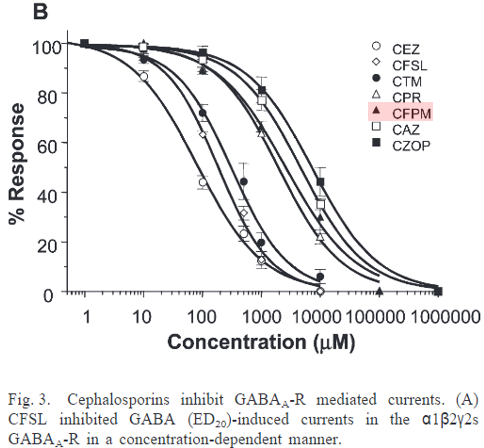
An obvious explanation would be that, since cefepime is renally cleared, elevated serum and CNS drug levels build up.

This is supported by the observation that cefepime and other cephalosporins block GABA in a concentration-dependent manner.

https://t.co/l2f9QHHEEW
12/
But increased drug levels might not be the only reason that patients w/ renal failure are predisposed to neurotoxicity.

The milieu around neurons seems to matter as well.
13/
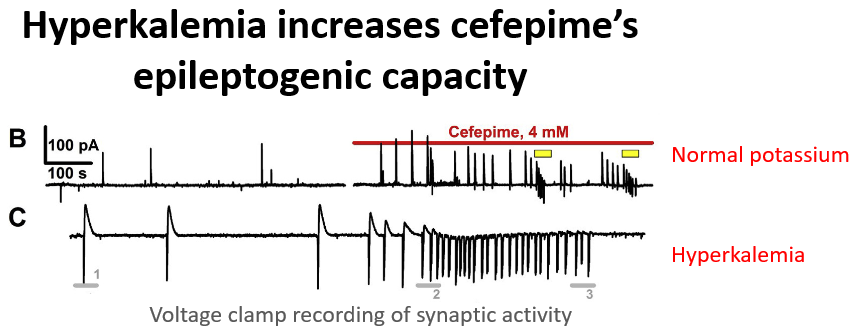
This experiment in rat brain slices simulated a "renal" milieu by using a hyperkalemic medium around neurons.

⚡️Exposure to higher potassium levels significantly increased the ability of cefepime to induce epileptiform discharges.

https://t.co/vb3p4xXdTm
14/
Let's ask one final question.

Why can cefepime (and other beta-lactam antibiotics) block the GABA receptor?

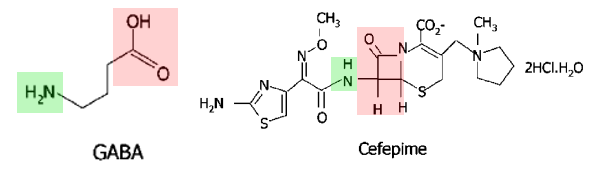
Exactly why hasn't been well-studied but it likely reflects sufficient structural similarity w/ GABA.

https://t.co/KN7I6ACXvb
15/
🧠Cefepime induces neurotoxicity by blocking the GABA receptor, similar to other beta-lactam antibiotics
🧠This results from structural similarities between GABA and the beta-lactam ring
🧠Renal failure = main risk factor b/c of ⬆️ drug levels +/- hyperkalemia

More from Health

1/
Remember woman who tuk multiple @SriSriTattva products 4 range of problems frm diabetes 2 gas 2 liver disease & developed liver failure, listed for liver transplant?
Here is original thread:
https://t.co/PXxI1Slyv2
23 samples, Analysis results
#MedTwitter #livertwitter


2/
Before I go into results, I must say this was overwhelming. There was SO MUCH the lab identified, impossible to put everything here. So I made a summary. At the end of this thread, I have linked a full analysis described in Excel format. Some results were VERY concerning

3/
How did we analyse?
Here R links 2 methods
They R high end, done under strict protocols
Frm Ministry of Forest, Environment, Climate / NABL approvd Lab
ICP-OES https://t.co/O1CLhqVQAu
GC MSMS https://t.co/zRJoXyWQIr
FTIR https://t.co/goAembQ08p
Here is list V analysed 👇


4/
Sample names written on top (each column).
First 5 samples: C what we identified in #Ayurveda #medicines
Antibiotics
Steroids (anabolic/synthetic)
#NARCOTICS - LSD, Morphine
Blood thinners (possible reason Y bleeding tests were off the roof in the patient)
Heavy metals!


5/
Next 5 samples (total 10 now)
Mercury is clear winner. Almost all samples
See controlled substances - Butyrolactones https://t.co/CPz0FwPEOm, methylamine https://t.co/OZnXY7U9UQ
Alcohols, industrial solvents
Rare metals - cobalt, lithium
Again lots of blood thinners
#Ayush
You gotta think about this one carefully!

Imagine you go to the doctor and get tested for a rare disease (only 1 in 10,000 people get it.)

The test is 99% effective in detecting both sick and healthy people.

Your test comes back positive.

Are you really sick? Explain below 👇

The most complete answer from every reply so far is from Dr. Lena. Thanks for taking the time and going through


You can get the answer using Bayes' theorem, but let's try to come up with it in a different —maybe more intuitive— way.

👇


Here is what we know:

- Out of 10,000 people, 1 is sick
- Out of 100 sick people, 99 test positive
- Out of 100 healthy people, 99 test negative

Assuming 1 million people take the test (including you):

- 100 of them are sick
- 999,900 of them are healthy

👇

Let's now test both groups, starting with the 100 people sick:

▫️ 99 of them will be diagnosed (correctly) as sick (99%)

▫️ 1 of them is going to be diagnosed (incorrectly) as healthy (1%)

👇
Some thoughts on this: Firstly, it might be personal preference, but I am not keen on this kind of campaign as I feel like it trivialises cancer. Sometimes the serious message gets lost because people are sharing pics of cats or whatever and the important context is gone.


More importantly, the statistic being used in the campaign is misleading. It says 57% of women put off cervical screening if they can't get waxed. But on further investigation, that's not accurate.

The page here goes on to say "57% of women who regularly have their pubic hair professionally removed would put off attending their cervical screening appointment if they hadn’t been able to visit a beauty salon."

So the 57% represents a concern not across the whole population of women, but only those who regularly get waxed. So how big of an issue is this across the whole population? And what else is stopping people getting smears?

I think campaigns for cancer screening are really tricky because there is so much nuance that often doesn't fit into a catchy headline or hashtag. It's certainly not easy and is part of a bigger conversation.

You May Also Like