Guj
https://t.co/v6Yk7U34AA corp 9 lacX6.8=63 lac
Gujarat Gas 4.7 CrX=2968 cr
Bandhan Bank 11.35X284 =32 cr
IDBI 5.5 lacX 44= 2.4 cr
MCFL 5.8 lac X 76= 4.4 cr
Total value of investment =4700 Cr
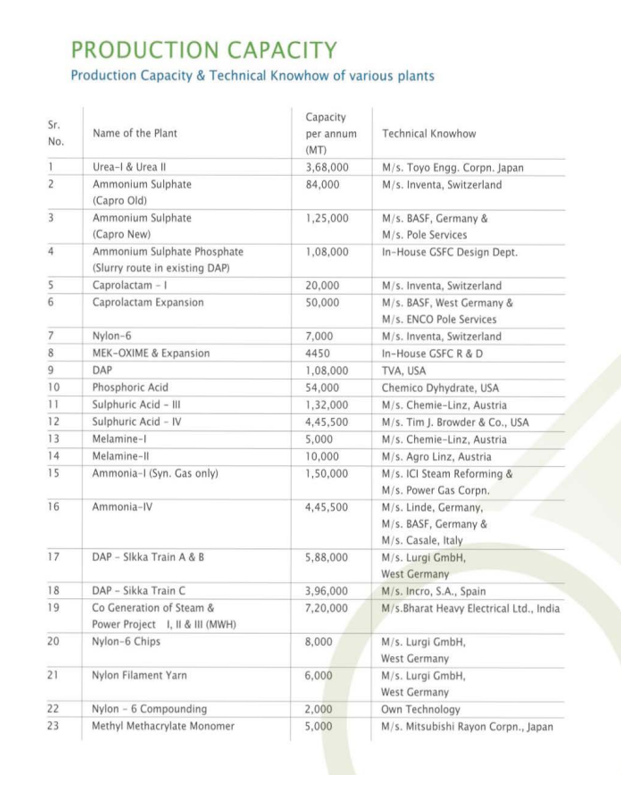
Production capacity of Its plant for Various products + Methanol plant plus Melamine plants
Major Raw Material
Rock phosphate
Ammonia
Benzene
Phosphoric acid
sulfur
Expansion-
1-ammonium sulphate 4th plant of 400 metric tonnes capacity - Revenue estimated 230 Cr
2- sulphuric acid, fifth plant. 600 metric tonnes per day for captive consumption.
3-commissioning nylon fix compounding plant
that is expected to be commissioned by December 21, that is a 48 metric tonnes per day compounding lines and estimated turnover 260 Cr
4-15 MW solar plants at around 85 crores investments 5- Board has also approved urea revamp
projects for energy reduction in line with Department of Fertilizers norms of energy consumption for urea.
Lets Talk about some products other then fertilizers
1-Melamine - 3 plants
-new plant of 40,000 tonnes
- old two plants - high energy consumption so no operations
What is Melamine -Melamine is made to react with formaldehyde and then developed into resins or moulding powder
for making many products of beauty and utility.
Melamine has a varied range of applications in the industrial and consumer sector like:
•Laminates for table tops, kitchen shelves, platforms
•Consumer Moulded Goods – bowls, trays, crockery
•Industrial Moulded Goods – Circuit breakers, automotive ignition components
•Treatment Resin for Paper – for currencies, toilet paper, shopping and shipping bags
•Resin for Lacquer Paints – for motorcars, refrigerator cabinets, washing machines
•Adhesives
•Melamine Resin for Textile Auxiliaries
•Leather Chemicals
Recently Government extended anti dumping duty on Melamine - Indian Demand is around 80000 tonnes /yr and GSFC is sole producer
Production chain - Natural gas- Ammonia-urea - Melamine
2-Caprolactam -for sale purpose it is some 55,000 tonnes to 60,000 for sale
Caprolactam for Nylon Fix is around 20000 to 25000 Tonnes
So, production maybe around 50,000
tonnes to 85,000 tonnes.
What is Caprolactam-Caprolactam is the basic raw material for the manufacturing Nylon-6.
The exceptional bearing and wear properties of Nylon make it one of the most widely used plastics in the world.
Due to its versatile properties, Nylon-6 forms an ideal starting point for a very wide range of products:
•Carpeting, domestic textiles, furnishing fabrics
•Industrial textiles such as Tyre-cord fabric, bristles, cables and ropes
•Industrial plastics such as gearwheels, dowels, mouldings and products in the tool sector
•Clothing textiles such as tights, swimwear, protective clothing and dresses
•Moulding engineering components and other extrusion profiles
CBIC recently proposed antidumping duty on Caprolactam
The main raw materials are Benzene, Oleum, Ammonia( In house) Carbon Dioxide, Synthesis Gas (in house) Sulphur Dioxide, Caustic Soda and Sulphuric Acid( Inhouse)
Production Chain- Caprolactam- Nylon 6
3- Inermediate for Pharma industry-GSFC identified some 11 products which GSFC can make and go back to the pharma industries , all in development stages
4-Methanol-GSFC started operations at its methanol plant at Vadodara after six years of its shut down in 2020
-capacity of 525 tonnes per day, Methanol is majority imported with RCF and GNFC are other major producer in india .
The major application of Methanol is in manufacturing of Formaldehyde, which accounts for 60 % of Methanol consumption. It is used in many Industrial applications like Formaldehyde, API formulations, Methyl Amines, Dyes & Intermediates, Paints, Solvents, Adhesives, and Pesticide
Most of the feedstock for making Methanol, like Synthesis Gases, is available from GSFC's existing plants
Some Negatives
1- Rise in natural gas prices
2- Fertilizer segment dependency on Government subsidy .