By the time @swaguphq was started I had launched at least 15+ different ideas of varying levels of success growing up
Deciding what to and when to go all in on an idea is super challenging and there’s a lot of bad advice out there
Here’s how it went for me and SwagUp
Here we go 👇
By the time @swaguphq was started I had launched at least 15+ different ideas of varying levels of success growing up
And that’s largely because building startups are less about the product and ideas, and more about markets, timing, and execution
This is where you see many “over night successes” that were really the culmination of years of at bats, even for me at 25, I started at 6 :)
Leading up to it, I had known a bit about the industry, needing swag while launching and app in school, eventually selling flags and custom shirts to fraternities on campus in college
When I got there, the two worlds collided, I had the swag background and also saw how passionate startups were about swag
- emphasis on brand development
- employee engagement/culture
- community building
- Remote work environments
- breaking through digital noise
All of these made the need for swag more apparent
On one side you had large, faceless ecom site like 4imprint that throw you into a sea of garbage for you to fend for yourself and figure it out
And on the other side you have...
People at startups are different, they are wary adopters, risk takers, they like great design and experiences, they like companies that get them
No “promotional products” understood startups
This cost basically nothing to set up and I could do it on nights and weekend
Turns out they did, within a matter of days we were getting inbounds from startups like Soylent (amongst others I can’t remember)
Startups were looking for a new way
In the first full month I think we did about $5k, it wasn’t a ton but it was enough to say people wanted a better way, were willing to try something new from an unknown co
1. How quickly I was able to get paying customers
2. Size and fragmentation of the market ($30B ish)
3. Favorable cash dynamics
Size/Fragmentation - Early on I learned that the market was close to $30b and consisted of 30k distributors, 98% of which did under $2.5m - Too many distributors all selling the same shit in the same way + fish where there’s already money
I think too many people want to be Elon Musk and change the world with solutions to improved problems (or at least they think that’s what he’s doing)
With swag, it’s custom, so you produce as ordered, no inventory needed
So no inventory + able to build differentiated product through no code tech = no real capital needed upfront
Don’t get so caught up on what the product is early on
Create rapid feedback loops and keep stacking wins
Keep your head down and do that for a few years in a large market and you’ll have a huge business
To the moon 🚀
Have another thread concept you think would be interesting, let me know below 👇
More from For later read





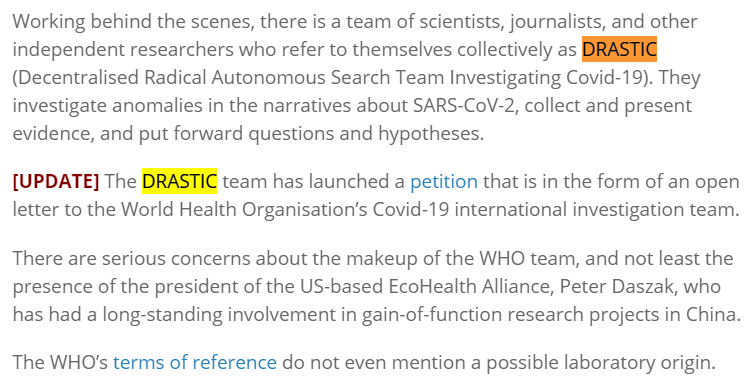
1. A little DRASTIC Project you may be able to help with?
We want to collate all references to DRASTIC in academic papers & media articles
Here are a few:
medium article by @emmecola
thorough report by @netpoette
@ColinDavdButler 's Paper
Please add any links to this thread. Tks!

2. More References
Papers by @MonaRahalkar and @BahulikarRahul
Papers by @Rossana38510044 and @ydeigin
Medium articles & papers by
@gdemaneuf & @Rdemaistre
Papers by @flavinkins (Daoyu Zhang)
Papers by "Anon" & "interneperson"
French News - le Monde
Can anyone remember any more?
3. More References
Papers & Blog Posts by @Harvard2H (Sirotkin & Sirotkin)
260 Questions for WHO collated by @billybostickson
If you find mentions of our individual names or "DRASTIC" in Papers or News, please forward here to this thread as links or screenshots.
Histoire du COVID-19 – chapitre 6 - Partie 2 : Pourquoi le séquençage complet du virus RaTG13 n'a pas été communiqué par Shi Zheng Li avant février 2020 ? https://t.co/MYEZZSAzaE

SARS-CoV-2: lab-origin hypothesis gains traction
BY ANNETTE GARTLAND ON OCTOBER 12, 2020
https://t.co/sPs1y8Herg
We want to collate all references to DRASTIC in academic papers & media articles
Here are a few:
medium article by @emmecola
thorough report by @netpoette
@ColinDavdButler 's Paper
Please add any links to this thread. Tks!
2. More References
Papers by @MonaRahalkar and @BahulikarRahul
Papers by @Rossana38510044 and @ydeigin
Medium articles & papers by
@gdemaneuf & @Rdemaistre
Papers by @flavinkins (Daoyu Zhang)
Papers by "Anon" & "interneperson"
French News - le Monde
Can anyone remember any more?
3. More References
Papers & Blog Posts by @Harvard2H (Sirotkin & Sirotkin)
260 Questions for WHO collated by @billybostickson
If you find mentions of our individual names or "DRASTIC" in Papers or News, please forward here to this thread as links or screenshots.
Histoire du COVID-19 – chapitre 6 - Partie 2 : Pourquoi le séquençage complet du virus RaTG13 n'a pas été communiqué par Shi Zheng Li avant février 2020 ? https://t.co/MYEZZSAzaE
SARS-CoV-2: lab-origin hypothesis gains traction
BY ANNETTE GARTLAND ON OCTOBER 12, 2020
https://t.co/sPs1y8Herg

This response to my tweet is a common objection to targeted advertising.
@KevinCoates correct me if I'm wrong, but basic point seems to be that banning targeted ads will lower platform profits, but will mostly be beneficial for consumers.
Some counterpoints 👇
1) This assumes that consumers prefer contextual ads to targeted ones.
This does not seem self-evident to me
Research also finds that firms choose between ad. targeting vs. obtrusiveness 👇
If true, the right question is not whether consumers prefer contextual ads to targeted ones. But whether they prefer *more* contextual ads vs *fewer* targeted
2) True, many inframarginal platforms might simply shift to contextual ads.
But some might already be almost indifferent between direct & indirect monetization.
Hard to imagine that *none* of them will respond to reduced ad revenue with actual fees.
3) Policy debate seems to be moving from:
"Consumers are insufficiently informed to decide how they share their data."
To
"No one in their right mind would agree to highly targeted ads (e.g., those that mix data from multiple sources)."
IMO the latter statement is incorrect.
@KevinCoates correct me if I'm wrong, but basic point seems to be that banning targeted ads will lower platform profits, but will mostly be beneficial for consumers.
Some counterpoints 👇
That targeted ads allow for "free" products for consumers is a common talking point and we're going to see more of it in the coming months.: https://t.co/Xty3My3f0u (1/14)
— Kevin Coates (@KevinCoates) February 16, 2021
1) This assumes that consumers prefer contextual ads to targeted ones.
This does not seem self-evident to me
Great post by @Sherman1890 got me thinking about the future of targeted ads.
— Dirk Auer (@AuerDirk) February 12, 2021
More and more tools (privacy labels, ad blockers, GDPR) enable consumers to opt-out from targeted ads - can limit the data platforms receive or block ads altogether.
The end of targeted ads? \U0001f9f5\U0001f447 https://t.co/MA6A3BrUWq
Research also finds that firms choose between ad. targeting vs. obtrusiveness 👇
If true, the right question is not whether consumers prefer contextual ads to targeted ones. But whether they prefer *more* contextual ads vs *fewer* targeted
2) True, many inframarginal platforms might simply shift to contextual ads.
But some might already be almost indifferent between direct & indirect monetization.
Hard to imagine that *none* of them will respond to reduced ad revenue with actual fees.
3) Policy debate seems to be moving from:
"Consumers are insufficiently informed to decide how they share their data."
To
"No one in their right mind would agree to highly targeted ads (e.g., those that mix data from multiple sources)."
IMO the latter statement is incorrect.

You May Also Like


Ivor Cummins has been wrong (or lying) almost entirely throughout this pandemic and got paid handsomly for it.
He has been wrong (or lying) so often that it will be nearly impossible for me to track every grift, lie, deceit, manipulation he has pulled. I will use...

... other sources who have been trying to shine on light on this grifter (as I have tried to do, time and again:
Example #1: "Still not seeing Sweden signal versus Denmark really"... There it was (Images attached).
19 to 80 is an over 300% difference.
Tweet: https://t.co/36FnYnsRT9

Example #2 - "Yes, I'm comparing the Noridcs / No, you cannot compare the Nordics."
I wonder why...
Tweets: https://t.co/XLfoX4rpck / https://t.co/vjE1ctLU5x

Example #3 - "I'm only looking at what makes the data fit in my favour" a.k.a moving the goalposts.
Tweets: https://t.co/vcDpTu3qyj / https://t.co/CA3N6hC2Lq

He has been wrong (or lying) so often that it will be nearly impossible for me to track every grift, lie, deceit, manipulation he has pulled. I will use...
... other sources who have been trying to shine on light on this grifter (as I have tried to do, time and again:
Ivor Cummins BE (Chem) is a former R&D Manager at HP (sourcre: https://t.co/Wbf5scf7gn), turned Content Creator/Podcast Host/YouTube personality. (Call it what you will.)
— Steve (@braidedmanga) November 17, 2020
Example #1: "Still not seeing Sweden signal versus Denmark really"... There it was (Images attached).
19 to 80 is an over 300% difference.
Tweet: https://t.co/36FnYnsRT9
Example #2 - "Yes, I'm comparing the Noridcs / No, you cannot compare the Nordics."
I wonder why...
Tweets: https://t.co/XLfoX4rpck / https://t.co/vjE1ctLU5x
Example #3 - "I'm only looking at what makes the data fit in my favour" a.k.a moving the goalposts.
Tweets: https://t.co/vcDpTu3qyj / https://t.co/CA3N6hC2Lq