IMHO, this article — https://t.co/wLiWDOZrvm — is an important corrective to fatalism about the new strain. As in, "welp, there are probably already at least a handful of cases of the new strain already here, so no matter what we do now, it's gonna spread." Not necessarily so.

"10 to 20 percent of infected people may be responsible for...80 to 90 percent of transmission."

"An early run of bad [or good!] luck...can produce dramatically different outcomes."

New Zealand had 277 separate introductions; only 19% of them led to more than 1 additional case.
That's all referring to the original COVID strain, but I haven't read anything suggesting that the same pattern doesn't apply to the new variant. Not sure if we know yet, but it's at least possible a lot of people don't spread it (while the few that do, spread it *A LOT* a lot).
Here's what we know, or think we know:

* The new variant is here, with probably at least a handful of undetected cases.

* The new variant is so wildly contagious that, once it gains a foothold, cases WILL spike.

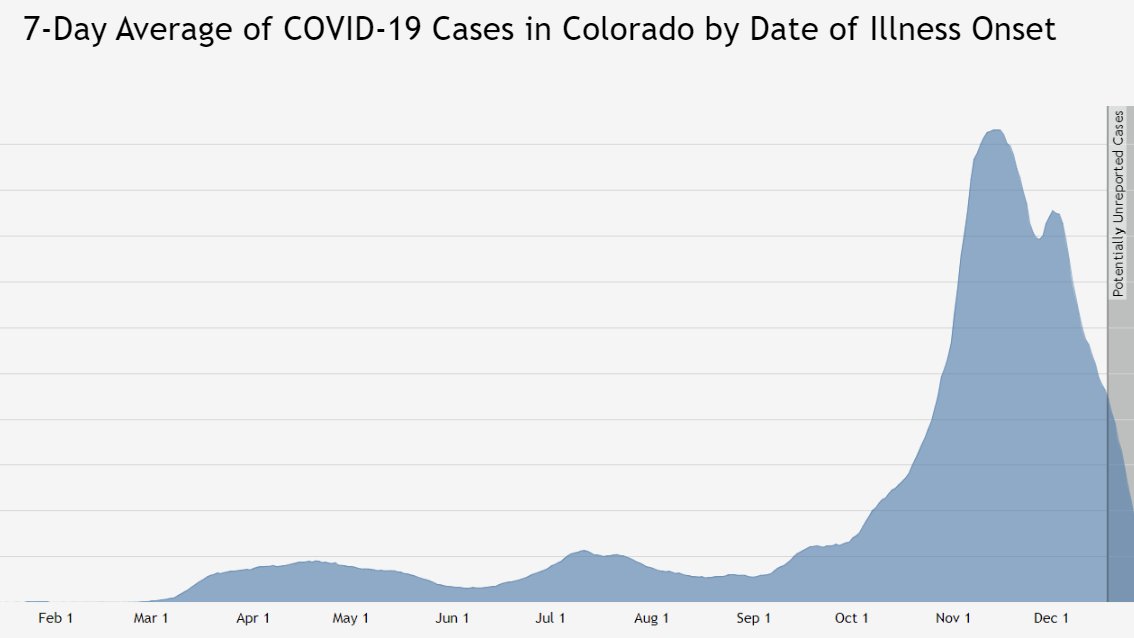
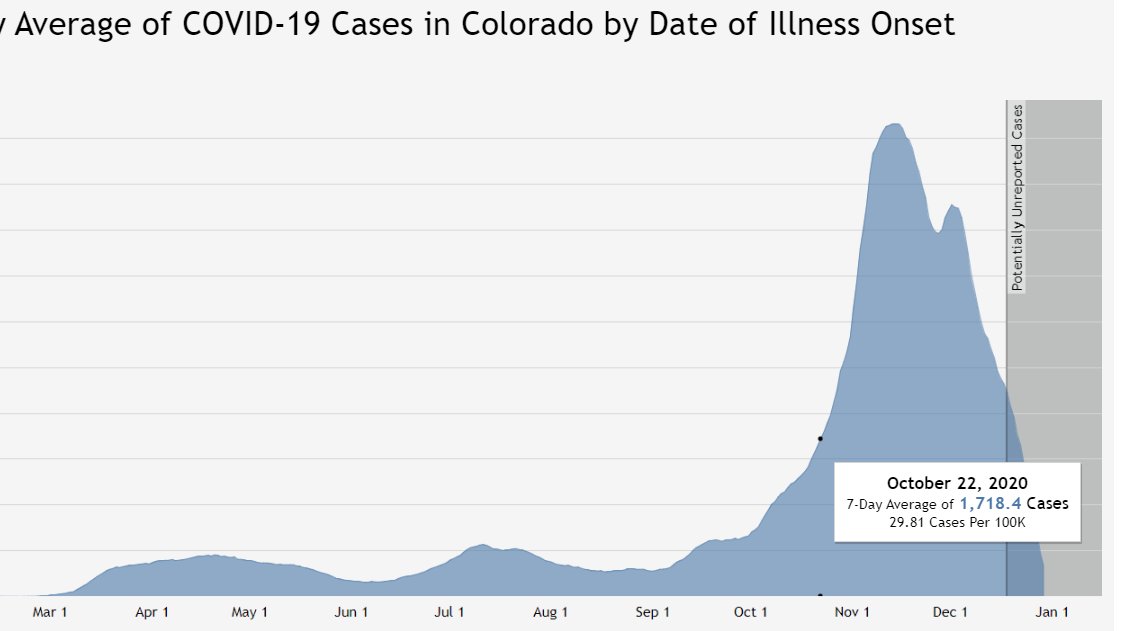
* Cases stopped rising steeply around Nov. 10 (by onset day).
It seems like 1 of 2 things is true:

1) New variant arrived in October or earlier, and helped cause our November spike. We then reined it in, without even realizing it was here.

2) New-variant community spread is low-level thus far, at least thru ~Xmas. No superspreaders yet.
Dunno if we've done enough genomic testing yet to effectively rule out #1. It doesn't strike me as the more likely scenario (arrival by ~mid-October seems pretty early), but it's certainly the more optimistic one!

If it's #2, tho, we might still be at a VERY high-variance moment
FWIW, the steep part of the case curve started around 10/22 (by illness onset date). So really we'd be talking about wide community spread by the first half of October, to produce that. And the variant supposedly only dates back to Sept. 20 *in the U.K.* So I'm skeptical. But...
...we don't actually know for sure that it originated in the U.K. It's possible the variant arose somewhere else, and spread from there to the U.K. in late September, and to Colorado within a week or two of that.

Again, I'm skeptical. But this would be the optimistic scenario.
The less-optimistic scenario is that it arrived more recently, which means it clearly hasn't gained a foothold yet (or hadn't as of last week, anyway), given our current case trends. But unless we act fast & also get lucky, it'll gain a foothold soon and then we'll be in trouble.

More from For later read

Ester Ranzen/ Childline/BBC/Saville/Mandelson 👀👇


1. 'MYSTERIOUS ESTHER RANTZEN' ..2017
https://t.co/aBsJL2Avqd


2. (Let's This Party Started) Keith Vaz and Ester Ranzen.


3. 'BBC'S ESTHER RANTZEN LINKED TO ELM GUEST HOUSE' https://t.co/a064KgW8LJ


4. Esther Rantzen is quizzed about Jimmy Savile - 2012

You May Also Like

The YouTube algorithm that I helped build in 2011 still recommends the flat earth theory by the *hundreds of millions*. This investigation by @RawStory shows some of the real-life consequences of this badly designed AI.


This spring at SxSW, @SusanWojcicki promised "Wikipedia snippets" on debated videos. But they didn't put them on flat earth videos, and instead @YouTube is promoting merchandising such as "NASA lies - Never Trust a Snake". 2/


A few example of flat earth videos that were promoted by YouTube #today:
https://t.co/TumQiX2tlj 3/

https://t.co/uAORIJ5BYX 4/

https://t.co/yOGZ0pLfHG 5/
"I lied about my basic beliefs in order to keep a prestigious job. Now that it will be zero-cost to me, I have a few things to say."


We know that elite institutions like the one Flier was in (partial) charge of rely on irrelevant status markers like private school education, whiteness, legacy, and ability to charm an old white guy at an interview.

Harvard's discriminatory policies are becoming increasingly well known, across the political spectrum (see, e.g., the recent lawsuit on discrimination against East Asian applications.)

It's refreshing to hear a senior administrator admits to personally opposing policies that attempt to remedy these basic flaws. These are flaws that harm his institution's ability to do cutting-edge research and to serve the public.

Harvard is being eclipsed by institutions that have different ideas about how to run a 21st Century institution. Stanford, for one; the UC system; the "public Ivys".