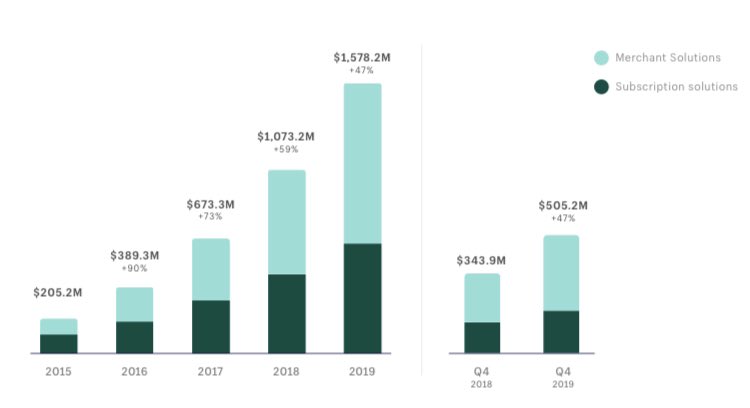
1) $SHOP launched Shopify Payments in mid 2013 and this substantially changed the trajectory of its business, which previously didn’t scale (directly) with the GMV running through its platform
Shopify Payments today is ~75% of SHOP’s faster growing non-subscription revenue
2) Shopify Payments currently drives ~50% of $SHOP revenue and is enabled by 2/3+ of all SHOP merchants (in 🇺🇸 90%) accounting for nearly 1/2 of GMV generated on SHOP digital store fronts
As we all know, Shopify Payments is powered by Stripe, so not available where Stripe is not
3) Per filings, $SHOP charges ~275 bps gross yield (rack rate is 2.4-2.9% + $0.30 depending on which subscription plan a merchant chooses) and makes ~90-100 bps net yield on Shopify Payments, after interchange and processing fees paid to Stripe and downstream (WFC/FISV)
4) For the < 1/3 of $SHOP merchants and 1/2+ of GMV not on Shopify Payments, the merchant brings its own 3rd party payment processor
In this scenario, SHOP only captures a nominal transaction fee on the non-Shopify Payments GMV (~25bps on blended basis)
H/t
@JerryCap
5) $SHOP introduced Shop Pay in mid-2017 as an accelerated checkout option for all merchants using Shopify Payments (no incremental fee)
Shop Pay helps conversion and is ...
🍎-to-🍎: Apple Pay, Google Pay
🍎-to-🍊: PayPal, Amazon Pay (not offered by Stripe, distinct gateways)
6) $FB launched FB Pay in Q4 2019 to enable a unified payment experience across its properties
It works as a wallet and is powered in the backend by PayPal, Stripe and several other payment partners that FB has lined up to enable FB Pay around the world
https://t.co/yA6VMeVlDb
7) While $FB has global ambitions to roll out FB Pay everywhere its users engage with its apps, today it is only really enabled for the Blue App (globally) and Instagram (🇺🇸, most of 🇪🇺 and 🇿🇦 only). For Messenger it’s only available in 🇺🇸 and 🇹🇭, for WhatApp only in 🇧🇷 and 🇮🇳
8) Then in May 2020, to much fanfare $FB announced FB Shops to enable merchants to sell directly on the Blue App and Instagram (today), and facilitate customer support or purchase goods via chat through Messenger, WhatsApp and Instagram Direct (future)
https://t.co/2qVxBJ9sgx
9) The same day FB Shops launched, Zuck/Tobi recorded a live chat discussing how $FB + $SHOP are partnering in this effort
But of course SHOP is only one of many e-comm platform partners, including $BIGC, WooCommerce and others to onboard their merchants
https://t.co/bqsg0wJpiS
10) Now the interesting part: How do payments work on FB Shops?
A: Depends on whether a merchant is approved to sell on $FB, and more importantly how the merchant enables checkout (native checkout on FB/Instagram or click to checkout on merchant website)
https://t.co/JYnneiUmyv
11) If native checkout on $FB, payment processing is run through FB Pay and merchant pays FB a selling fee of 5% per shipment (minimum $0.40)
This fee is deducted by FB directly from net proceeds. No fees are collected for payments by $SHOP, even if it’s a SHOP merchant
12) On a relative basis, the 5% $FB seller fee is clearly higher than the ~2.75% gross yield $SHOP charges for Shopify Payments, but it’s in line with pricing for FB Marketplace and a substantial discount to take-rates for $EBAY and $ETSY (both around 10% when including payments)
13) Don’t know for sure but an educated guess would indicate that on a net basis (after interchange and processing fees) for any GMV processed through native checkout on $FB, FB Pay is probably pocketing ~2-3x the 90-100 bps net yield that $SHOP captures from Shopify Payments 🤑
14) Can’t wait for Q3 2021 to come soon enough!
Why?
Because $FB hasn’t implemented this 5% selling fee yet. It’s been waived until July 1, in part due to the ongoing pandemic, but also in order to drive usage
Q3 will be when this revenue will start appearing in FB’s numbers
15) Other pros/cons of $FB native checkout for merchants:
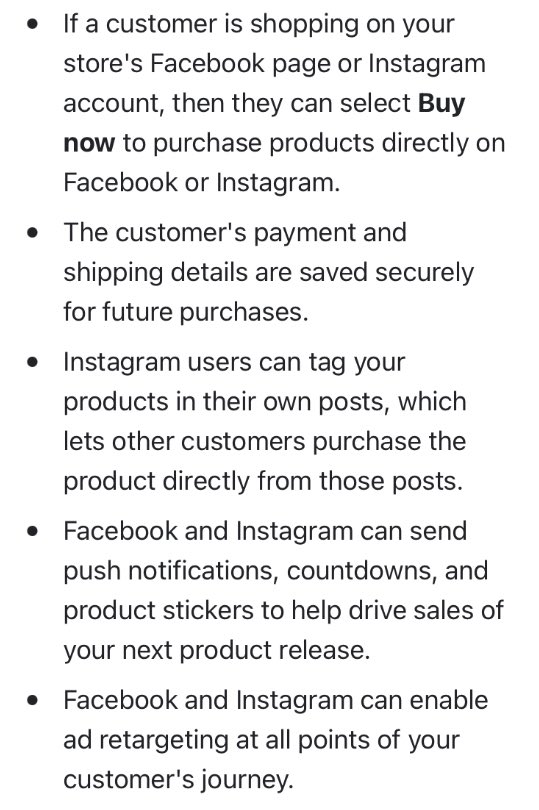
Good: streamlined purchase flow, drive purchase intent through FB/Instagram tags/notifications, retargeting
Bad: No discounts/subscriptions, limited shipping options, various other FB limitations/requirements
16) If the merchant only provides a link to checkout on its $SHOP website (thereby steering consumers off $FB/Instagram for payment), the payment fees are lower and the transaction would be processed with Shopify Payments (or 3rd party processor)
No 5% seller fee paid to FB ...
17) ... but of course $FB will still recapture some of that lucrative selling fee lost by charging the merchant ad fees for driving a click to its website
Mr/Mrs Merchant, pick your poison. Either way, driving more commerce is good for FB 🤑
18) Now this week, $SHOP announces it will integrate Shop Pay into the native $FB checkout experience as an option consumers can choose to accelerate the checkout flow
It’s only available for purchases on SHOP powered digital store fronts on FB/Instagram
https://t.co/vnjNq9NLJw
19) This integration benefits $SHOP and $FB in different ways but is mutually advantageous: higher conversion + faster checkout is good for both (and the merchant)
SHOP likely gets a small cut of FB’s 5% selling fee (similar to if FB user pays using PayPal). Better than nothing!
20) Capturing % of GMV through payments is already part of the $SHOP equity story— not so much for $FB at 25x Fwd P/E (GMV isn’t even disclosed... yet)
Still early days but if native checkout catches 🔥, hard not to see how FB Pay doesn’t scale into something very meaningful 🤗